A Tout's Guide to Sigil
Source: In the Cage: A Guide to Sigil p.4
The View from the Spire and the Streets.
You look lost, sirrah. Walk with me through the murky twilight for a momen, and I'll teach you the dark of things - that’d be the secrets, for a clueless traveler like yourself. Mind you don't brush against the grime; there's lots of soot-stained walls here. Now, sir prime, look up. Makes you dizzy, don't it, seeing the city of Sigil above you? See, living in an impossible city ain’t always simple. You need a guide. That'll be twelve silvers.
Oh, those fellows? Dabus. They speak to each other with those illusions. They're servants of the Lady of Pain, who rules the City of Doors and keeps it safe. - No. I don't mind the questions. - It’s called the City of Doors 'cause it's the center of the multiverse, or leastways, a body can get anywhere from here through the city's portals. It's also called the Cage. Why?
Sigil's a cage for everyone: for the celestials, for the fiends, for the tieflings and the Clueless, and for the Lady, That's why the cutters who set their cases - uh, their homes - in Sigil call themselves Cagers.
The Cagers who know the place best are us who teach; we're known as touts. My name’s Etain the Quick, and I do my level best to tell a cutter everything he needs to know to survive in Sigil. Not everything there is to know, mind you: That'd cost extra.
Sigil’s the Crossroads, the great, shudderin' home to all the planewalkers of the Great Ring. Under the lady's watchful and serene gaze, Sigil stays out of the politics and bloodshed of the conflicts raging throughout the planes, especially the lower ones where the Blood War never stops. No matter what a cutter hears, most of the planes ain't that friendly to strangers, whether they're planar or prime or something else. Whether they're living in wealth or squalor, smart cutters set up their cases in Sigil.
The Lady creates portals that lead everywhere, and when she wills, she closes them. Most of the simple portals look like doorways: they only take cutters elsewhere when they carry the right key, and a key could be anything - a silver blade, a secret word, or an elaborately illuminated deck of cards. Because the city's doors lead everywhere, everyone comes to Sigil sooner or later, even if they're just passing through. That's when a sharp tout latches onto them, whirls them through the sewers and the jink-shops, and takes his fee. Sure, it's not polite, but everyone’s a cynic in Sigil, and the Clueless pay the price for their ignorance. Oh. no. I'm not calling you ignorant, sir prime! You, I respect!
No one knows the city better than the touts and the factotums, the two "professions" that guide the curious and the Clueless through the rat's maze that's the City of Doors. A tout’s a fellow who serves as a guide to Sigil, or to a part of it: the sights, or the markets. A few touts’re more shills than anything else; an innkeep pays them to lead a cutter to his inn or tavern. A factotum is a tout who serves a faction, one of the groups that think they've got the key to unlock the multiverse, (Sort of like squares and rectangles: All squares are rectangles, but not all rectangles are squares. Well, all factotums are touts, but not all touts are factotums.) Some of the factotums have other duties to carry out for their factions: spying, carrying messages, and generally licking the boots of their factols. Most of the touts and factotums were born in Sigil, or at least claim they were. An immigrant doesn’t really stand a chance as a guide - places move, wards change, and the important sites and portals aren't in the same spots from week to week.
Listen Up, You Clueless Screwheads
Sigil's no place for the ignorant, especially if they're arrogant. Sure, Cagers are arrogant past measure, hut they’re wise to the way of things. For anyone visiting from out of town, but especially for tile Clueless, guides are recommended - and their prices are reasonable. Considering what they know and the risks they run. Prices are much higher if a cutter wants a guide in the Hive, which’ll cost him dear. Not having a guide in the Hive may cost him his life, though, so even the 30 or 40 gold coins he'll pay for a blood willing to guide him through the Hive is cheap.
Sigil ain't like other places. It’s connected to everyplace, and it's impossible, and its peace is enforced by terror. A cutter - even a prime - who learns the city’s customs can get by. A berk who ignores them gets put in the dead-book.
Architecture
Sigil's a city overwhelmed, barnacled, and encrusted with buildings. With a 5-mile diameter and 20-mile circumference (as officially measured by the Harmonium; in actuality, the Lady can enlarge or shrink the city as she wills, at any time), Sigil's huge, but it ain't infinite. Sure, it’s big enough to hold new things for the oldest bloods, but the bizarre soon becomes mundane if a cutter sees it often enough. Even the view ain’t the usual; almost anyplace a cutter stands, if he looks up, he sees buildings. Course, smoke and distance obscure the view across the hollow center, creating a gray arc with a few lights.
Despite the city's size, somehow it still always seems crowded. Tiny spaces that might become servants' rooms or pantries in another city are shops and homes in Sigil, where every square inch must house some of the infinite multitudes. Even the buildings crowd each other overhead, and some streets are cut off from the sky entirely, its dim light pinched out by the towering walls.
Although Sigil is ancient and every available surface is already occupied, new streets, boulevards, and courtyards are constantly created by the dabus masons, and new buildings set on top of old ones create crypts and catacombs aplenty. Since it’s impossible to know every street and keep up with every change, cutters need to learn the patterns of Sigil’s buildings, especially for those bashers who live on the dark side of the law. Even a footpad who’s been in and out of the Court and the Prison can make a mistake. One dead-end alley is all it takes to get a cross-trading knight scragged by the Harmonium - or worse, scragged and then killed by those he's doublecrossed.
The traditional blades and spiked fences of Sigil define its architecture for planars everywhere on the Great Ring. The blades of Sigil are added for looks as much as for protection against intruders, as they are part of the city's rich tradition of ornamental iron and stone. Primes notice the faces and gargoyles built over doors and into other structural features like pillars and rainspouts, the most common locations for such decoration. Iron and stone are more common building materials than imported wood: after all, iron and stone can be created by magic. The iron and stone of the high-ups' cases, though, are certainly not conjured but imported through one of the gates. Blackstone from Gehenna, limestone from Mount Celestia, and marble front Arborea are all popular.
Walls vary, but the strongest are up to 9 feet thick. Spiral stairs are the most popular form: the spiral winds up clockwise, to give the advantage to a right-handed defender and hamper the swordplay of anyone going up (-2 to attack rolls of any right-handed attacker). The roofs are generally made of dark gray slate tiles.
Most of the ironwork in Sigil isn't just ornamental; it protects the houses it decorates. Doors and windows are tightly sealed and protected with iron bands and locks, and fanciful iron grill-work covers most windows (at least among the houses of the high-ups). Spikes on the Hat surfaces of windowsills and the like prevent Sigil's great gray-and-black executioner's ravens from roosting.
Sigil's indigenous watchdogs, called Aoskian hounds, are two-headed creatures with a nasty temper. Besides a double bite, these snow-white or pale tan death dogs boast a tremendous hark. (See "The Dark; Sigil’s Wildlife.") Knights of the post never tangle with Aoskian hounds if they can avoid them. Most are muzzled during the day and only allowed to roam by night. Their ghostly pale appearance and deadly quick reflexes have caused many a second-story man's tumble into the street, and most have been thankful for the fall. After all, the Aoskian's bark can stun a knight long enough for the watch to arrive.
Below the streets themselves lies a web of catacombs and crypts (mostly of important dabus, though the Dustmen also maintain a few large necropoli throughout the city), but no sewers. The oldest crypts have been there a thousand years, though bubbers often claim that there're many deeper levels, which the dabus have sealed off.
In the better portions of town, public fountains bubble and burble, their carved stone and molded iron spouts working day and night. The water is always pure, though sometimes very metallic tasting: most Cagers prefer ale, wine, or anything else purified by fermentation. The fountains take many shapes, from drab pillars whose single spigots are decorated with the seal of the carver or foundry, to the justly famous Singing Fountain whose pure tones come from the splash of water from higher metal basins into lower ones. A charismatic fortuneteller named Black Marian (Pl/♀human/P5/Believers of the Source/N) claims to hear the future of anyone who drinks from the fountain. Few take her up on it, though, for the Singing Fountain's steadiest customers are the city's gray-green pigeons and their feathers often float atop the waters.
In addition to the public fountains, the city's got a number of public wells. Where do the well waters come from? The chant is, most anywhere, from the Elemental Plane of Water to the Styx and Oceanus, to Ysgard's Gates of the Moon, to Limbo. The best waters are said to be those drawn from wells sunk into the seas of Arborea and Mount Celestia.
Streets're all cobblestones in the richer districts and mud in the poorer. In both rich and poor districts, houses surround open interior courtyards hidden from the streets and accessible only through narrow alleys or covered passages through the surrounding buildings. Often these buildings're protected against theft by large doors or portcullises that're shut each night, making them into tiny strongholds in the midst of the city. In times of danger or riots the courtyard gates are often magically warded as well. For high-ups of The Lady’s Ward, the interior courtyard might serve as a garden, a family graveyard, or an open-air ballroom. In other places like the Farrier's Court, guild members and craftsmen conduct their business in the courtyards. For tanners and dyers, this gets messy quickly. Those who like their privacy keep Aoskian hounds and grow razorvine in the courtyards; not everyone’s open space is meant to be a refuge from the streets.
Wards and Mazes
Sigh's six wards arc the Lower Ward where things're made; the Market Ward where they’re sold: the Clerk’s Ward where ownership is noted; the Guildhall Ward where the craftsmen gather and train apprentices: the Hive where the poor, the bubbers, and the barmies're kept out of everyone else’s sight; and The Lady’s Ward, the richest and most powerful of them all, where the city's rulers and criminals dwell. The quick Cager’s summary of them is "smog, shoddy goods, accountants, apprentices, barmies, and politics."
The ward system’s the easiest way to keep track of where things are, since houses and even streets disappear and reappear under the working hands of the dabus. The size of the city makes it impossible to describe all its wonders, but a sampling of the possibilities is enough to convince most cutters they’ll never be done exploring the City of Doors.
Though their boundaries’re shifting and unclear, the wards are defined by their inhabitants at least as much as by simple geography, If an area stops operating smithies and manufactories because barmies have moved in, then the area’s said to have moved from the Lower Ward to the Hive.
The other reason the boundaries between the wards seem to shift over time, of course, is that the Lady of Pain creates mazes, sections of the city that’re somehow spun off into the deep Ethereal to rid the city or those who refuse to keep the Lady's peace (for more information, see the Planescape Campaign Setting box). The city shifts and groans from the weight and stress of its portals and the contradictory directions that keep it always carefully balanced. Likewise, the dabus’re constantly shifting buildings and streets by remaking them, painting them, and forcibly occupying some of the homes trying to shift from one ward to another. What defines a ward? Mostly, the cutters living in it, the jobs they hold, the houses they live in, and the streets they walk on - and the Lady’s whims.
Portals
The City of Doors is lousy with portals to the planes; in fact, the portals make life on the planes possible, or at least much more interesting. They're shortcuts from one infinite space to another - traveling infinite planes would be futile without them, so mastering the types of portals and the keys that open them is important for any Cager. Like all important tilings, portals follow the Rule of Threes. The three forms are permanent portals, temporary portals, and shifting portals. Each form’s got its own rules and habits, but all’re under the Lady’s power. Portals too disruptive to lift in Sigil inevitably disappear. (There’s a fourth type, in keeping with the "rules are made to be broken" rule; It appears only in the Hive, and it’s a one-way portal from the Hive to the Paraelemental Plane of Ooze. See "The Dark: Ooze Portals," in the chapter on the Hive.)
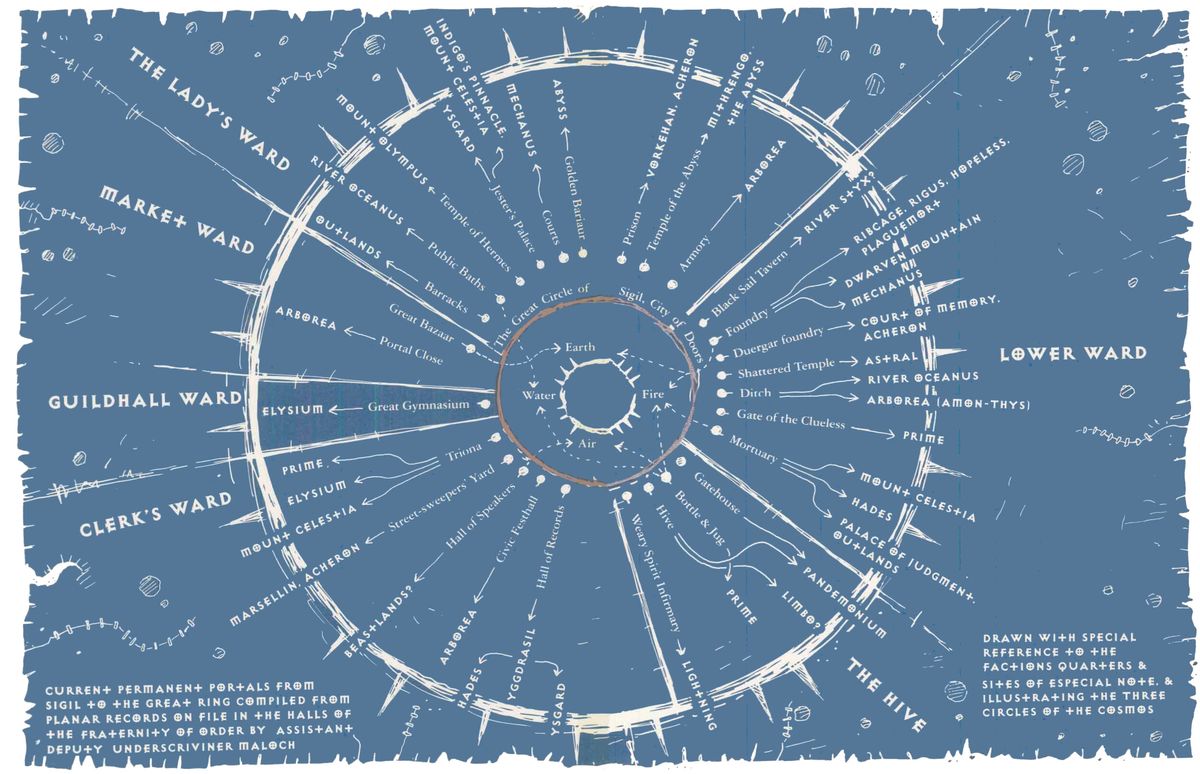
Permanent portals tend to cluster or concentrate around the Faction headquarters. In fact, many headquarters are actually built around portals to the faction’s plane of major influence; for instance, the Mortuary’s a nexus of dozens of portals connecting the realms of the powers of death, the inner planes, and other major sites. More details on these portals are available in The Factol's Manifesto.
Known permanent portals include several portals in the Hall of Records in the taxation filing area, in the butcher shops and taverns (leading to the food stores of Arborea), public baths (leading to the River Oceanus), and in Foundries (to the Dwarven Mountain in the Outlands). Other permanent portals lead to less pleasant places, to the nether planes. Those portals and their gate keys are well-hidden from berks who are better off not knowing about them, but though they are hidden they are not permanently closed. The only way to keep a portal from opening is through strong magic: planar wards (see Well of Worlds) or gate seal spells.
Where do portals come from? The sages and graybeards argue endlessly about the nature of astral conduits, mature portals, and the flux and nexus-points that underlie the creation of a permanent, shifting, or temporary portal. Some say that powers can, others say only powers of travel can open gates for themselves and their followers (and they are barred from Sigil). Only the Lady herself opens new portals in Sigil. The hard fact of it is, only spellcasters with their gate spells can open portals anywhere else in the planes.
Temporary portals don't follow any pattern at all: they appear and disappear at whim. Often they seem created to serve some design or purpose. For instance, a portal might appear for a faction to use against the Lady’s enemies, or a portal that’s being misused to bring tainted food into the city might suddenly close temporarily. A few barmies in the Hive claim to be able to predict the appearance of temporary portals by powerful divinations and the sacrifice of valuables: most of these are frauds, and the few who're apparently successful always quickly disappear. Whether they’re silenced by the dabus or stolen away by a faction to serve in captivity is a mystery that a body’ll best avoid trying to solve.
Shifting portals follow a few known configurations. Both ends of the portal shift location in a pattern. The Sigil end might cling to an arched, razorvine-covered trellis deep in The Lady's Ward for days, then shift to a sewer grate in the Lower Ward for a few hours before moving to the entrance of a storehouse in the Clerk's Ward for a month. The other end of the portal shifts as well, and the two sequences don’t always match. (That is, while the Sigil end of the portal stays in the Lady’s Ward, the other end of the portal may switch rapidly from Mount Celestia to the swamps of Durao in the Abyss to the Viper Wastes in the midst of the Blood War.)
The Guvners are said to keep a secret log of the shifting portals' secrets, and many’s the forger who's lived fat and happy after he's sold a false Shifter's Logbook. None but the factotums of the Fraternity of Order are allowed to see the Shifter’s Log, and even then, they say, many of the shifting portals have such long or complicated patterns that no one has ever seen them repeat. Many others keep logs as well, especially priests of the powers that protect travelers, namers paid by their factions to watch for portals, and, of course, the most successful planewalkers. Some say that modrons are the best, because of their patience and consistency. But any fool who enters a portal he learned of from a bought logbook should mind he carries naked steel the first time through; not all the portals are investigated before they are recorded!
The forms portals take vary, and the Lady's twisted humor is apparent in the location and keys of some of them. For instance, a shifting portal to the Abyss has been known to appear in the Golden Bariaur, and the Ditch is said to lead to the dry wastes of Amun-Thys in the third layer of Arborea. The gate to orderly Mechanus shifts between a junkyard and the scrapheaps of the Lower Ward near the Great Foundry.
Only a few portals arc truly well known; they are shown on the two-page map in this section. At the center of the map is the Inner Ring, containing the Elemental Planes. Surrounding it is the torus of Sigil, showing locations present on the streets of the Cage. Outside this are the Outer Planar locations. The whole is divided into the six wards of the Cage, labeled accordingly.
I have pursued the twisting portal through the use of divinations and auguries and discovered that its pattern in sigil is the following:
- Twelve days within the arch of the monument to the memory of the Tragic Plague of the year of the Deva, in The Lady's Ward. The key here is a blue diamond. Funds for investigation not yet authorized
- Two days in our own Courts, in the stacks near the fourth section of the comprehensive Civil Codes. The key is a chip of lapis lazuli.
- Three days in the kitchen pantry of the Inn of the Blue Toad, in the Guildhall Ward, beneath the stairs. The key is a blue topaz
The Laws governing this traveling portal seem to match the spiral sequence first noted by the master scrivener Varval the Elder. Whether the same mirror pattern of the end-points of these portals matches the spiral sequence is not confirmed as of this writing, but the planes at the other end have undergone one investigation, using a gate key in the Courts for secrecy's sake. No volunteers were able to actually enter the opened portal, but the appearance of a hellhound in the stacks indicate a correspondence between the city and the plane of Baator. Cleanup costs of the resulting fires were in excess of 4,550 gold crowns, so caution is advised for further investigations.
Time and Direction in Sigil
The bashers in Sigil base their timekeeping on hours relative to the peak hour of light. Peak is roughly equivalent to noon on a prime world: the six brightest hours in the City of Doors are the three hours before peak (b.p.) and the three hours after peak (a.p.). For the primes, this means 2 b.p. matches 1000 hours in military time, and 2 a.p. corresponds to 1400 hours. "Midnight" in Sigil is called antipeak. The six darkest hours come just before and after antipeak. Cutters should be aware that hours don’t have names or numbers, really (no Hour of the Weeping Crow, no terce or matins), just positions before and after peak and antipeak. This is clearest on the city’s clocks, which all have twenty-four increments and are shaded from black at the bottom (antipeak, not that anyone can read the blessed docks at that hour!) to white at the top (peak). The lack of numbers makes it easier for Sigil's many races to tell local time: trying to cram fiend, modron, and aasimon numerals together on the same clock face results in more confusion than sense.
The Cage is eternal, so much so that no one knows the date of its creation or founding. The Lady surely was present, but whether she and Sigil came into being simultaneously or she preceded the city will never be revealed. Years are measured, then, from beginnings of factols' rules, most often according to those of the Fraternity of Order. (The current date is the 127th year of Factol Hashkar’s reign.) Clueless visitors often are confused by this timekeeping system, but those who stay long enough soon realize that with the constant changes in Sigil it doesn't matter too much precisely how long ago something happened.
In the City of Doors, there is no east and west, no north and south. Directions are given in temrs of wards and direction relative to the spire. Spikeward is up (to the Civic Festhall or the Armory, for instance), and Downward is down (the direction of the Market Ward). The peculiar directions of Radial and Chordwise also exist among surveyors and mapmaking Guvners. These are simply ways to indicate two points that are directly opposite each other on the city’s circle (Radial) or nearly so (Chordwise) - like the Great Gymnasium and the Great Foundry.
Usury and Moneylenders
There's plenty of money for the taking in Sigil. Fact is, lots of bashers'll lend money to anyone who asks. Scads of jink, too, not just a few coppers here and there. Most of the customers are the Clueless, hut desperate souls'll pawn anything for enough coin to buy bread, warmth, and shelter. The maximum legal rate of usury is 1 coin in 4 per week; that is, if a cutter takes a loan of 40 gold, he’ll have to repay 50 a week later. The rates aren't good, but the consequences for not repaying are worse.
Never take money from a baatezu. Even if a cutter can pay it back, sometimes a baatezu won’t accept the jink that's offered. See, the fiend isn’t in it for the profit in cash. He'd rather have a basher in his debt, someone he can lean on, have arrested and sent to the debtor’s prison. When a basher repays a loan, he should always get it in writing, even if he can’t read.
Weather, Smoke, and Thin Air
Foul rain, gloom, cold, and smoke - these are the reasons for the long, dark cloaks so many Cagers wear. The Lower Ward’s smoke and steam keep it marginally warmer and fouler than the other wards, at the price of burns from airborne ashes and embers. Leather is popular in the Lower Ward because it won’t burn; even sedan chair owners often keep a special set of curtains for trips through the Lower Ward, both to prevent burns and to keep the smell out of the regular drapes. 'Course, those dark cloaks help the knights fade into the shadows as well, and they don’t show a stain from Sigil’s brownish rainwater.
Most Cagers don’t complain, 'cause the weather in most of the Great Ring is worse. Besides, the air's too foul for a body to waste words crabbin' about it. Cagers who work outside often develop a constant hacking cough, and many die in the streets from consumption. Horses die young from the strain of breathing Sigil's smog - a beast of burden spitting its lungs onto one of Sigil's streets is a common sight. It's a mystery why anyone bothers to smoke pipeweed or black tarweed cigars when they can just go down to the Great Foundry and inhale,
A few barmies and primes claim that the weather reflects the mood of the Lady of Pain, that her dismay is rain, her joy is sun (rare indeed), and her fury is snow or sleet. For a copper, they'll scry the heavens and predict a cutters omens for the day. While this forecasting is an amusing conceit with which to nick a few coppers from the Clueless, most Cagers just snort at the thought that the Lady would be this maudlin.
Cagers: Citizens of Sigil
Most inhabitants of Sigil are carpetbaggers or transients, and few call themselves Cagers first and foremost. Most cutters, if asked who they are, respond with a name and a faction, or even a ward, rather than naming themselves as Cagers. Sure, sometimes a berk wants to impress the yokels from out of town (not Out-of-Town, just not from around Sigil), but most people in Sigil are from out of town themselves. Though the city has a population of more than a million, two-thirds of that are transient planars and primes. The core population of planars comprises humans, githzerai. bariaur, and tieflings, with a few prime elves, dwarves, and other obscure. Clueless races (one called gnomes, one called halflings who can tell 'em apart, really?). Sigil's always ready for a fight, a bob, or a lark, and half its citizens are on their way to the wonders of the Great Ring, so adventurers are common as copper bits. Sigil is as close to home as a cutter gets on the planes.
In addition to the planars, most of the races native to the Great Ring come to Sigil for their own purposes, though few settle in the city. Fiends, aasimon, slaadi, and modrons are all present in large numbers, but few find Sigil pleasant enough to warrant staying for long. Its enforced neutrality makes them irritable; the fiends miss the bloodshed and can’t bear the sight of their Blood War enemies walking freely down the street. (Drinkin' next to 'em's another matter entirely.) Aasimon and other celestials can't stomach the grime, the blood, the filth, the vulgar coarseness of it all. Kuriel, the deva of curiosity, is an exception, but there aren't many like him. Most of the sods get homesick, even though they're too proud to admit it.
The only people who call themselves Cagers with pride are the dabus, the faction members born and bred in the various headquarters, and a few families of planars who’ve settled in Sigil and made it their home. These hardcore Cagers look down on all other residents, though no one else seems to care. This lot views all other Cagers as intruders, and treats them accordingly. This attitude probably has much to do with the Cagers’ reputation as arrogant snobs.
A few primes come to Sigil and want to stay, but many more are gate-orphans, those who’ve arrived but can't leave. They are sometimes called the Keyless or the Marooned. Their pathetic attempts to return to their sheltered lives on the Prime are a rich source of Cager humor, resulting in a long list of Keyless jokes such as "Why did the Harmonium scrag the Keyless? To protect him from the menace of the streets." The Harmonium ain’t known for its sense of humor.
Precious few petitioners live in Sigil; most who do serve neutrality or powers of travel. A few petitioners from the Outlands come to the Cage as well. Sigil serves as a neutral zone that somehow belongs to all realms of the Land. This means that Outlands petitioners aren't permanently destroyed if slain while within Sigil. Nevertheless, few petitioners care for the contrast between the paradise of their power's realm and the Cage, and they scurry home as soon as their orders permit.
Collectors
The Collectors are the untouchables of Sigil, those unclean outcasts who collect the bodies of the dead. A few Collectors are members of the Dustmen (and wear the dark, drab weeds of that faction), a few are Indeps or Bleakers, but most are just too poor to worry about the factions or the Truth of the Multiverse. All of them just barely eke out a living by looting dead bodies and taking them to the Mortuary. The Dustmen pay the Collectors a pittance for saving them the trouble of transporting the deceased (and Mhasha Zakk pays 'em more; see "Zakk’s Corpse Curing" in the Clerk's Ward chapter). A few say that the Collectors are a little overeager in the pursuit of their duties, and who can blame them?
A typical prayer of the Collectors runs a bit like this: "O whatever power this poor sod worship'd, look kindly upon the departed spirit of - anyone know this sod's name? - oh. well, the departed spirit o' your servant. 'Ere now, is that a gold tooth he's got?"
The Collectors are also ragpickers, thieves, and rather dismal merchants, reselling anything that still has a shred of use in it. What they can’t use themselves, they sell to others. To them, there's no such thing as garbage: only filings that they haven't quite found the proper mark for yet.
Dabus
The dabus are the servants of our Dread Lady, Her Serenity the Lady of Pain. Her will is their will. They are also Sigil's first settlers, more native than the planars who just happen to be born here. There are no records, no tales, not even rumors of a time in Sigil when the dabus were not present, silently watching over the City of Doors.
Some of the wise say that the dabus built Sigil, and that's why they serve it as no other Cagers do. Dabus seem to consider Sigil their master as much as the Lady, for they are forever patching and fixing it, laying cobbles, digging for pipes, trimming back razorvine, roofing city buildings, whitewashing, and sweeping the streets. Likewise, they often tear down sections and build over streets that they find unworthy (for reasons known only to themselves). Oddly, when the dabus are questioned they claim that the city itself created them. No one's quite clear on what they mean by this, and they rarely elaborate. The few vague explanations they do offer are completely obscure.
The homes of the dabus are deep underground; some Cagers say that the entire torus is a warren of dabus, and the part of Sigil on its surface is only the face the city shows to the Ring, to travelers. The actual city is a maze of deep tunnels, storehouses, dungeons, and corridors that have remained entirely proof against invasion for eons upon eons. Others (perhaps less prone to exaggeration, perhaps less willing to see the truth) claim that the dabus' supposed warrens are no deeper than fox dens or slaad nests: shallow diggings that are simply refuges for the dabus. The darkest rumors claim that the dabus wish to restore the pristine state the city exhibited before other races traveled the planes, when the Cage was entirely under the dabus' control.
Factols and Faction Headquarters
It's easy to lose track of where the factions' cases are, and easy to forget the names of those who run 'em, A body should know who runs the town, and - since those who meet the Lady don't live to tell the tale - knowing the factols should be enough for any reasonable cutter. Sure, some bodies just can't go on without meeting a high-up, more fools they.
The quick and dirty table below is the current listing. Note that the Free League and the Revolutionary League have no factols.
One defunct faction’s also worth knowing about. Called the Expansionists, they were led by Vartus Timlin in an attempt (failed, obviously) to overthrow the Lady of Pain. Chant is, Vartus has been thrown into a maze, and his followers dispersed once their factol was gone. All written references to the Expansionists have been removed to the Rare and Dangerous Volumes Vault of the Hall of Records. And then there's the Communals, berks who thought everything in Sigil ought to be shared equally. The Lady "removed" them, too - personally.
Leaders of the sects rarely come to Sigil, but they are worth knowing regardless; a body never knows when they might decide to move into the big city. The Anarchs are the rulers and masters of the chaos-stuff of Limbo, able to bend raw matter to their will. The Children of the Vine are Dionysian revelers from Arborea; great at a festival, not much good for anything else. Limbo's Converts, also called the Chameleons, are dangerous because they always believe whatever they were last told, and they can assume the guise of any faction. The Dispossessed are a grumbling lot of exiles and whiners hiding in Pandemonium, unwilling to face the dangers that led to their exile in the first place. A bitter lot of talkers, really. The Order of the Planes-Militant is a powerful order of knights with a Cause, headquartered in an enormous monastery on Mount Celestia. Fortunately, their strict code keeps their numbers low, and they rarely show themselves in Sigil. The Ring-Givers are a strange pack of mendicants from Ysgard who believe that a cutter's worth isn't how much he owns, hut how much he can give away. They're always poor and begging, and the chant's that any gift to them comes back to the giver tenfold. Course, any gifts Ring-Givers give come back to them tenfold as well, so watch out for Ring-Givers bearing gifts. (See the Planes of Chaos and Planes of Law boxed sets for more details on these sects.)
Factotums
Factotums are a step up from the lowest ranking (and most common) faction members, who are called namers. Factotums're more trusted and more useful to their faction than namers, so the factions actually pay them to carry out tasks for the factol. The factotums’d have a cutter believe this means lots of action, magecraft, and secret missions, but most of the time, it means lots of shepherding guests around Sigil. This don't mean their lives are dull: In fact, a factotum's half tout, half street preacher. Most tours can't abide this encroachment on their business, and wage a constant propaganda war against the factotums. (Well, some of'em. anyway.) According to the touts, the factotums're slaves to the factions they represent, and can't give a body an unbiased view of Sigil for love or money. Their real duty is to spy on high-ups visiting the Cage, and all the factotums see that important visitors to their factions get what they need, stay out of trouble, and don't see what they shouldn't. Sure, factotums’ll guide a body around, but what they're really good for is guiding a body through the ins and outs of Sigil's politics.
A cutter can't pay a factotum to guide him around Sigil (not that he'd want to): factotums're assigned to those visitors that the factol deems need one. A body should avoid these poor bastards unless he needs to get into a faction headquarters; then, there's no choice.
Hirelings
Sigil's full of helpful people: They help themselves to wallets, hats, neglected mounts, and anything else not nailed down or locked up. Entire gangs of thieves devote themselves to stealing rich garments from clotheslines, or fishing for lace through windows, or throwing cargo and baggage from moving vehicles, or plucking valuable wigs from pompous advocates. But there are sharpers within the best houses as well. A blood won't let the cheerful smiles of servants fool him; they're taking home extra food and nipping at the bottles in the cellar. Everyone knows that servants and hirelings will take a little off the top for themselves, but no one objects.
Cagers hate a stingy berk. The poor are more than willing to be loyal, hardworking servants for anyone with a little jink. Any high-up who refuses to hire servants is considered an antisocial miser who's probably up to no good. Cutters who can afford it should boost their standing among others by hiring at least a small retinue: a tout, a light boy, and perhaps a sedan chair when required. Displaying poverty is not a virtue. Displaying wealth - and sharing it - will make any cutter well-loved, or at least well liked, by servants and neighbors.
Couriers
Getting a simple message across town is no simple task in Sigil. A trip from one side to the other can take hours, even as much as a day in bad weather. Some have families, apprentices, servants, or namers (faction members who're low folk on the totem pole) to take the message, but those who don't - travelers, widows, slaadi - can always hire a courier. Professional couriers live by their reputations, so they're fairly reliable. The more powerful their customer, the more reliable they get. There's always the danger of cross-traders and impostors, but then, writing down anything truly important instead of delivering it face-to-face is dangerous, too.
All said, the best thing to do is not to go telling the dark of things to just anyone by writing it down and handing it to a stranger. That's why the so-called "silent couriers" are so highly regarded; they serve as receptacles for magic mouth spells that are triggered in the presence of the intended recipient. The sight of a courier suddenly sprouting a mouth on his chest, forehead, or elsewhere is enough to turn a weak stomach, but it ain't often seen in the inns and taverns - most of the ensorceled messengers deliver their information in private. 'Course, all this magic and privacy costs a pile of jink, so silent couriers are an elite breed working for elite masters.
Most all the silent couriers and the best of the rest answer to Autochon the Bellringer in The Lady's Ward, the so-called Minister of Messages (Pl/♂human/Fl2/ Free League/NE). Autochon's a strange one: always in full armor, with a hunched back and a thin, whispery voice and a crushing handshake. It ain't that the Bellringer does much for his servants except collect his fees from them, though he does look into anyone threatening or assaulting them (bad for his business). The real reason every courier makes at least token allegiance to Autochon is that he punishes those who "impersonate a courier" (that is, don't pay their dues to him) by hamstringing them and tearing out their tongues, ending a potentially profitable career.
The couriers are one of the few castes of Sigil that shine with a bit of gallantry and glamour; many of the young of the planes look up to the couriers because of the bards' tales and songs about them. In stories, the couriers are always dashing from palace to palace and headquarters to headquarters on their exotic mounts, laying about them with their riding crops and elephant prods. Many of Sigil's filthy children play at being couriers in their street games, pushing and racing each other to be the first to deliver their goods.
Most of these bards' tales're about as useful as the road apples the Arcadian ponies leave behind them on the cobblestones, (What's an Arcadian pony? Look to the Clerk’s Ward chapter, under "Tea Street Transit.") Sure, a few lucky berks get to bend the ears of some rich fops, but most drag themselves quickly and silently through Sigil's stinking streets. A real courier doesn’t want a crowd: Someone might want to bargain for what he’s delivering, or just plain nick it.
The most famous of the real couriers are magically bound to the goods placed in their care; if their messages and packages are taken from them, they wither and die until they recover the goods. For this reason, their precautions are extreme and their fees exorbitant. (Face it; How would you like it, knowing that if you lose a packet you'll become some kind of zombie, doomed to shuffle the streets of the Cage until you get it back?)
Light Boys
With so many hours of darkness and gloom, and the claims no longer maintaining the ancient city streetlights, light boys are more than a common service; They're a necessity. Mostly children (rarely girls, who are often kept at home by protective parents) under the age of 12 or so, the light boys stick together for protection outside inns and in the larger squares, where they wait for customers. Though they hire out to anyone with ready coin, the light boys're especially adept at handling drunks. Though a few bubbers blame them for stealing their cash, the truth's more likely that the bubbers just forgot how many rounds they drank.
Most light boys’re street urchins just barely out of the gutter; somehow they've begged or borrowed a lantern staff, that is, a staff or wand enchanted with a continual light spell. The color of the staves identifies the light hoys, for each staff shines with a subtly different shade from cold purple to rich orange to sickly green. An old legend says the light boys were first formed when one of their number knocked out a bubbed-up wizard in a dark alley and took the key to his tower, a tower full of prismatic magics. In the weeks thereafter, the light boys destroyed every magical light the dabus maintained (to create a demand for their services, the little scamps), using a wand of negation given to them by a lesser baatezu with a personal agenda.
These days, the light boys aren't nearly so united as they once were. The urchins fight among themselves for the staves, so light boys are hardened to brawling and can prove helpful in a scrape. They have no leader, though the older hoys can often persuade the others to obey them. The cleverest light boys become touts when they outgrow the staff. Light boys are useful for more than just light, since most of them know a particular neighborhood pretty well and can act as unofficial guides or touts.
Most light boys are human, but there's a smattering of enterprising young tieflings or bariaur. Though the majority of the light boys are simply hirelings with lanterns, some are young thieves who only pose as light boys, to lure the unsuspecting into a trap. These frauds (and a few dishonest souls among the regular light boys) are panderers, fences, or sneak-thieves willing to cut a purse, arrange an "accident," or recover stolen property for a reasonable finders fee.
Such cons bring the wrath of the Harmonium down on the light boys, but it never lasts long. The light boys simply take their staves and go home to their hovels. After the city’s been plunged into darkness for a few hours, the Harmonium relents - mostly because the cover of darkness creates more problems than a few deceptive light boys ever could.
Sedan Chairs
Sedan chairs are Sigil’s taxi service. The city's bad air, narrow streets, and harsh cobblestones etch away horses' lungs and infect their hooves, so there aren't too many horses or other valuable mounts stabled in the city. Most things are carried on the backs of other people (human or otherwise), and this includes the high-ups who usually travel in carriages in other cities.
A cutter can arrange for a sedan chair at the Great Bazaar and most important buildings, like the Festhall. Each chair can seat two human-sized creatures, and all are draped with sarin or velvet curtains that are kept drawn for privacy or against the chill. A small grill-work window gives the occupants a view forward. Most chairs are carried by four strong bearers, from bariaur to fiend to githzerai, though a few single-seated chairs are carried by just two. Sedan carriers won't go to the Hive or to the most dangerous sections of the Lower Ward.
Chairs are the easy way to travel and to show off wealth for the high-ups of the city, but their bearers don't tell a basher where he should or shouldn't go. Chairs are also for those who can’t or won’t walk (which are often the same folk as high-ups - why become a high-up if you’ve got to live like everyone else?).
Hiring a chair's like anything else: There's a right way and a wrong way to go about it. Bloods know it’s proper to pay the head porter, not others. The head porter always takes the position in front and on the left-hand side of the sedan chair (where he can use his right shoulder and and and has a clear view of the traffic ahead). It’s an insult to pay any of the lesser ones - though not enough of an insult that they won't take a cutter's money. (They will give a cutter a swaying, bumpy ride, though.) A tip to the Clueless: Sedan chairs may be expensive, but they're a good way to escape pursuit when boxed in.
Touts
To listen to their claims, touts are the miracleworkers, the guides and loremasters of the city. Sure, they come up from the streets, from the smithies and the pubs, and they know their way through every ward and every major street and square. A tout worth his jink knows the password to every kip and case in town worth visiting, and knows how much garnish (see below) to give everyone, from the warehouse guard to the keeper of the keys of the Armory (though if a tout’s been insulted by the body who hired him, a smart one'll skim a little extra jink for himself). But then, a blood never takes a tout entirely at his word.
Touts know people as well as places: Any tout worthy of the name can get a cutter an introduction at Fortune's Wheel (in The Lady's Ward) or a quick visit into the private halls of the Guvners, for the right price. He can arrange companionship, find difficult spell components, even arrange visits with prisoners (or those awaiting execution, if he's one of the best) - and negotiate a fair price for every service as well.
A Guide to Garnishes
Sigil's a paladin's nightmare; it runs on bribes (garnishes, the Cagers call 'em), graft, thievery, and violence. Everything's for sale, and only the threat of force keeps opposing factions and fiends in line. Riots break out when the breweries deliver late, when it's payday among the smithies of the Lower Ward, or even when the weather’s just been miserable for too long (which is pretty often).
To avoid these troubles, it's best to smooth the waters with a little jink - This's a matter of much debate in the alehouses of the rich, and is largely a matter of personal taste. Some claim more than the minimum guarantees promptness, better service, anti a certain loyalty. The opposing school of thought says a cutter shouldn't waste his money: anything more than the minimum guarantees nothing but (perhaps) a smug smile from the recipient. The only solid rule's that offering less than a basher feels he’s worth is a sure insult, guaranteed to backfire. So, what's the minimum?
Officials of the factions won't all take a garnish. Those who will are the Athar, the Godsmen, the Ciphers, the Fated, the Sensates, the Dustmen, the Signers, the Mercykillers, and the Doomguard. Bleakers and Chaosmen'll take it if they're in a receptive humor; otherwise they tend to ignore jink as meaningless or uninteresting. Guvners’re split; only the evil ones will take a bribe. The Free Leaguers and Revolutionary League will not take such monies, and the Harmonium - well, bribing them is an exercise in diplomacy.
It’s often crucial to offer the right sweetener to a Harmonium patrol, but, sadly, a body can't bribe 'em all. The ones who do take garnishes prefer to think of the jink as a fine or a penalty - just a bribe in disguise, really, but they don’t see it that way. Wait for their officer to bring up the subject (often as "a fee" or "a fine" for some offense), then offer at least twice as much to make sure he stays bought. If the officer doesn't suggest a bribe first, a body might offer a "donation to the Harmonium cause" and let the Hardhead worry about where it ends up, it's risky, though, since such an attempt might be taken as an insult - or worse. When fighting a court case, a cutter's sometimes got to destroy the opposition or obtain crucial evidence from the other side. Happily, many advocates are easy to win over, though they need the jink less than most. Advocates'll often just come out and ask for it, but never give them more than a third of what they demand, or they'll take you for fat, easy pickings. Usual requests are for at least 20 gp, and often more.
Priests are a trickier business; the power involved must be considered (priests of gods of wealth have very large appetites for garnishes). Best recommendation of most touts is to offer at least 4 or 5 silvers as a donation, just as with a faction.
Bribing servants is best done only when the servant is first hired or when special favors are needed. Never offer more than 20 gp. even to the most powerful valet or well-placed butler. They'll feel guilty enough to report it to their masters if they get more than they can quickly spend.
Clerks and scribes appreciate something "for their trouble," since they feel their attention is a privilege, not a right. Because of these cutters' small salaries, small garnishes gather big favors. Large amounts of gold make them feel guilty and nervous; avoid the temptation to slather on a garnish. However, gifts need not be cash - these folks appreciate luxury goods such as fine wines, books, and the like.
Guild artisans can he bribed to complete a project early, or to place it before other standing orders. The general rule is 10%, paid as a "token of esteem" (and then forgotten about when the goods are delivered and the full bill comes due).
Harmonium Patrols
The ever-vigilant Harmonium keeps the peace or the faction’s idea of it - with foot patrols of two to four watchmen (Pl/var/F3/Harmonium/L). Now, a Harmonium guardsman's view of things is that everyone should obey orders, which are always lawful and generally good.
Arguing or trying to explain one's self is a sign of defiance, which in itself is cause enough to get a berk arrested, it's no surprise that when the guardsmen see something they don't like, most all of the Cagers - not just the guilty - make themselves scarce.
This don’t mean that the Harmonium is really respected: only feared. The Harmonium patrols’re the strong arm of the Law, ever willing to enforce order on the unruly city. Most citizens think they’re either self-important buffoons, always looking out for everyone else’s business but their own, or dangerous meddlers, upsetting the carefully laid plans of their betters. The Harmonium guardsmen ain’t fools, though, as anyone with eyes to see can tell. After all, even the bravest of them never ventures into the Hive.
These patrols use planar mancatchers, which look much like a prime version of the weapon but are engraved with mystic runes that prevent a githyanki, githzerai, or other planeshifter from escaping. There’s always at least one in any patrol.
Writing the Dead-book: Executions in Sigil
Sometimes when a body's written into the dead-book in Sigil the entire town turns out to watch, 'cause when the Mercykillers decide it's time for an execution, the Cagers prepare to be entertained. The condemned are led out of the Prison into a tumbrel (a simple, two-wheeled cart) and taken to the place of execution, called the Petitioners' Square. All along the way the crowds jeer the prisoners, pet them with stones and offal, and mock their crimes (and their stupidity for getting caught).
We have three ways of dealing with troublesome primes like you: Hanging, beheading, and the wyrm.
Once the prisoners have been carted into the Square, the road out of town takes one of three main forms: by the noose, by the sword, or by the Wyrm (see part about Petinioners' Square). Before the criminals are brought before the gallows or the block, they are always allowed a short speech, either to repent their crimes or to brag of them, or to curse their accusers or their executioner (ensuring a painful, lingering end). Provided the condemneds' speeches are entertaining and relatively short, the crowd is generally indulgent at this point. The festive atmosphere is highlighted by sales of meat pies and cheaply primed "life stories" of the accused (many of which are simply cobbled together from previous executions' unsold pamphlets).
Death on the gallows has a hundred names: the Leafless Tree, the Rope, the Last Dance... By and large, hanging is reserved for deserters, embezzlers, murderers, and escaped slaves. The noose is considered both quick and quite entertaining, for unless the neck snaps immediately the victim always struggles. 'Course, the prisoner’s expected to offer a garnish to the hangman to ensure a properly set rope: Setting the knot at the side of the neck improves the chances of snapping the spine cleanly, whereas a knot at the back of the neck ensures that the hanged man will suffocate slowly, dancing all the while.
Execution by the blade is generally reserved for nobles and powerful faction members - high-ups guilty of crimes such as seeking to close a portal to the Outlands, failing to provide taxes to the city treasury, libeling the Lady, or such like. The executioner’s swords are specially suited for the task: They have terrible balance and no point, only two sharp edges - a bit like an elongated cleaver. The two executioner’s blades of Sigil are nicknamed Scythe and Raven, and endless debates rage among the Mercykillers as to which of the two cuts cleaner. Both are engraved with the same motto: "Justice reigns."
Death by the Wyrm is an extremely rare, lingering, spectacular demise. The occasion is almost always declared a public holiday, so that the entire town can turn out to watch. The roar of the Wyrm, the terror of the victim (usually bound to a post, blindfolded if the executioner is given a bit of garnish), the impassiveness of the Guvners - all these things make for a spectacle few Cagers want to miss. Enormous crowds turn out, and brawls over seats can turn into small riots. Since only traitors to the city (those who betray the trust placed in them, such as those who slay dabus, those who reveal secret gates, or those who charge tolls and tariffs on the Lady’s portals) are sentenced to death by the Wyrm, the square is rarely treated to this show.
There's only three ways out of the lady's prison: By the miracle of justice, by the cerainty of death, or by the magic of money.
As with any entertainment, the crowds demand satisfaction from the executions rather quickly, and so after the prisoners' speeches, the whole matter is usually settled in 15 minutes or less. The law also demands that the sentence be carried out promptly; for death by the blade, if an executioner fails to put the deader in the book after three tries the criminal is pardoned and set free.
Most prisoners don't get this sort of pardon; their bodies are put on display in the square. Most are simply put on pikes, but a few of the worst offenders are always displayed in iron cages where the city’s ravens peck at them until nothing is left.
If someone don't shut that fiend's yap I'll shut it for him, and what's the wyrm?
THE CONTENTS Of THIS GREAT WORK were Revealed in a Dream to the Notorious and Infallible Seer Holledamnis and further confirmed by a tranlated Slaadi elemental horoscope of the Lady cast by Zigkrat, the Grey Slaad of Eternal Wisdom.
Setting forth also the Habits and Likings of this patron Protectress of the City of Doors, and her Origin among (and Escape From) the Tanar'ri of the realm called the Sulfanorum, where she was hatched from a Dabus Egg by Io, lord of Dragonkind.
By Arcane and Exacting Calculation, A Complete and Detailed Listing of Things to Come for the Lady and all Cagers has been Compiled, fully Explained in all particulars.
Lastly, An Appendix detailing the Secret Ceremonies of the Cult of Aoskar is included at no extra Charge.
All Facts Guaranteed.
Those Wishing to Dispute the Truth of this Great. True, and Secret Work are directed to Her Serenity,
Our Lady of pain.
The Lady of Pain
The Lady, Her Serenity, the most high-up of all of Sigil's bloods, is a mystery wrapped in an enigma. She never speaks, yet her will is plain to the dabus without a sound. What is the meaning of Our Lady's dread silence? No one knows. Her servitors, the dabus, don't utter a sound either, hut their images speak for them. The strange symbiosis between the dabus and the Lady has been commented on by more than one graybeard, but few are willing to go the next step and suggest that perhaps the Lady is one of the dabus, perhaps their queen, or even their (whisper it) goddess. There's no evidence for it, yet it seems plausible.
The Lady of Pain has been the ruler of Sigil as long as living and written memory tells us. Tales of only a few events of her long life have survived the passing of years, and those events are all tied to the city that cages her. The full details of the secret history and intrigues of the Lady are best left unexplored; her compassion for her chroniclers has never been very profound. Her destruction of her enemies has always been swift and merciless.
The Lady has a very long history of defending herself and her city, using the mazes as the ultimate defense. But Our Lady has not always had access to the mazes, for she once cast pretenders to the Throne of Blades into Agathion, the third layer of Pandemonium. As recounted in the oldest known legend of the Lady, 10,000 years ago Shekelor - then the greatest mage in the city of Sigil - sought to increase his already formidable power. The tale tells that like many others, he wanted to seize the Lady's throne, but unlike others, he was cautious and wary, for many had failed before him. He sought an almost successful usurper entrapped in Pandemonium, but in the end the plane's dangers destroyed him, and he died burning from within before a crowd in the City Courts. What’s most interesting about the tale is how it hints that the Lady hasn’t always had the power to create Mazes, which in turn implies that the power could be taken away from her. How that might be done, though, is darker than the bottom of the Abyss.
The most recent troublemakers in Sigil were members of the faction called the Expansionists, who were destroyed when their leader was cast out into one of the Lady's Mazes. Vartus Timlin was the factol of the Expansionists, and his great influence was made even more so by a powerful sword named Lightbringer. However, when he began speaking openly of seizing power, deposing the Lady of Pain, and making himself the Cage's center of control, both he and his blade were cast into one of the Mazes.
Chant also has it that the Lady's hand is behind the destruction of the Shattered Temple (which now serves as the headquarters of the Athar, also called the Lost), because its worshipers began offering sacrifices to her as an aspect of Aoskar. Since none of those present at the destruction of the Temple survived, the story's pure conjecture at best, but it matches her present behavior.
Little else is known about the Lady’s origins or history, but a few of her behaviors follow a pattern. The Lady never speaks. Some say that she just doesn't waste her time talking to those who aren't her equals - and any equals would be cast into a Maze.
The statistical indexes and compilations of the Guvners have also established the fact that when the dabus are disturbed, the Lady’s mind is troubled. How the dabus know, however, is a question that brings no useful answer from the mute dabus.
To our faithful servant Sarin of the Harmonium, Factol and public servant, in whose hands rests the care of our city.
Seek out your peer, Vartus Timlin, Factol of the Expansionists, also known as the imperialists, and take him speedily into custody that he may cause no more harm to the body politic and imbalance our fair city of doors.
Once he is rendered bound and harmless, you are to take this miscreant tot the courts with all due haste, that he may be judged by hashkar of the guvners and sentenced according to the law.
Let him then be taken to Mallin of the Mercykillers, Gauler of the tower of the wyrm, there to suffer such justice as may await him.
By our hand with all affection,
The Lady of Pain
Six Tours of Sigil
The Sensates claim the only way to know anything is to experience it, and that's as true of Sigil as it is of any great city. Here, then, are six quick ways to get lost in Sigil. Choose a path, and watch your back.
The Quick Tour for the Clueless
Some of the Clueless show up in Sigil expecting to see it all in a day, then go and see the Great Ring in another week at most. The touts do their best to accommodate these berks, and the Quick Tour is one way to make ’em beg for more.
The Quick Tour depends on the rare portals that lead from one part of the city to another, such as from the Ubiquitous Wayfarer (see lower ward chapter) to the Clerk's Ward or The Lady's Ward. It covers the city’s major temples, its main squares, and all the faction headquarters that are open to the public (all but the Prison and the Mortuary, that is). Tours don’t slop in any location longer than 15 or 20 minutes, and the tour still lasts all day. The effect, especially when combined with a few strong Cager ales and the thin air, can be quite dizzying - a few poor sods have passed our before the halfway point.
Sorry, Friend.
The Snob's Tour
The tour that gives arrogant or elitist visitors a taste and leaves ’em happy but unfulfilled is called the "Six New and Superior Wards," invented by Armaud the Honey-Tongued, the creator of many of the true tout’s best tricks. It’s a tour to give snobs more than they bargained for, and works best on those bashers who think they’ve seen it all. In fact, those are the marks who really just need good food, lots of drink, and some friendly company. It goes like this: Starting in the Market and Guildhall wards, snobs visit Risvold Street and Imel's Happy Tongue (see its entry in the Market Ward chapter], then move on to Ninmin's Aerial Tours for a quick overview of Sigil. In the Clerk's Ward they tour the Civic Festhall, where they are treated to a concert by the planes' finest artists. After the final curtain, the visitors move along to the Hive Ward and the B&J - where, if their tout's been clever, they're entertained with one of Hoxun's boxing matches. (See the B&J entry in the Hive Ward chapter.) Following this rousing spectacle, the tour continues on to the Styx Oarsman in the Lower Ward, in which the marks mingle with fiends the likes of which they'd normally pay to be kept away from. When the atmosphere becomes too uncomfortable, it’s time to move on to the final stop: the Park of the Infernal and Divine, in The Lady's Ward. The rants of the barmies and Anarchists are like heavenly choirs compared to the previous two stops on this tour. Armaud’s made certain that anyone paying for the Snob's Tour won't be disappointed.
The Pub Crawl, or a Tour for the Clueless
Every sod worth a copper knows that half of Sigil's in its cups front peak to antipeak (or later). That's no surprise; there’s a thousand stinking alehouses in the Cage, and the Clueless always want to see them all, as if they were that different from the ones "back home." Why? Who knows? Who can fathom the Clueless, mystery of the multiverse that they are? Well, maybe the poor berks have never seen a slaad or a baatezu drinking, but the smoke and smog make every Cager thirsty. Besides, fiends and aasimon got problems, too.
The drinking tour for the Clueless begins in The Lady’s Ward at the Speckled Rat, goes to the Golden Bariaur for what may be the multiverse’s most expensive flagon of water, moves on to the Styx Oarsman in the Lower Ward, and ends at the Green Mill (sweet sanctuary after the poor primes' trials and troubles, plus the owner pays a bounty to touts who bring him new business). Basically, even the mildest (to a Cager) exotic atmosphere and least unusual (ditto) patrons are enough to gel the marks shuddering in terror and whispering to one another. The poor bashers act like they've never seen a deva in a tavern before, and tip outrageously if a tout "arranges" to protect them from a hostile fiend even the most pox-ridden rutterkin's enough to make the Clueless quake. A true tout works out arrangements in advance, and never cuts a deal with a tanar'ri. True touts stick to baatezu; they'll ask for more jink, but they’ll honor the setup if it profits them.
The Merchant's Tour
Some bashers don’t care about nothing but things. They don’t care where the sods, barmies, or bloods are; they're looking to unload their wares and pick up some trinkets on the cheap, to sell to the Outlanders and most innocent of the Clueless. In other words, they're looking for berks with a pile of jink, and they care more about the jink than the berks. Good touts’ll give the customers what they want.
This tour starts with the Great Bazaar, passes by the Guildhalls and the Great Foundry that are of interest to the body who pays for it all, and ends where it began at the Great Bazaar. Truly greedy bashers have been known to have food and drink brought to them while they haggle with a merchant, for their negotiating can stretch for hours or even days when major purchases are involved. For a tout, it's boring but gainful work. Longtime pros bring a chessboard, cards, or dice to while away the time between business deals.
I have seen the hordlings of baator, the mephits of carceri, the yugoloths of gehenna, none are as vile, as unclean as the slum dwellers of the hive ward.
The Gentleman's Tour
"Step this way, sirrah, I can show you the wonders of the planes in an hour's time! What d'you fancy, sir: the embrace of a succubus, the fiery song of the asuras, and the truth of your future foretold by the lillend or the modrons? Step this way, good planars, and I'll tell you how I bearded a cambion in its lair and spun a web of magics from the hands of bubbing mages who should’ve seen it coming. Trust me, gents. I can show you anything you like."
"Gentleman" adventurers want flash, dazzle, and a little magic. They like it best wrapped up in the arms of new companions with winning smiles. They’ll go slumming long enough to laugh at the poor and spit on the weak, but they don’t really want to take chances: looking at the Hive through a spyglass is enough to send a chill down their spines. A tout who gives 'em the illusion of danger’ll be rewarded with insults - and fat garnish, once they’re in deep and need a smooth talker to get back out.
The Blood's Tour
It don’t happen often, but once in a while, one of the high-ups from the Out-of-Town or Out-of-Touch realms asks to see where the power is. (That means from the Outlands or from beyond the Great Ring, you clueless sod!) These high-ups ain't marks: They’re steps up the ladder to riches, joy, and a fat, slothful retirement full of companions (hired or otherwise) and ale. Bloods are big rippers, so good touts don’t screw it up. They give the high-ups what they want, are polite, and don't tell jokes. The main centers for these visitors are inner chambers of the faction headquarters (whichever ones a tout can arrange for the price agreed), Fortune's Wheel (a gambling hall and tavern in The Lady's Ward), and the Palace of the Jester, also called the Court of Pain, where many of the bloods of The Lady’s Ward meet.
The old man young again, or age rejuvenescence in the power of material things, being an excursus on the uses of physical magics and potions and of the means of augmenting vigor of all genders and of preserving and giving greater force to the same.
Also clarifying the uses of the apples of immortality lately brought to our fair city by the noble hero Wei Minh Lee, who risked both life and mind in their recovery.