The Lady's Ward
Source: In the Cage: A Guide to Sigil p.28
Wherein is told the Tale of the Riches and Corruption of the city's High-ups.
The Lady's Ward is as silent and watchful as a chessboard. No move goes unnoticed or unchallenged here, so pawns and bit players die in droves - that's pawns like you and me, cutter. Watch who you cross, and beware of who you're seen with: it don’t pay to have the wrong enemies (or the wrong friends) here.
The ward's as open and spacious as the hearts of its rulers're closed and cramped. Every main street's cold, broad and echoing, and a cutter can see huge swathes of the sky, more than anywhere else in the city. Most Cagers don't care for the view, 'cause the view’s a bit too big.
From the edge, some say a cutter can see right into that endless Void, and a smart cutter knows that that fall is infinite. Truth is, you just see black. And you never hit the bottom, you just die along the way. It's a convenient way to get rid of bodies "quietly" in this part of town. Most cutters spend as little time as possible on the ward's streets, under what passes in the Cage for open sky.
Off the main streets, the ward is a little more like the rest of town. The alleys are full of sharp corners, with lights shining from recessed windows. There're a good half-dozen public clock towers in the squares, all of which run forward and then backward, from peak to antipeak. Drives the modrons half-mad, it does, but attempts to make these clocks run forward always fail.
It's called The Lady's Ward (a Cager can hear the capital T) alter the Lady of Pain. Not that she lives here more than anywhere else, it's just that she keeps her tools here: the City Barracks, the Court, the Prison, and the Armory - all the things that define her power and enforce her will. Since power attracts power, bloods set their cases in The Lady's Ward.
'Course, power also attracts those who feed on clout, money, and influence. The knights of the Ward are the hidden government, the shadow lords of the city. They are organized and keep a relative peace among themselves, to better their profits. The knights of The Lady’s Ward live in the High Houses, as the palaces of the ward are known (see details below). The majority of these cases are set in what’s called the Noble District, bounded by Portal Close, Harmonium Street, and Lords' Row. Most of the High Houses are private and extremely well guarded: nighttime deliveries are common, and even rich garnishes yield little valuable Information. Few know what goes on behind their doors, or what treasures are larded away in their cellars. What the knights of the Lady want kept dark, stays dark.
Perhaps as a way of balancing the grasping, shameless greed of the High Houses, the ward is also home to over half the city’s temples. These ain’t just for the provincial powers from the Prime or some upstart Lords of the Abyss; no, The Lady’s Ward is home to temples for the bloods among the powers, including Ptah, Opener of the Ways, Io the Dragon King, and Brahman the Creator. (Don't forget, though; no powers are allowed into Sigil, by order of the Lady, Temples? Fine, Proxies? Fine. Powers? Not a chance.) As might be expected of the finest ward of the crossroads of the planes, most powers of travelers and wandering have their proxies and temples here, such as Muamman Duathal the dwarf wanderer, Baravar Cloakshadow of the gnomes, Koriel of the ki-rin, Diancastra of the giants and titans, Zivlyn of Krynn, and Daragor the shape-shifter. Their temples are all elaborate, sprawling buildings, richly decorated and well staffed with wide-eyed acolytes and hardened priests. Naturally, every temple in The Lady's Ward is designed to display the might and glory of its high-up. It’s as if the multiverse itself had been mined of its monuments, and all of them were placed here.
The great creators and the traveling gods aren't the only ones who set their proxies' cases in this ward; there're also proxies of many powerful pantheons' leaders, including those of Shang-ti, Corellon Larethian, Gruumshh, the Lords of the Nine (the high-ups among the baatezu, rulers of the layers of Baator), Odin, Moradin Dwarffather, Garl Glittergold, Primus, Maglubiyet, and Zeus. Sure, the houses of the powers are great, and their proxies and servants are powerful, but in the end they too are drawn into the mad whirl of the kriegstanz that obsesses factols, fiends, and crime lords alike. In The Lady's Ward, even the powers' representatives are seen as merely more powerful pieces on the chessboard. Rooks, maybe, or bishops, I'd say.
Bend your back and labor for your joy.
The High Houses
Not surprisingly, the buildings in this ward reflect the power and wealth of their owners. The greatest of the palaces are called the High Houses, and each of them has a name and history longer than that of any of the lords who ever dwelt within. A few of the High Houses are known to every Cager: the grim, dominating Prison, the dour and humorless Barracks, and the regal and imposing City Court. Most other palaces, held privately, lie in the Noble District.
For all its majesty. The Lady's Ward is still cold and lifeless. It’s the quietest and most orderly place in the city, because only a leatherhead'd make trouble in an area that's home to both the Harmonium and the Mercykillers. The regular hurly-burly of street life is missing, as too many folks're afraid of the Hardheads and the Red Death (and with good reason). That suits the residents just fine, because the rich haven't ever been fond of the poor camping on their doorstep. The tapestry of life in the ward is actually much more vibrant than it seems, but it's carefully hidden behind iron-gated walls and discreet facades.
Most of the bloods who come here merely seek diversions: gambling, intrigue, a distracting but passionate affair with an inappropriate someone - the rebellions of the rich. Beneath that, the true players struggle for every advantage in their treachery: blackmail, forgery, necromancy, even forbidden and arcane rituals for the benefit of dark powers. If a cutter finds his way inside, there're great costume balls where rivals circle each other, where grand plots are hatched over lavish dinners, and where secret affairs are hidden far from sight; but the price of knowing the dark of the high-ups is that one can always learn too much and be cast from the spire to fall forever...
Knights and Servants of the Ward
Power ain't the same as security, berk! The Lady's Ward is far front honest, although a rogue who's nipping purses on the street is sure to be scragged in an instant. Just like their prey, the criminals of this ward think on a grand scale: They nip entire treasuries, plunder kingdoms, and pillage realms and layers. The bloods are plunderers who fear nothing and hide their true business well: they always claim to be import/export merchants, or sages of fields no one understands, or protectors of the weak. Their careers are as bright and brief as meteors, for in Sigil there's always a body ready to take down the giants of the planes.
Those giants are currently led by the physically imposing but disarmingly charming King of the Crosstrade, Shemeshka the Marauder (Pl?/♀yugoloth(arcanaloth)/LE). Shemeshka is involved in a number of tolerated businesses, from the sale of potions of Styxwater in the Great Bazaar to usury, to slave-trade, to the ownership of a string of festhalls featuring denizens of Baator. The operations that bring her true wealth are her net of spies among the factions, who allow her to sell secrets to the highest bidder, and her extortion over passage through new portals through her protégée, Ramander the Wise, the Master of Portals (see below). She also gains a share of the profits of Autochon the Bellringer, her Minister of Messages. The chant is he owes her his life because he was once a thrall of the Temple of the Abyss who escaped from the Demon of the Bells only with her assistance. No one really knows the dark of it but them and the Abyssal Lords, and the Lords certainly aren't admitting that one got away, Shemeshka hasn't been destroyed by the factions because, though they find tier despicable, they also find her extremely useful.
Until recently, Shemeshka was aided by her hatchet man and suspected consort, Mantello the Jeweler (Pl/♂githzerai/ F9,W11/Fated/N). He has long been suspected of stealing magical items and somehow changing their form while keeping their enchantments intact, but not even the peeriest cutters’ve been able to catch him at it. Ever since his conversion to the Fated. Mantello has held off the attacks and insinuations of his former partner. Truth be told, even Shemeshka dares not risk the wrath of the Fated - and the Lady would surely intervene if the fiend were foolish enough to try a direct attack on that faction. Shemeshka has managed to convince herself that losing Mantello from her ranks merely means netting more swag for herself.
The most neutral but ruthless of the Knights of the Lady is Duprak Jarneesh (Pl/♂human/PI0/NG), who calls himself the Lord of Wealth, a priest of Puchan, a great and powerful god of relationships, wealth, and travelers. Duprak has taken the wealth aspect of his power’s teachings to an extreme, exacting large tithes from his followers and claiming the monies'll be used for the greater good; he’s also made several correct predictions about changes in the relationships between the various High Houses and knights of The Lady's Ward. Chant’s that he plans to lay the foundation stone for the first temple to Puchan ever built in Sigil. All his followers believe in it and merely await the signal to begin building, but more skeptical Cagers are just waiting for the day Duprak skips town. In fact, Duprak does hope to build a temple to Puchan, but his more immediate goal is to ferret out and defeat the knights who oppress the people of Sigil. To do so, he is posing as one of them.
Finally, there are the overnight golden lords, such as Wei Minh Lee (Pl/♂human/Ro14/N), who claims to be a proxy of Shou-Hsing, lord of longevity. In fact, he claims to have been given an apple from the tree of youth, and his followers sell vials of the elixir of youth, water supposedly steeped in a vessel containing the golden apple. Here’s the dark of it: Wei Minh stole the apple, and only his wealth and the protection of the Lady of Pain keep the avatars of the Norse gods at bay. One day, a true proxy may reclaim the apple (and take Lee's life as interest on the loan), and then the other knights of the ward will forget they ever knew him. Until that day comes, though, sales will remain brisk; the charlatan's potion does work as a half-strength potion of longevity.
All the wealth of The Lady's Ward attracts burglars and second-story men the way blood draws flies. The risks are great, but so are the rewards, and only the finest burglars can worm through the magical protections and alarms that safeguard the ward’s treasures. A few of the lucky have been immortalized, but for each name enshrined in glory, a hundred berks wound up scragged or lying in pools of their own blood while the crowds hurried over them to market. The lucky ones include Hargin "the Brawler" Silverhoof (who galloped off into the Ring, some say to live out his days on Yggdrasil), Rule-of-Three (though he lost an eye, which he replaced with a gem of seeing], and Bright Nessy, who was captured but escaped. Her loot was never recovered, and that's enough to count as a victory in the eyes of most Cagers.
Even those who made it didn’t always last. The sad fate of Setross the Short should suffice to remind a smart cutter that only the wisest of thieves can avoid the revenge sure to follow such a job. Some fences won’t touch anything they suspect of coming from The Lady’s Ward, for there are many rales of terrible curses laid on valuables by the rich, who don't mind losing a bit of jink here and there (after all, they can afford it), but who are enraged at the thought that anyone else should profit from the theft. Curses known to have struck down knights of the post in the past include aging, blindness, clumsiness, forgetfulness, impotence, leprosy and other wasting diseases, and youth. Setross became a child and lost all the skills he knew - when last seen the former guildmaster was begging with all the other urchins on the street. Robbing the high-ups takes nerve and luck in equal measure.
'Course, housebreakers are small fish compared to the real criminals. The corruption and graft in The Lady's Ward make a jewel robbery look petty: The Master of Portals rakes an "inspector's Fee" on all goods entering and leaving the city, the Head Trustee of the Prison charges those in his care for food and for each servant they bring into the Prison, and the Master Scrivener charges a tiny tax for each piece of paper in the city as well as a stiff fee for each bit of knowledge released from the Guvner’s library. These are just the best-known peels of the high-ups; dozens more are better hidden and twice as profitable. See, the high-ups who live here know the way of things: who to squeeze just when and for how much.
The Armory
Home to the Doomguard, this headquarters is in the seediest part of the ward. In fact, some folks argue it's really part of the grimy Lower Ward. Like most of the other buildings in Tire Lady's Ward, it's huge and dominating. All the windows are covered with stone grates, and razorvine covers the lower walls. The single entrance over which looms a gigantic sculpture of the faction symbol makes it clear that the Doomguard’s got the weapons and intends to keep them. However, some of the shops in the neighborhood specialize in custom-made weaponry that a blood can drop a lot of jink on, if she knows the right words to get her into the back room.
The streets around the Armory are quiet, but that stillness hides a lot of sinister activity. So close to the Lower Ward, this area's a toehold for thieves and rogues seeking entrance to The Lady’s Ward. It's also a popular area for the wealthy who wish to mingle with the lower classes, and for mercenaries and assassins to meet their employers.
The Catacombs and the Twelve Factols
You, Sirrah, look in need of a stroll. Follow me to the tunnels.
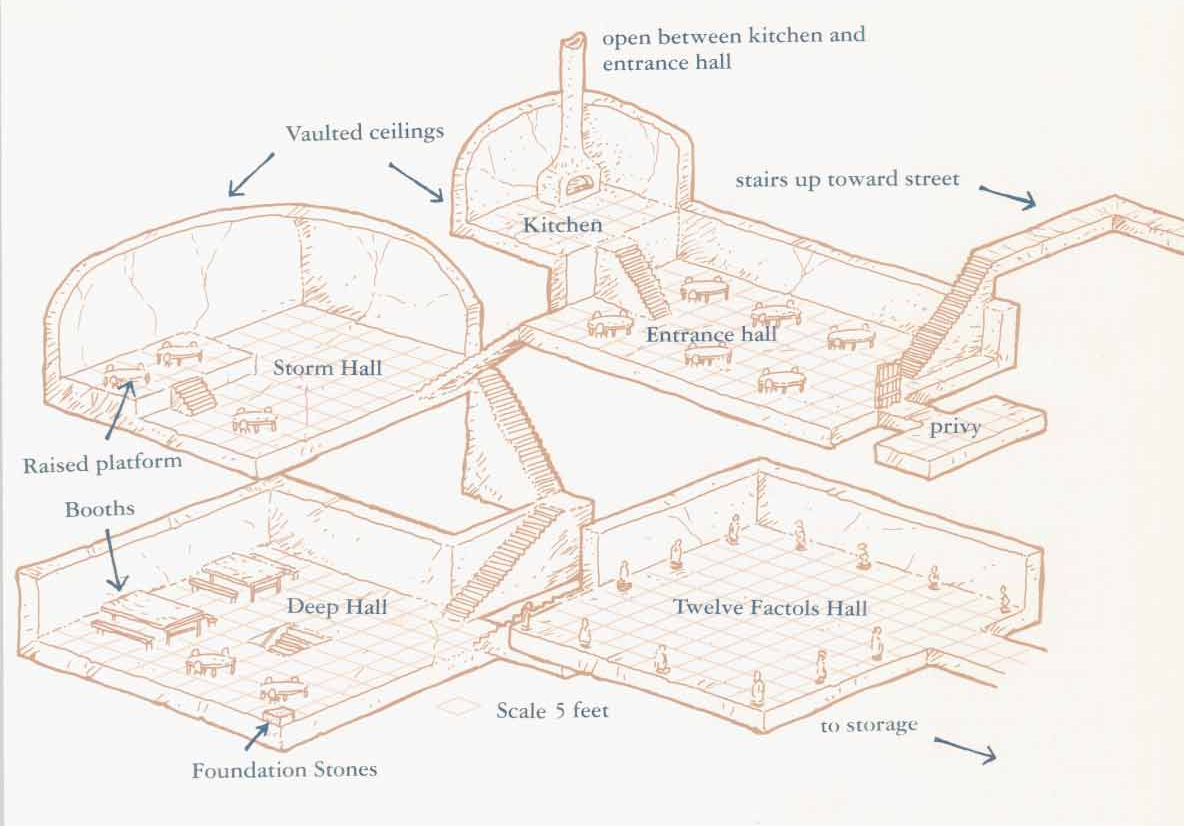
Persistent rumors claim that the door into the realm of the dabus exists somewhere within the catacombs, what the dwarves from the Outlands call the Doorway into the Mountain. The rumor is a popular topic of conversation at the Twelve Factols, a restaurant and tavern underneath the city streets, near Bossy Street. The entrance leads down 88 steps from a dirty, swine infested courtyard into an arched and vaulted chamber called Storm Hall after the loud and blustery singing, yelling, and boasting of the einheriar, bariaur, and other Ysgardians who often drink and wrestle there. A few stairs lead up from there to the kitchen, but most patrons go deeper into the catacombs, past the Foundation Stone that marks where the Twelve Factols met to beg the Lady for her support against the Expansionists almost a thousand years ago. (The messenger they chose by lot must've done the job. 'Cause Timlin’s Maze came soon thereafter.) The very deepest and largest of the Twelve Factols' chambers is the echoing field of benches called the Deep Hall.
Why not?
Beyond that lies the Twelve Factols’ Hall, where the factols of the time are preserved in twelve small stone statues, each no more than 2 feet high. Many storerooms lead out from the Deep Hall and the Twelve Factols' Hall, and other passages are said to be beyond the warded doorways of the storerooms. Once in a while, a mob of drunken revelers will insist on seizing torches and going exploring - when the argument is made at knifepoint, the barkeeps and serving wenches always agree that it is a good idea. Most of these groups are eventually rescued when their torches burn out, and they begin screaming in panic, but a few are said to have vanished without a trace into the deep passageways.
The City Barracks
Located at the opposite end of the ward from the Armory, the City Barracks with its surrounding quarter is a restful place, much quieter than the seething chaos of the other Wards. It's easy to know when a body’s getting closer to the Barracks; compared to the teeming chaos of most of Sigil, the streets near the Barracks are serene, even empty. Lone passers-by stride steadily toward their goals, and only polite noise wafts front the doorways of the sparsely placed taverns and inns. There’s a peaceful air in this section that's found nowhere else in the city.
That peace is punctuated by the imposing presence of crushing granite: the City Barracks. Outside, the rectangular building looks dull, heavy, and impenetrable, with a single, guarded entrance opening onto the street. Four sentries stand before the arched doorway at all times, ready to challenge visitors. There's not all that much to see in the Barracks, but the guards are members of the Harmonium, and the City Barracks is their headquarters, so not just any berk can walk up, enlist, and take the tour. The Hardheads like to keep street traffic minimal; they don't trust crowds. After all, crowds always go to extremes, and what looks like an orderly mass one minute may be a seething mob the next. Nothing annoys a Hardhead more than having to put down a riot.
From the street, the Barracks is just an immensely long, low two-story building with a roof of gray slate. Built in four identical sections, the Barracks forms a quadrangle around an immense parade ground. Its sheer size gives an impression of strength, but the lack of spikes, gargoyles, and other ornamentation keeps it faceless, unable to inspire deep terror. The Harmonium considers that a good thing (Hardheads want to make converts and want to be well liked), but they don’t give their patrols the same appearance. Most watchmen will use force to make people like them and foster belief in the struggle against chaos and crime. In fact, pressing members into the faction isn’t unheard of - that is, literally taking bashers off the streets and into the barracks, where they’re broken, trained, and reformed into members of the Harmonium machine. Sure, impressment’s a desperate tactic, but if the Harmonium numbers drop too low or when riots or fiends threaten order in the city, the faction does what it must to restore that order. Given the Hardheads' attitude, it’s no surprise the streets are empty, even compared to the rest of the empty Lady's Ward.
Very few businesses thrive in the nearby district, mainly because any merchant who doesn't conform to Harmonium standards gets scragged fast. Sure, the Guvners release the poor berk after a while, but who wants to go through that all the time? The taverns and inns in the area all closely follow the Harmonium official line: Every barkeep gives full measure, menus don't lie, customers always leave a tip, and all businesses obey the 10 a.p. curfew. The doormen keep out obvious minions of chaos, and entertainment in a Harmonium bar will put a berk to sleep right quick - only certain songs, plays, and jokes that have the approval of Harmonium censors are allowed, and they’re stale before a berk's heard them even once.
Oddly enough, despite all the armor the Harmonium patrols wear (and wear out), the only armorer is at the other end of the quarter, near the Armory. Rumors say a Harmonium dwarfs being recruited and even paid to set up shop closer to the Barracks. The Harmonium district around the Barracks is home to a chartered Harmonium butcher, a greengrocer, a tinker (who sharpens larger blades more often than smaller ones), a farrier, a tailor, and a blacksmith. All are good workers, who deliver on time and at the cost agreed on. There's many cutters who’ll put up with a horde of regulations if they can get the Harmonium’s consistently solid work.
The City Court
The Headquarters of the Fraternity of Order (more commonly called the Guvners), the City Court and the surrounding quarter are the liveliest places in The Lady’s Ward, perhaps because the people in it are so close to death. Every crooked cutter, it seems, comes here sooner or later, scragged by the Harmonium. Whether he gets out of it again depends on the judges in the private halls of the Court. Because it has a public function, the Guvners headquarters is divided into public and private halls. In the public halls, a cutter can find knights, Cagers, witnesses, advocates, clerks, accusers, and Mercykiller and Harmonium guards. The crowds and bickering seem like disorganized chaos (unlike the organized chaos of most of the city), but the Guvners have a plan for everything. In the Court's private halls, a body doesn’t find anyone but Guvners and their guests. There, the judges meet to discuss cases and reach their decisions, often referring to the immense library of laws the faction's assembled.
Outside the Court, a number of taverns and inns serve those attending trials. In comparison to other places in The Lady's Ward, they’re pretty lively. In comparison to places elsewhere in the city, they can seem damned quiet, especially after a number of harsh sentences have been handed down. The taverns serve anybody from thief to Hardhead, and there can't help but be a little life in ’em. Most of the alehouses do extra business selling meals to prisoners or running wine and beer to the back rooms of the Court.
The private halls of the Guvners are best left to those who have a reason for going there; describing them to others might only invite disaster. The more important portions of the Court don’t belong to the Fraternity of Order at all: The public halls, the outer courtyards, and the arched porticos where advocates hawk their skills are where much of the business of the Court is decided. With large, distracted crowds all over the Court, cross-trading knights are cheeky enough to pick pockets, snatch purses, and strongarm the weak. The Court itself has little protection to spare: a peery cutter with friends is better off than a lone fool with a fat purse. The Guvners' guards are too busy corraling prisoners and maintaining order in the courtrooms to make time for every barmy who upsets a baatezu in the alleys nearby.
Outside the halls entirely are the thriving businesses that feed on the rule of Law; scribes, turnkeys, servants, undertakers, mourners, and smugglers willing to provide services to the living and the soon-to-die as they are transferred from the City Court to the Prison. The best of the turnkeys will get all the others in, so there's no need to make all arrangements during the trip.
The law library of the Guvners is useful for many things, the least of which is codifying all the laws of the City of Doors. A mage with any sense at all knows that the laws that govern the multiverse must also contain the laws that govern magic. In the Library of the Guvners, that’s literally true. Every spell known to man or mage exists somewhere in the library, though it requires a mage of great learning to find the strands that reveal a spell's secrets. A wizard in the library can research any spell in a number of hours equal to the spells level.
Judges and Advocates
Finding an advocate isn’t a problem - dozens of them strut like roosters outside the Court, resplendent in their robes, brocades, and wigs. Getting a good advocate is as rough as finding an embezzler on Mount Celestia; the best way to get one is to fling about great piles of jink while standing amidst a squad of hired guards. For berks without that sort of jink, the best way is through a faction they favor, Guvner advocates are assigned pro bono cases by the faction headquarters.
Even if a basher gets a proper advocate, he also needs to avoid the worst of the judges. The worst of these was Aratik Melber the Mad, a barmy githzerai whose rulings are almost completely unpredictable; the Guvners plotted against him for years, but as a member of the Revolutionary League he always evaded them - until Hashkar got Aratik thrown into a maze. Almost as bad is Black Ogustus, a nearsighted human priest of Ptah whose rulings are so meticulous and so slow that he has been nicknamed "the Snail." Advocates often try to push their rich but foolish clients to seek justice in his court; many cases brought by the Clueless are heard in Ogustus' chambers.
The third of the disastrous debaters, as expected from the Rule of Threes, is Ylvirron the Cloven, a cornugon baatezu with an eye for his own profits and little else. Assisted by an erinyes clerk of the court named Kartina (whose cross-examinations are often agonizingly thorough), he bleeds advocates and plaintiffs dry with fees, fines, and none-too-subtle demands for garnishes. Since he was once an advocate himself Ylvirron knows most of their tricks, and winning a case is a breeze for him. Despite his incredible corruption (and notorious frenzies when advocates push him too far). Ylvirron’s rulings are almost always perfect (if often harsh) examples of logical legal reasoning. His true purpose in serving in the Court is a mystery to everyone - even the Fraternity to which he belongs - and is the source of much speculation.
I don't care who you are. You spend enough time thinking, you're gonna be miserable, confused, or left behind.
Fortune's Wheel
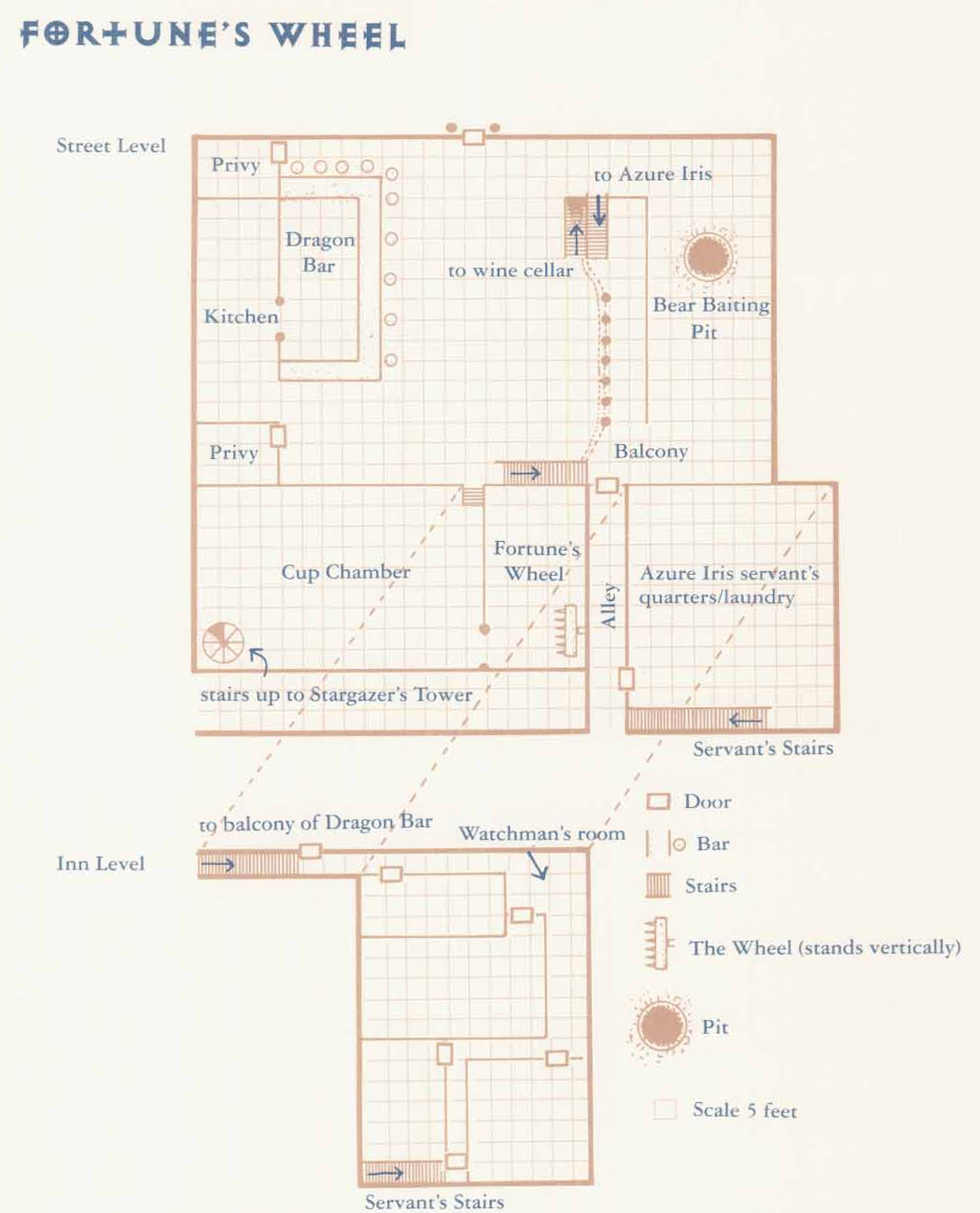
The tavern/inn called Fortune's Wheel is where the high and mighty come to engage in the kriegstanz that makes their lives interesting - and to eat and drink the very finest while they do it. The Wheel also attracts a large proportion of fakes and sharpers, so a basher with a heavy purse would do well to consider bringing along a few bloods as guards to keep his money out of the hands of the Fated or the Fiends who also make their fortune - in the streets just outside the Wheel.
The common room is called the Dragon Bar, a chamber that as much resembles most homey taverns as a factol's audience chamber resembles most bashers' parlors. The size of a great hall and twice as opulent, the Dragon Bar is named after an enormous carved dragon's head that arches over the bar's mirror and descends to the corner of the bar itself, where the head entertains the Wheel's patrons with tales of its life on the Prime. Most bashers who care guess that some necromantic spell controls the thing. Rumor claims that the dragon enforces peace in the Wheel whenever guests get too boisterous. Those guests are generally invited to leave and never return; if that threat fails, they’re enveloped in a cloud of blackness - the dragon's breath. Other rumors claim that the dragon is in fact the owner, and its serpent-form is an illusion; in fact, so the story goes, the entire beast perches just below the balcony, for it enjoys the company of powerful creatures. Where its hoard lies, the rumors do not say.
The other, less-exclusive public chambers of the Wheel are the Dicing Cup, the Bear-Baiting Room, and Fortune’s Wheel itself. The Wheel began as the iron rim of an enormous cartwheel, decorated with nails and gilded with payoffs right on the weathered iron. The whole wheel is mounted vertically and spun until a clicking strip of boiled leather brings it to a stop, indicating a square between two of the nails: bets placed on the wooden table before it are then paid off. The odds are terrible, but a unique golden square pays 1000 to 1, so there’s always a bubber or a prime at the table, desperately trying for the long shot.
Fortune's Wheel
Bill of Fare
| Meal | Price |
|---|---|
| Abyssal Beef Roasted Long and Slow over our finest Coals |
5 gp |
| Divine Dogmeat Quick-Seared in the Fires of Baator to a Raw and loody Flavor |
3 gp |
| Hangman's Ham Served with Spiced Arborean apples and Arcadian eggs |
2 gp |
| Final Supper Horse flank, seared and served with a chicken broth, green tea dumplings, and a vegatable medley from the Outlands, lightly seasoned with arsenic for our tiefling customers (by request) |
6 gp |
Potables
| Drink | Price |
|---|---|
| Ale | 1 sp |
| Lager | 1 sp |
| Bitters | 2 sp |
| Mead | 4 sp |
| Firewine | 6 gp |
| Pure Water | Market Value |
The Wheel made the tavern's reputation and gave it a name, and the room has a certain quaint nostalgia, but now only the Clueless and those with more money than sense try to win the gulden square; the gambler's wheel takes far more than it returns to the crowd, and only the promise of a magical item payoff (set on a tiny half-space between extra clickers) keeps the regulars coining back. The prize is changed each fortnight, and a few past winners have walked off with the Mage’s Prize: magical rings, wands, or potions. Despite this exception, the Wheel rarely pays off -just often enough to keep the credulous coming back for more. A minimum 10-gp bet is required to try for the Mage's Prize.
The Dicing Cup is the most dangerous of the tavern's entertainments, for some of the rich and powerful are very poor losers, and the patrons of the Dicing Cup play as much against one another as against the house. Losing huge sums gives the high-up gambler as much status as winning huge sums - perhaps even more. After all, anyone can win big, but few can afford to lose big. Though the money is not very important to the players except as a way of keeping score, any riff-raff who try to take their cut from the bloods are in for a big surprise: An invisible mage and two gargoyles lurk in the shadows, always watching for such attempts to bob the customers.
The house favorite is the albino musician Estrella (Pl/♀half-elf/B10/Fated/CN), a stunning, pale-skinned bard with lustrous silver hair who claims to hail from Ysgard. In fact, Estrella’s claims are true, though she was exiled from Ysgard, and she spies for the Fated while here.
The Wheel's an old building that leans on its neighbors, and its creaking Floors are layered with thick carpets to muffle their creaks and groans. A second-floor passageway connects the Wheel to the Azure Iris, a tiny inn run for those high-ups who have drunk a bit more than they should and decide to retire for the night in safety. Others use the Iris as a discreet locale for their assignations and even for business dealings; the chambers are magically warded so tightly that even an unwanted roach can't find its way in. Costs are 40 gp a night and up, when a room is available.
The Golden Bariaur Inn
Three streets beyond the enormous statue of some prime named Bigby, just a short walk from the Armory, the Golden Bariaur serves a clientele from the Upper Planes, from Arborea to Mount Celestia. Soothing music, subdued lights, and heavenly dishes make the Golden Bariaur popular with the richest and most refined citizens of The Lady’s Ward. Prices are set accordingly, though an evening in the Bariaur is always money well spent.
The tension between the lawful and chaotic aasimon is always present, though both sides are usually polite about it; outright violence is rare. Disputes that can’t be settled any other way are resolved by duels conducted at dawn in the skies over the city, when shining champions of Law and Chaos fight to first earth - that is, until one celestial combatant is forced from the sky.
The more obvious sources of tension are the sniggering fiends who occasionally stop in briefly to tease, harass, and heckle the Bariaur’s patrons, smearing them with filth or spoiling the inn’s soothing atmosphere with foul language, fouler stenches, and even sulfurous magic. Despite the temptation to attack, actual fights are very rare for both fiends and aasimon fear the Lady’s wrath. In fact, most fiends can't stand the place and fidget as soon as they step inside the door; few stay for very long, so the aasimon can afford to simply be patient and wait for the problem to go away.
The doorman gives the place its name: Goldenmane (Pl/♂bariaur/F12/Believers of the Source/NG) is a lustrous, tawny bariaur who appears to have leonine blood. More polite and even-tempered than most of his kind, he’s still blunt enough to tell a deva to its face that it’s had too much bub and is insulting other patrons. Luckily for Goldenmane, a strong word from him is usually enough to encourage better behavior from the inn’s clientele.
The Palace of the Jester or, the Court of Pain
Covering as much ground as the Great Bazaar, the Foundry, and the Hive put together, the Palace of the Jester is a neutral gathering ground for the rich and powerful. Too bad there aren't enough of them to fill its empty halls - a quick and daring berk could nick enough jink from these high-ups to live a lifetime of comfort and ease. In fact, the Palace is a ghostly place, all echoing corridors and dead-end staircases - no easy way to approach a mark and make off with the goods. Only the dabus seem completely at home in it, and even they have been seen throwing nervous glances over their shoulders from time to time.
Though the courtiers, factols, and other visitors might not agree, the real power in the Palace is the Lady's Jester, Jeremo the Natterer. Unlike his silent mistress, Jeremo never shuts his babbling bonebox - he'll collar primes, eladrin, anyone who'll listen. Dispite his jabbering, the Natterer is very much a power in Sigil's government. Jeremo’s real strength comes from his control of strings of the city: its civil service and its bureaucracy. He also has an uncanny ability to predict where portals will appear, a knack that has never been explained. The dark of it will probably follow him to his grave.
In fact. Jeremo is a member of the Ring-Givers, a sect of Ysgard that has slowly gathered power. Jeremo hopes to become the factol of the Ring-Givers when the sect finally moves into Sigil to begin its part in the kriegstanz, the undeclared war for control of Sigil, in earnest. When that happens, Jeremo plans to displace Ingwe, the current leader of the sect - and Ingwe is unaware of the danger he is in. At the heart of his palace, Jeremo keeps a great secret: a permanent portal to Ysgard that he hopes to make the centerpiece of the sect's headquarters in Sigil. So far, traffic through the portal is minimal, but that may change.
Jeremo's retinue comprises 60 humans, 24 bariaur. 7 glabrezu, and 1 lillend, all of them members of the Ring-Givers. In addition, hundreds of sympathizers throughout the city help his retinue create diversions, sell stolen goods, and play lookout to keep the watch away from his operations.
The Prison
The Mercykiller's headquarters looks like everything a berk fears: a mass of grim stone and spikes, surrounded by broad avenues. Sometimes a cutter’ll hear a faint wail from within, and when he does, he doesn't stop walking. There’s some things a sod just don’t want to know about.
The one good thing about the nearby quarter is that street crimes are virtually nonexistent. There’s not a cross-trading body around who’s going to ply his skills under the very noses of the Mercykillers. There's too many rumors of them deciding they can arrest, try, and punish a berk themselves, especially if their headquarters is close and convenient. Rigidly honest folk who’ve got the money and no vices at all set their cases in the blocks around the Prison.
The businesses around the Prison seem as gray and humorless as the Cage itself. The taverns are quiet, well-ordered places where nobody makes trouble, as only a barmy’d attract the attention of the Mercykiller squad drinking at the next table. The inns are spartan, with no hint of the temptations that sortie of the other establishments in Sigil offer. The markets are scrupulously honest, so the prices here are lower (and the quality better) than just about anywhere else.
Temple of the Abyss
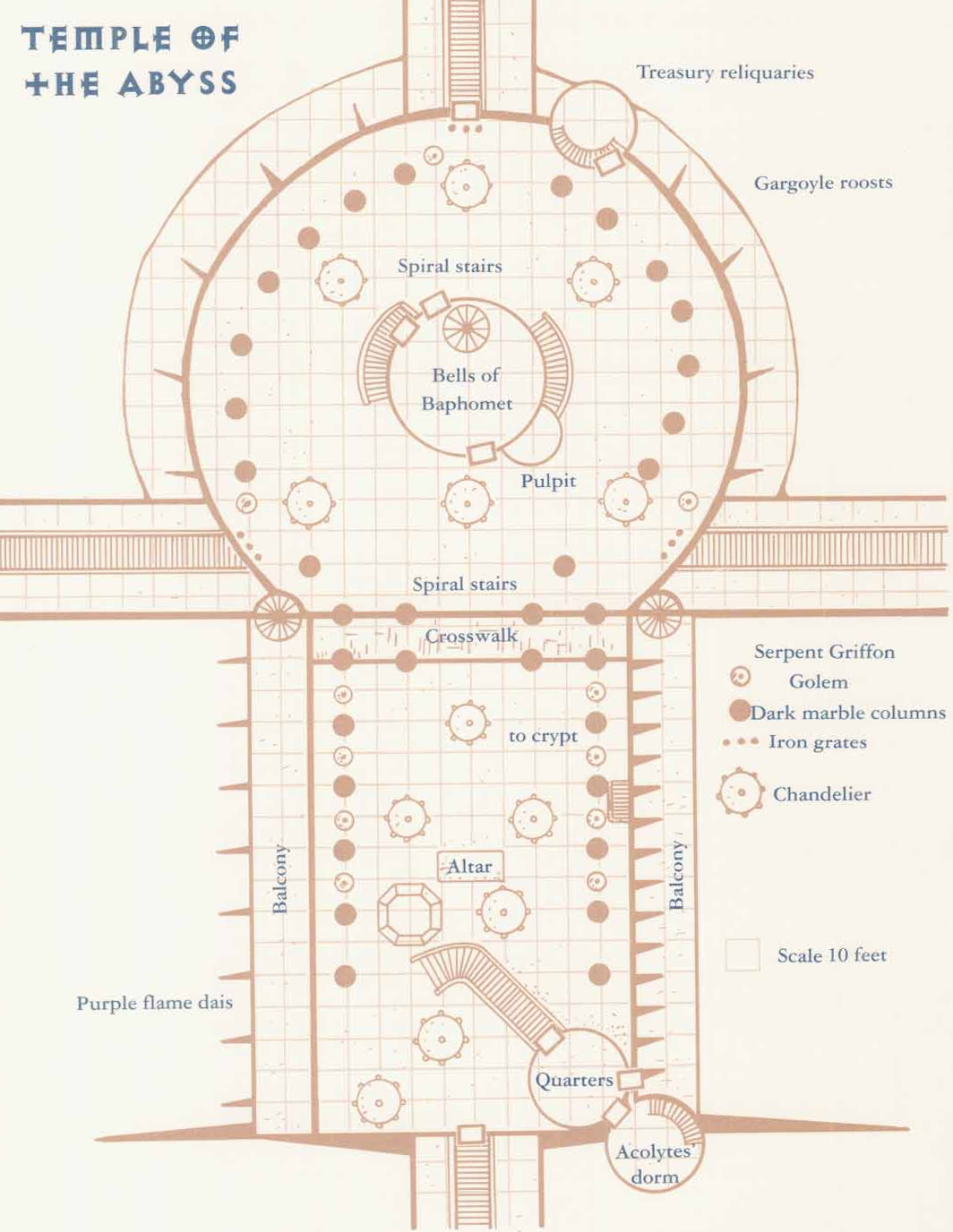
A cross between a portal to and a celebration of the plane of the same name, the Temple of the Abyss soars menacingly into the sky in the heart of The Lady’s Ward. It is governed by the High Priest Noshteroth and a legion of his followers, who function as both priests and tax-collectors. Services are held each night at antipeak: all the Lords of the Abyss art venerated, one each night until the entire list is exhausted, when the sequence begins anew.
The temple's exterior is simple black stone embellished by the tarnished silver blades with which Cagers enjoy decorating nearly every building. What’s more, in the gray morning light those blades are sometimes festooned with sacrifices from the previous antipeak’s rituals, These are usually cleared away by the Collectors before peak, though by the law of the city they must leave the living to hang there. The executioner ravens usually finish these victims off when lack of water weakens them. A few sacrifices have been known to remain on the Temple for as long as two days, though they invariably die from loss of blood (from the ravens' wounds) or lack of water by the third morning. Those who volunteer to remove these surviving sacrifices from the Temple's blades are often instead found hanging among them the next morning.
The interior of the Temple is a gloomy sanctuary of evil, with dark marble columns and 12 stone golems in the shape of terrifying, semi-reptilian griffons with deep emerald eyes. Iron chandeliers encrusted with the drippings of a thousand thousand black candles hang from the temple's ceiling, and a purple flame burns in the heart of the sanctuary, on the seventh (topmost) step of the central dais that stands before the altar. A grand, sweeping staircase leads up to the quarters of the priests and acolytes. The faces of the lords of the Abyss are carved over each entrance and exit to the temple, watching all those who fall prey to its barbed promises.
The Temple of the Abyss has a reputation for getting things done, and many factols have been known to turn to it when all other means fail. The price is always blood and spirits, preferably those of the supplicants. The Temple of the Abyss is remarkably discreet on the part or those who come to it for help; even the most righteous and holy of priests or paladins are never unmasked before all their peers and followers. (Of course, extortion is always an option if those whom the Temple favors cause trouble.) After all, when desperate berks sign the Temple's contracts, the priests can afford to take the long view; they already own the sods, lock, stock, and barrel.
The high priest of the temple is Noshteroth of the Umber Scales (Pl/♂tiefling/P10,Ro12/Bleak Cabal/CE), a member of the Indeps or the Bleakers depending on who you ask. He commands a mass of rutterkin, three nabassu who serve as messengers and who also guard the temple's blades, a hezrou adviser named Urgrek who also serves as master of rituals, and a squad of four armanites who carry his sedan chair. He also commands a set of cambion twins who constantly maneuver to take Noshteroth's post for themselves (and whose schemes are transparent enough for even the rutterkin to see through - the chant is the brain intended for one was split between the two when they became twins). His consort and only confidante is Noxana the Unwilling (Pl/♀tiefling/Free League/CE), who some say is also his daughter. Noxana is responsible for the Temple's contracts, and thus for its bell tower, the Temple's most fearsome but best-hidden feature.
The Bells of Baphomet hang far above the ground in the Temple's central tower, from where they're rung at antipeak. Those who have struck bargains with the fiends of the Temple are the only ones who can hear its bells tolling. Berks who have heard them and turned stag (that is, renounced an agreement with the fiends) hear the ringing constantly in their heads no matter where they flee, in Sigil or beyond. The harsh clanging of the bells keeps these oathbreakers from sleep and drives them to madness. Each night, such a victim must make a Wisdom save with a cumulative -1 penalty on each consecutive check. If the check ever fails, the oathbreaker is driven into a killing rage and bloodlust. The madness passes after a single night but returns at the next nightfall.
The madness of the Bells of Baphomet is only a wanting of worse to come. In time, the poor stag-turners who hear the constant tolling of Baphomet's Bells are always hunted down, captured, and killed by the Demon of the Bells, a shimmering spirit that appears and slays oathbreakers. Each time it is struck by spell or sword the Demon rings with an incredibly loud and dissonant tone, a sound foul enough, apparently, to kill anyone or anything near it. Since very few who survive can speak of the Demon of the Bells without trembling and whispering, details are sketchy.
For the Creator of the multiverse, humility doesn't come easy - but I do the best I can.
Temple of Hermes
Most planars don't concern themselves too much with any single power, 'less they're priests, but Hermes has a wide and varied following among Sigil's travelers and sojourners. Never mind that his temple's said to be a portal connected to Mount Olympus; no one knows how the portal opens, but carts and wheelbarrows of succulent Arborean fruits and vegetables rumble over the cobbles near the temple early each morning.
The assistant underpriestess is Mad Moll, an erinyes posing as a mural painter while seeking the secret of traveling through Mount Olympus.
The Tower of the Wyrm
Filled with inhuman cries and droves of well-armed, crisply-saluting guards, the Tower of the Wyrm is the holding pen for troublemakers and petty thieves who have caught the attention of Our Lady by peeling or bobbing other Gagers. The Tower stands not far from the Prison (some say the two were once part of the same structure, before a terrible explosion destroyed their link), and it is run by the Mercykillers. Those that're smart never even mention the place by name - it's unlucky. Those berks who do are jinxed, and the only way to shed the hex is to cross a Harmonium paJm with silver and gold, something that pains even the richest knights of the post.
The Tower is named for the faction symbol of the Mercykillers who constantly stand watch on its walls. The Tower always holds the Red Death mascot, a sort of winged snake that Cagers (sensibly enough) call "the Wyrm" or "the Dragon" Prissy primes say it's really called a "wvvern," as if anyone cares.
The mascot serves more than just a decorative function; the Wynn's venom induces delirium, making it easier for Mercykiller inquisitors let extract confessions from their charges, which in turn makes the duty of the Guvners' judges easier, and guarantees that the poor sods return to the Mercykillers' hands. It's just another way to ensure that Justice is carried out. And, of course, some death sentences consist of simply feeding the offender to the Wyrm. Justice certainly cuts down on the cost of Wyrm chow.
Traban's Forge
Located in a side street near the City Court, downward from the Noble District, this smoke-spewing smithy produces fine nonmagical armor. The ancient Traban (Pr/♂dwarf/F1/LG) specializes in highly ornamental plate mail, suitable for triumphs, parades, and battle. All work is done to order and costs between five times and one thousand times the normal price, depending on the workmanship. Many of his customers are members of the Harmonium, though orders also come in from the paladins of Mount Celestia, especially the Order of the Planes-Militant. Traban is fully 471 years old, but he has never refused an order. He knows without a doubt that he’ll die before he finishes the work he has already agreed to, but he also knows his middle son'll carry on the family work. This comforts him, and he looks forward, in his dour dwarfs way, to dying at the Forge he carried with him from Krynn. He'll tell all his customers about this personal death wish; his sons find this embarrassing.
Traban’s assisted in his work by his middle son Trabanson (312 years old), great-grandson Tarholtson (138). and a young, adopted ogre named Coal-chewer, Coal-chewer works the bellows tirelessly and sings (or more precisely, hellows) along to the dwarven work-chants in rather good dwarvish - one might say he bellows at the bellows. (Hell.) Tiefling and fiend customers frighten Coal-chewer, and when they come into the smithy he tends to hide in the hack until they leave. Tite dwarves find this oddly endearing and amusing.
Trahan’s grandson Tarholt (343 years old) no longer works the forge; instead, he wanders between Sigil and the Dwarven Mountain on the Outlands. seeking customers, taking orders, and secretly searching for a place where his grandfather might retire quietly. The ogre, with the family since he was orphaned at two, is the subject of an experiment of Tarholt's; the hypothesis is that an ogre raised in proper dwarf fashion can be reformed. So far, Coal-chewer hasn’t killed anyone.
The Traban clan, carrying the clan anvil, came to Sigil from Krynn about 120 years ago as part of a small exodus of dwarves to the Outer Planes. Trahan's got no plans to ever go back, although his children are all curious to see the homeland again. Trahan keeps telling them an earthquake destroyed their family diggings, but none of then believe him.