The Lower Ward
Source: In the Cage: A guide to Sigil p.46
In which the stinking, festering workshops and the most notorious Alehouses of the city are laid bare for the Inspection and Edification of the Public.
This ward got its name from the many portals to the Lower Planes that're found here. These doorways have changed the place, so there’re more smoke, steam, and cinders in the air than there should be. The Lower Ward's the source of most of the foul industrial smogs that sometimes choke the city, brownish-yellow blankets of stinging sulphurous gas that cling to the air and linger as a stench in clothes for days afterward. Too long outside in the Lower Ward and cutters' throats get raw and their eyes teary. After a while, the quantity of foul miasma absorbed by their skin gives it a sickly pallor, often accented by boils or pustules. Their eyes grow hollowed and dark, their hair pale. The Lower Wards the only one that scars a berk’s face,
'Course, it ain't just people that suffer from the bite of the ward’s industry. The thick smogs are so common that some Cagers name them the way some primes distinguish different types of weather: woodsmoke, meats moke (smoke from the curing houses), eyesting (alchemists' fumes), coffinsmoke (or "coughin' smoke," the stench of cheap pipeweed), ironfumes (smoke from the smelters and smithies), and cooking fires. The smoke and ash of the Lower Ward are easiest of all to identify, for their acid bite is unmistakable. Grime and sulphur from the Lower Ward's fires coat every available surface, their soot and arid slowly etching black paths into the stone and rusting iron. Most statues and roof tiles are entirely eaten away within 40 or 50 years, and statues must be enchanted against corrosion.
The Great Foundry is the center of the ward. All around it huddle lightless warehouses, smoky mills, ringing forges, and a host of other small workshops. Most of the city's craftsmen are concentrated in this district. Despite the constant creation going on in the ward's forges, ever since the destruction of the Temple of Aoskar (a power now presumed dead and drifting on the Astral) the Lower Ward has been on the wane. 'Course, Aoskar's ousting was to the Athar’s benefit. The Athar - who say all gods are frauds - set up their headquarters in Aoskar's ruined house of worship, now called the Shattered Temple.
Though the Lower Ward has clearly shrunk over the past decades, it is still larger than the Market and Guildhall Wards. It once included the City Armory and Mortuary, now considered part of The Lady’s Ward and the Hive, respectively.
Folks in the Lower Ward are secretive and stubborn. Most of the craftsmen feel like they’ve got trade secrets, and they’re always peery of strangers, even customers. Their moods aren’t helped by the number of fiends that haunt the dives and flophouses tucked in back alleys, or by the barmies who slip out of the Hive by night to prowl. The Harmonium patrols aren't strong here, and most folks expect they’ve got to take care of themselves.
Here's a short list of things I don't need from you: your ideas, your help, and your breath in my face.
The sickening vapors of the Lower Ward often cripple or at least slow those who breathe the ward's air Any PC exposed to it must make a Constitution saving throw, with the usual bonuses for poison saving throws for dwarves and half lings. Tieflings are also entitled to a similar bonus against smog. Those who succeed lose nothing and suffer nothing but the stench. Those who fall suffer a -1 penalty to Strength and Dexterity for the duration of the smog; any strenuous effort requires an additional successful Constitution check, or it brings on a coughing fit that prevents spellcasting and increases the ability score penalties to -3 and -5 for 1-6 rounds - long enough make the difference between life and death in the City of Doors.
Most smogs last only a day or two before a wind rushes through the spire; however, old-timers can remember hot, calm summers when the smog grew and grew until it became nigh unbearable.
The Black Sails
The Black Sails tavern stands in the shadow of the Armory, the Doomguard headquarters, at the end of a dark alley between a pair of armorworks. The blackened bowsprit of an ancient galleon juts our over the figurehead. Soot has stained the sails' canvas black. Inside, dark rafters loom over about a dozen curtained alcoves that conceal the furnishings of the tavern's dim common room. Several stained and notched tables stand in the room's center, where groups of sullen crafters gather to drink quietly.
The Bones of the Night
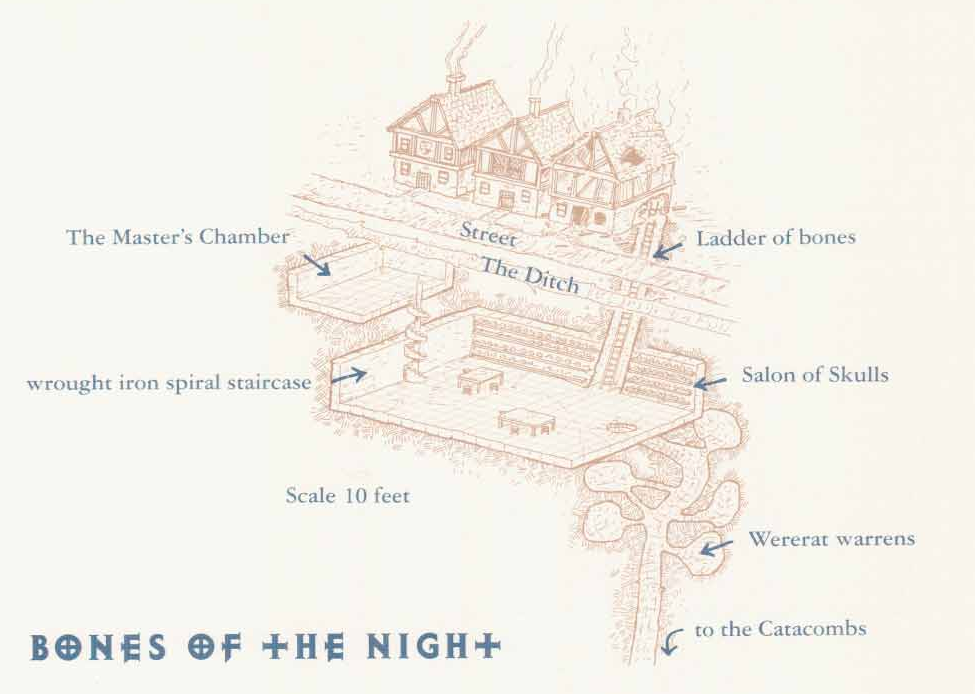
The Guvners have reams of knowledge, of laws and regulations in their carefully organized archives and repositories of dead wood and papyrus. The Bones of the Night is also a font of knowledge, but one far less organized and less regulated - this is where thieves, wizards, and knights of the cross-trade come to learn from the dead.
The Bones of the Night is a cavern complex among the catacombs near the Ditch in the foulest-smelling region off the prodigiously odorous Lower Ward. The entrance is a gaping hole that fills an entire fire-gutted building; a ladder with rungs of bone leads down into the obsidian darkness. The chittering of rats can always be heard from the top of the ladder, though it fades whenever someone climbs down to the entrance salon.
The salon is richly decorated with the grave goods of a hundred thousand wealthy headers: plush chairs, thick layers of tapestries, and burial shrouds. Officially, every tout who's asked the Master of the Bones for permission to lead the curious on a brief tour has been turned down, but in fact the wererat servants often look the other way for a little garnish, or help the tout for a little more. In return, they lead the lucky visitors on a quick, chittering walk through the catacombs to the Chamber of the Reaper, where the bones of the dead decorate the walls and ceiling in elaborate patterns. The Master of the Bones usually animates one of the skulls to scare off the trespassers.
The Master of the Bones is Lothar the Old (Pl/♂human/C25/Free League/N), a feeble-tooking bearded man with a face full of wrinkles and a mind full of secrets. Called simply "Master" by his servants and many of his visitors' stories say that he is too wise for death to come near him, though others say that he has already foretold his own death, which will come through a gift given to him by a loved one.
When a supplicant comes to him with a question, Lothar negotiates his fee, then goes to gather the answer by consulting his "library" of skulls. After all, the dead are experienced, knowledgeable, and unable to lie, Factols, master thieves, mummies, and the master of the stonemasons' guild compose but a fraction of his collection; the king of the rag-pickers, a sane slaad, and a true tanar'ri are also prizes on his shelves. What most cutters don't realize is that the Master of the Bones is a necromancer-priest who uses the nature of the questions asked as a source of information for himself.
When he p s presented with a skull by one of the resurrection men who sometimes bring him their most important finds, Master Lothar offers what he considers a fair price - after all, few others have the skill to use the skulls as anything but paperweights. Prices vary from 1 gp for a wise servant with a single valuable story to tell to 10,000 gp for a factol’s skull taken from the mausoleums and crypts beneath the faction headquarters. Chant is, the Master of Bones is currently looking for the skulls of Shekelor, who defied the Lady of Pain, and Imendor, the last priest of Aoskar, who knew the plans of his god (and died for them).
The Master is hardly alone in his catacombs. His best assistants are wererats, on loan from Tattershade, the King of the Rats, who gains valuable information in exchange for the loan of his servants. The rats scurry off into the catacombs in search of particular bones when a question requires more specific information than his library can provide.
The entire complex is guarded by a powerful stone golem shaped into the form of an enormous ghoul, complete with sharp claws and dickering black tongue. This golem stands constant guard over the Master's library of skulls and his new acquisitions. An eldritch fire in its heart animates it; some say that when the Master dies, the fire will go out as well. Until then, the golem is justly famous for stopping thieves and expelling rude guests. No one has given it the laugh, at least not yet.
The Ditch
Sometimes said to define one edge of the Hive, the Ditch is Sigil‘s only large body of water: a foul and reeking morass where corpses (partial and otherwise) seem to sprout overnight. Its waters are corrosive, and most bodies become unrecognizable within hours of being dumped - a virtue as far as most Cagers are concerned, but a devilish problem when the locals call for the Harmonium to sort out who’s been put in the dead-book. Rumor has it that the Ditch is a backwater of the Styx; though few bashers'll actually admit to seeing a marraenoloth sailing on it, everyone seems to know the friend of a friend who has. Don't believe 'em.
In some ways, the Ditch resembles more the idea of a river than an actual river: It ices over, sometimes it runs green and quick, but usually it is still, brown, and sluggish. The River Oceanus cleans out the Ditch from time to time, these rare occasions are cause for celebration among the poor folk of the Lower Ward, who spend the day bathing in the silvery sweet water. This scouring is all too infrequent.
The banks of the Ditch are a gathering ground of the Xaositects and the Guild of Teamsters, who use the waters as a quick way to get material from the foundry to the portals of the gate towns Ribcage, Plaguemort, Rigus, and Hopeless, which lead respectively to Baator, the Abyss, Acheron, and the Gray Waste. At night, even these stubborn souls refuse to work there for fear of the Ditch Beast, an almost certainly mythical animal that they claim devours those who linger near the festering wafers during the gloomy night hours.
In fact, the Ditch Beast doesn’t exist, except as a result of the illusions of the dabus, who use the Ditch themselves during the hours near antipeak as a dumping ground for all sorts of refuse in addition to bodies, from nightsoil to kitchen offal to splinters of furniture swept from the taverns and alehouses. Few Cagers know about this nightly gathering of dabus, for the dabus tell no one and work quietly. The only exceptions are the Collectors, who wait patiently each night for the dabus to leave, then swarm over the abandoned refuse searching for anything the least bit salable or usable.
Wererats also gather along the Ditch, where they receive the orders of their king through his lieutenants. The King of the Rats, Tattershade, lives underground in a section of the Realm Below taken from the dabus and never reclaimed. These tunnels are arranged entirely for defense, for Tattershade lives in constant fear of... something, something he will not reveal even to his trusted lieutenants. Speculation is rampant among the wererats; some say that he fears the Master of the Bones, or a baatezu he crossed, or the Lady. A few claim that he fears the ghosts of his offspring, whom he drowned in the Ditch. Others claim he fears his followers, and those who know the dark of the shadow fiends say that Tattershade once sold a captured mind that later escaped and that haunts him still (a certain Abyssal Lord is often mentioned). In any case, Tattershade has turned the tunnels into a series of storerooms, poisoned traps, deep pits, and secret passages that even the rats can't always navigate. Visitors (usually priests or mages hired to cast magical traps and wards) are allowed only under the strictest precautions and supervision. In addition to the main, wererat-sized passages, the entire region is honeycombed with small passages, just big enough for rats and shifting shadows.
The Golden Bell
Standing hard by the Temple of the Abyss, the Golden Bell is a pawnshop for the poor and the desperate. The Bell carries weapons, armor, kitchen goods, tack and harness, jewelry, supposed spell keys, holy and unholy symbols, maps, and more. A few are magical or at least of superior workmanship. All goods are available for half the usual price, with no returns or promises of quality.
The Bell is also famous as the home of a fence named Marisha the Fox, an alu-fiend whose left leg was crippled years ago, forcing her into semi-retirement. Many believe she is a spy for the tanar’ri in Sigil, but in fact the spy is her human husband, Pincher the Exile (Pl/♂ human/C4/Athar/CE), a servant of the Abyssal Lord Baphomet. Pincher isn't much in a fight, but he has powerful friends among the Temple of the Abyss and the tanar'ri in the city; his store has been robbed often, but the robbers almost always wind up floating face-down in the Ditch. The store’s bouncer is an enormous prime minotaur named Crookshank (Pr/♂minotaur/F6/Athar/CN). His cloven hooves are shod in spiked iron, and he always carries a shield +2 and a powerful mace +3 named Thunderflash. Crookshank is actually a draw for the store: He’s bold, smart, rude, and barmy in an amusing combination. He makes people laugh, even as Marisha and Pincher swindle them.
The Great Foundry
This is the headquarters of the Godsmen. The foundry's a dirty, sprawling complex of workshops, warehouses, storage yards, and furnaces. The Godsmen work it nonstop. By day it belches smoke and steam, and by night the district’s lit by its fires. The products of the foundry, petty metal goods needed by everyone throughout Sigil and beyond, are the Godsmen's major source of jink. They make tools, hinges, pots, nails, and anything else that can be fashioned out of iron. Their skills aren't very great: very few of their wares are fancy work, bur they’re all strong and serviceable.
The streets around the foundry are a jumbled weave of workshops and worker’s taverns. They're not luxurious or particularly clean; when a cutter’s been at the forge all day, he tracks in a lot of grime. Drinking and dealing are both serious business. There's always somebody haggling over the price of goods. Other deals get cut here, too, for this’s the neighborhood where men and fiends meet. Their dark talk doesn't get whispered outside these doors.
The Green Mill
This leafy sanctuary is half tavern, half safe house; it caters to the most powerful prime elves, those who seek the glories of Arborea, Alfheim, and the Beastlands. Humans, half-elves, bariaur, and primes are tolerated, but fully sylvan customers are given preference. Githzerai and tieflings are not permitted on the premises. Many weary Clueless have been cheered by the Green Mill - they claim it's like going home to their crystal spheres. (Puling nostalgic weaklings, really.)
A body can't miss the building itself: The mill is painted a bright yellow-green in contrast to the soot-darkened walls of the buildings all around it, and it's scrubbed each week to keep it that way. In its large central courtyard grow the largest trees - perhaps the only trees - of Sigil. The chant is the elves have planted a small World Ash (and the thousand years they'll need to spend growing it doesn't bother them). The rumor is amusing but unlikely, since most Arborean and Alfheim elves know that the Yggdrasil's seeds are sterile.
Inside, the Green Mill is opulent, with fragrant pillars and beams of cedar, richly gilded and carved to resemble vines and leaves. The walls are hung with thick, sound-deadening tapestries in repeating leaf patterns of light and dark, like the sun in a forest. The light is dim at all hours, and the air hangs heavy with the scents of flowers and moss.
The house bards play elven airs, and the lack of an echo makes the acoustics seem like those of a real forest. The most famous of the Green Mill's epic sagas is "Sketches of Sigil," a lay that has enjoyed a wide popularity outside the inn's walls: even yugoloths have been heard humming its tune to themselves. The dabus sometimes visit, and those nights are unforgettable. Their response always adds to the fireworks, flashing throughout the hall as a rapid series of images, rather like musical notation and visual interpretation. Even some of the bloods from The Lady's Ward have come to see the dabus, and rumors of the Lady herself appearing are as common as soot.
The mill still operates as a mill, the rotting swill of the Ditch turning its great wheel, said swill generating power to make elven breads and wayfarers' cakes. For slow periods, the Mill’s equipped with a small windmill, sails, and gears, but these are cumbersome and less powerful than the waterwheel.
A Few of the youngest elves insist that the Mill lies within The Lady's Ward, but most agree that it is part of the Lower Ward. However, its charm and warmth have won it a following from the rich and powerful of The Lady’s Ward; whether that is merely a pleasant, but soon forgotten, diversion for the high-ups or something more remains to be seen. The work of its Fletchers, weavers, and millers keeps it within the Lower Ward, but even there it's a rare oasis of elegance in a wasteland of smoke, sweat, and steel.
To you, it is greed. To me, it is need
Care Charming Sleep
Care charming Sleep, thou Easer of all woes,
Brother to death, sweetly thyself dispose.
On this afflicted berk, fall like a cloud
In gentle showers; give nothing to it loud,
Or painful to his slumbers: easy, sweet,
And as a purling stream, thou son of Night,
Pass by his troubled senses, sing his pain
Like hollow murmuring wind, or silver rain.
Into thy self gently, oh gently slide,
And kiss him into slumbers like a bride
The Bells of the Temple
Deathe, rock me asleep.
Bring me to quiet rest,
Let pass my weary guiltless ghost.,
Out of my careful breast,
Toll on thou passing bell,
Ring out my doleful knell,
Let thy sound my death tell.
For I must die,
There is no remedy,
For now I die.Farewell my pleasures past,
Welcome my present pain!
I feel my torment so increase,
That life cannot remain.
Cease now then, passing bell,
Ring out my doleful knell,
For thou my death dost tell.
Lady, pity thou my soul
Death doth draw nigh;
Sound dolefully.
For now I die
The Hands of Time
This amazing shop is a little piece of Mechanus, brought somehow complete to the heart of Sigil. Entire sections of it rotate and move and gyrate, with sliding floor sections, crude (and open) elevating platforms, and doors that open and shut by invisible bands. It even has its own clocktower and eternal lamppost.
The Hands of Time is a collaboration of like-minded aasimon, modrons, and prime gnomes and dwarves, all devoted to making better compasses, steam toys, music boxes, humanoid automata, timekeeping devices, area no-mechanical songbirds, mechanical hammers and bellows, spell-driven engines for drills and orecarts, and other obscure but durable technologies. The members of the association call themselves Timekeepers, though only a few actually work on docks of any kind. They will pay handsomely for any interesting mechanical apparatus brought to them.
Though it specializes in mechanical devices of every description, from pendulum clocks to armillary spheres, modron holy symbols to driving gears, sextants and padlocks to magical looms, the shop presents different faces to different races - in a way, the Hands of Time is more a club of like-minded individuals than a craftsmen's guild. Modrons view the shop as a peculiar sort of temple, and are accordingly respectful, leaving offerings and appearing en masse during the Great Modron Parade to make the proper prayers/finetuning on ritual days. The craftsmen are unwilling to sell any of their constructs, though they will give them away willingly to other Lawful creatures that express an interest in the modrons' view of the multiverse. A cutter should know, though, that accepting one of the modrons' creations puts a body in their debt. They may come back to ask for help or simply to ask for their item's return. Refusal earns the freeloader the undying enmity of the modron race. Since modron craftsmen are utterly, fanatically devoted to the shop, a cutter shouldn't accept anything unless he’s willing to return the favor or fight off a squadron of angry modrons.
Aasimon see the Hands of Time as a reflection of the harmony of the multiverse, and consider the mechanical constructs expressions of the greater harmony found outside Sigil. They find the shop comforting, but rarely do more than purchase curios from it. The gnome and dwarf apprentices are most willing to part with their constructions, though only after thorough testing to ensure their durability and proper functioning. Nothing leaves that doesn't work - which means an awful lot of dangerous half-completed or failed projects are lying around the shop to be scavenged for pans.
Oddly enough, the guildmaster of the shop is Saddam Hasan Ibn Arvalas (Pr/♂human/W14/Fraternity of Order/ LG), a master artificer from Toril. Though his specialty is infusing mechanical items with magical motive forces, his skills have been sharpened by the exchange of ideas with other engine-builders and the theories of the modrons. He can construct a skeleton framework for any mage or cleric seeking to build a clay, stone, or iron golem (cutting the building time in half), and often more obscure forms of automata as well. In any conversation, Saddam often refers to his mentor. Trobriand, the previous master of the shop and another prime from Toril (responsible for Trobriand's automata, which now infest a region of Undermountain).
Sigil can't keep a secret. Most of its wall are doors.
Harbinger House
Not well known, even to the touts. Harbinger House is a madhouse overseen by the Godsmen, Certainly Sigil has more than its share of barmies, driven mad by the powers, fiends, and contradictions of the planes. Most of them are allowed to wander the streets without interference, but the dabus and sometimes the Harmonium bring the real troublemakers here to be gently confined. The Godsmen themselves do not go out and search for barmies; they only care for those that are brought to them. Their most infamous charge is Sougad Lawshredder, the dreaded mass murderer.
Some berks will say Harbinger House is in The Lady’s Ward. Within lie nexus upon nexus, portal on portal, all behind many locked doors. Strangely enough, even berks who have walked past it a thousand times seem to forget that they’ve seen it.
The head of Harbinger House is Housemaster Bereth, appointed by Ambar, factol of the Godsmen. A new Housemaster is appointed only on the death of the previous officeholder.
The Shattered Temple
Once a temple to Aoskar, the Shattered Temple is now the faction headquarters or the Athar. The Shattered Temple stands at the heart of a zone of destruction several blocks across. The Athar only repaired what little they had to in order to make the temple usable, preferring the broken look of the place, (They are the Lost, after all.) The area's been a ruin for a long time, as anyone who knows anything about Sigil can testify, but there's no clear hint as to what caused it. The best guess is that it involved the Lady of Pain and a conflict with a rival power. That would explain the broken temple, once belonging to the power Aoskar, which is now the Athar’s home. Whatever the cause, the area’s considered ill-omened by most, and nobody has built there since. Only a bunch like the Lost would ignore these superstitions.
Still, even they can't overcome other folk's fears. The few Athar merchants who've tried rebuilding in the blasted zone have all gone out of business for lack of customers - only other Athar'd even consider dealing with the berks. Wagoners stop at the very edge of the ruins, sedan chair porters won't enter, and moneylenders refuse to give out loans to those foolish enough to ignore the tradition. While all this makes good security for the Athar, it's lousy for business.
Yet there's always a way to turn trouble into profit, folks figure. Packed at the outer edges of the ruin are a whole host of shops and inns catering to the Lost and their visitors. These form a ring of gaudy nightlife around the ruin. Over the years, the reputation of the area’s grown enough to attract even wealthy lords looking for a little low-life fun.
Society of the Luminiferous Aether
A gentleman’s club for working mages, the Society was once in The Lady's Ward, but has drifted into the Lower Ward with the passing of years. The drift may be because the Society's members have accepted more and more commissions from the smithies and fewer and fewer from the high-ups of the city, who want too much privacy. (Soft whispers claim that knights of The Lady's Ward kill the mages they hire, to ensure their silence.) Besides, the high-ups offer loo little latitude for experimentation.
The sign over the single entrance - a basement-level door — reads simply "Lumen." Only members of the club and their guests are allowed in; others are turned away by Gamnesto the Vile, the senior doorman (Pl/♂fiend(gehreleth)/Free League/ME). Stories say that Gam was summoned by the Society's founder and is bound to defend the society as long as it exists. Gam's violent reaction to these stories makes most cutters believe that they’re true. Any provocation brings a furious storm of violence from the doorman, who has no other outlet for his rage at being confined to the same duty for decades.
Once within the cellars of the Society, visitors are amazed by the floor-to-ceiling books, scrolls, logbooks, charts, globes, and tablets, all pertaining to the planes, fiends, and powers. Most importantly, it maintains a long list of spell keys and spell effects on the various locations of the Great Ring. Of course, on infinite and shifting planes, the list is unreliable even though it is constantly updated. However, every arcane, valuable work is enchanted with wizard marks that the doorman can clearly see, as well as deeper runes that he can sense whenever works are removed from the library. Any removal of a volume from the Society brings his wrath and that of every mage present down on the offender. Teleportation and similar spells do not function within the Society’s quarters, either coming or going. Everyone must pass the doorman.
Bright magical lights shine warmly in every room, and the entire complex is decorated in rich (though worn) fabrics and swathed in layers of sound-dampening carpets and tapestries. Private rooms are available in the deeper cellars or outlying buildings for security while summoning major fiends or potent (and unamused) creatures of good. The society also keeps a well-stocked wine cellar and runs an excellent kitchen (most prices are double or even triple those listed in the Player's Handbook).
Membership in the Society is not cheap; the entrance fee is currently a pile of jink most cutters won't see in a lifetime (10,000 gp or more, some say), and Society mages must donate either 10% of their annual earnings or 1,000 gp per level each year (whichever is greater) to remain in good standing. However, since use of the Society library for guests costs 1,000 gp a day, joining is sometimes worthwhile, Exceptions are sometimes made for those who donate new and valuable works to the Society's library.
That ain't the chant, it's just the rotgut talking.
A volume form the reading library of the Society of the Luminiferous Aether:
On the Wings of the Lords of the PitA treatise with a Description of their foul Appetites, their cruel lusts, and their Magics
Translated from the Malbaogni, the language of Baator, by Crookshank, a tiefling and a scholar
This material has not been approved or revealed to the Censors of the Fraternity of Order. No Guarantees are made by the Society as to Its Accuracy or Efficacy.
Donated By Crookshank,
Junior Doorman to the Right NOble Mages of the Luman
The Styx Oarsman
If the name doesn't give a cutter a clue about this kip's ambiance, the tiefling guarding the door will. Nobody gets inside without knowing the password, which tends to change from day to day, ('Course the one password that never changes is "jink," as in garnish the bouncer's palm, berk.) Once inside, a body knows for sure this's a fiendish watering hole. The common room's dark - not just romantically dim, but outright dark. The glimmer of a single candle illuminates the taps. Voices whisper to each other in the blackness. Cold, dry, snakelike skin brushes a cutter's side. Eyes flash with their own light.
The tavern's run by Zegonz Viatic (Pl/♂githzerai/F4,WG/Bleak Cabal/CE), an emaciated and scarred githzerai with one arm frozen into a claw. He was permanently maimed - beyond even the means of magical repair - during a run-in with a band of good-aligned adventurers. This tavern is his revenge on all those he blames for his sorrows. Zegonz openly courts tanar’ri clientele, giving them a place to discreetly meet and do their business. The fiends know it, too, and they protect him from the wrath of the Harmonium or any band of self-styled do-gooders who might try to close the place down.
The Oarsman's a bolt-hole for many a cross-trader giving the Law the laugh who's willing to trade some of his swag (and maybe a bit of blood) for a place safe front the Harmonium and less dangerous than the Hive. After all, sometimes even the peeriest sharper will pluck a pigeon that turns out to be a hawk. Once his bob's fallen apart, he needs to hide, but he can’t risk the Outlands or, like some Cagers, he just fears life outside the city. So, he comes to the Oarsman.
Rule-of-Three, the tanar'ri wise man (or beggar, depending on who you ask), occasionally comes to the Oarsman for a laugh; his very presence scares newbies into quivering silence. He enjoys taking the form of a gap-toothed old githzerai sage, because this leads most bashers to underestimate him. He’s always got three answers to any question, and his triplicate patter drives some listeners barmy. Rule-of-Three loves watching them squirm.
The Ubiquitous Wayfarer
Some say the Ubiquitous Wayfarer is in The Lady’s Ward, some say it's in the Clerk's Ward, but all agree that it contains many, many portals to other planes. Its portals lead to the planes of the Great Ring, not to the gate-towns or the Outlands.
Unlike all other taverns of the Cage (except the World Serpent, which caters to primes in someplace called Arabel on Toril - and there are those who claim it’s actually in Arabel), the Ubiquitous Wayfarer has permanent portals for some of its entrances, so as not to inconvenience anyone in another part of the city, 'Course, some of those Clueless berks in the Clerk's Ward don't even know they’re passing through a portal when they go in, so they think the place is part of their ward. Pathetic.
Other Beloved Alehouses of the Lower Ward
The Lower Ward breeds dives and pubs, taverns and public houses, places where the air is thick, and the floor is sticky with spilled blood and lager. Here's a quick guide to the best and the worst. (You won’t find these on the poster map, but a good tout can point the way.)
The Dirk & Firkin
A well-heated, well-kept greenhouse that has attracted large crowds of upper planar customers ever since it opened, the Dirk & Firkin's whitewashed glass skylights and smoked glass windows hide a fragrant refuge full of eladrin, palms, aasimon, tulani, flowering plants, einheriar, ferns, and bariaur - even occasional lillends or devas. The warm, humid air isn't to everyone's taste, but a few cutters weary of the Lower Ward’s stench make pilgrimages here "to breathe the vapors"(good for the lungs). The food is simple but wholesome, and the drinks are strong, clear, and sweet.
Living is a hard habit to break.
The Face of Gith
As expected, this establishment's frequented by githzerai, all being alone together, drinking silently and sullenly. They enjoy no company but their own, and they enforce the policy with drawn steel. The githzerai who've been there claim that the bar has installed a sealed blob of Limbo’s primal chaos-stuff, which the Anarchs and other chaos-masters shape into images, creatures, and shifting colors for the amusement of the patrons. Some conversations are held entirely by telepathy, lending the place a further subdued atmosphere.
The Hooded Lantern
This informal thieves' guild is a place where sharpers and knights of the crosstrade meet, share trade secrets, and plan jobs and scams together. They only one they don't dare peel is Old Larsmith, the barkeep, whom they call the Great Old Wyrm behind his back (on account of the hoard of gold he’s said to keep buried in the basement).
The Mermaid's Cups
Famous for its sign, which shows a mermaid (a sort of semi-aquatic female from the Prime) with two shell-like cups covering her breasts, this place is a local favorite. A teasing smile - cruder berks would call it a leer - lingers on the painted female’s lips. It’s equally famous for its dancers and for Larissa the Fence, a sharp cutter who’ll steal a berk blind and leave him aching for a repeat performance.
The Red Pony
Working men, loud and boisterous, always ready and willing for a laugh or a brawl: These are the regulars at this comer tap. Fights are more than a way to blow off steam; they’re entertainment for everyone, a chance to bet and settle scores. Food and drink are of average quality but cheap.
The Speckled Rat
The Speckled Rat is a dive for those with barely enough jink to buy watered wine and weak ale. Dustmen linger in the corners, waiting for the patrons to approach them for The Contract. In exchange for a legally binding, witnessed contract - drawn up by the Guvners’ best advocates - that guarantees the Dustmen full use of a sod’s body after death and into undeath, the poor berk gets a paltry negotiated sum, varying between 6 silvers and 3 or 4 gold crowns. Once in a while, the patrons get indignant about the whole sordid exchange and chase the Dustmen out, but they always show up at the Mortuary a few days later, apologetic and asking for "one more contract, for a friend." Sigil makes pulp out of the hardest cases.
The Sword and Buckler
Its place at the edge of The Lady’s Ward makes this bar almost respectable. Many of the principals of the kriegstanz come here to hire members of their corps de ballet; thugs and bodyguards for the dirty work among the clean streets of the Court and the Prison. The Sword and Buckler's a good place both to get hired and to get put in the dead-book.
When you're up to your eyeballs in bub. One kip's as good as another.
The Tenth Pit
As its name implies, the Tenth Pit is the home of tieflings, succubi, and other fiends. Their tastes run to blood and suffering, and few visitors are left unscarred by a visit to the Pit. Oddly enough, it has become the Sensates' current favorite: Many members of this faction view suffering as a valuable experience. The fiends are more than willing to oblige, if a bit puzzled about the whole thing.
The White Casket
This is a faction gathering ground for the Dustmen, who often line up for a drink beside the undead, mostly zombie servants and the occasional enslaved ghoul. The entire place is decorated with morbid trinkets: skulls of unusual species, mosaics made of bone, twitching homunculi sealed in glass, skull-rattles, and thigh-bone flutes. Most drinks at the White Casket are made with brandy or mead, though razorvine wine is also available. A grinning, pickled osyluth in an enormous glass amphora full of yellowish brine dominates the space over the bar; the Dustmen can ignore it, but it puts most visitors off for obvious reasons.