The Hive Ward
Source: In the Cage: A Guide to Sigil p.100
A journey into the Heart of Madness, and an Introduction to those Unfortunate Souls who must Dwell in Sigil's Darkest, Vilest Slums.
Life's cheap, berk, but nowhere's it cheaper than in the Hive Ward, a dismal collection of dirt-caked slums and battered tenements more fit for vermin than humanoids. Looking for honest work? Keep looking. The Hive’s a good place for cutpurses and gamblers, not so good for jewelers and art dealers. But it's a fine place to be a Dustman - the faction's headquarters, the Mortuary, is here, with corpses enough to keep its crematory blazing for the next couple of eons. And it's a perfect spot for the Xaositect headquarters, also called the Hive (the Chaosmen ain’t known for clever names; why bother?). A tangle of safehouses and hideaways, it squats in the middle of the ward like a wart - make that a bunch of warts. The Gatehouse's here, too, the headquarters of the Bleak Cabal; to prove that existence is a cruel joke, a Bleaker just points out the window.
For most, life in the Hive is a tedious journey down a road of despair, with death waiting at the end. And not just any old death. Death in the Hive wears a variety of disguises.
Take, for instance, the tale of old Neevie Sheevis. When they Finally found old Neevie, even Allesha, her own sister, didn't recognize the body. All that was left were her feet.
Now one might say that was downright ironic. Neevie meant well. Somebody had to get rid of Squinty Mak, and Neevie nominated herself. There were barmies aplenty more dangerous than Squinty - he got the name when a brawl at the Snapped Finger left him with one eye fewer than he came in with - but none more annoying.
Squinty was a boot puller, and his victims were children. A kid’d be walking down the street, minding her own business, when Squinty'd yank her into an alley, jerk the boots off her feet, then scuttle away with 'em like a cockroach, leaving the barefoot kid screaming for her mama. Squinty'd sell the boots to some poor sod for a few coppers, then buy himself a gutful of bub.
So when Neevie's daughter, an almond-haired 8-year-old named Cynda, came home sobbing about a one-eyed geezer who knocked her down and took her boots, that was it for Neevie. Armed with a club as big as her leg. Neevie stormed off to the Slags.
Neevie found Squinty snoozing away on a pile of bricks that used to be somebody's front porch. She landed a good one, right above where his left eye used to be. That's when Kadyx - a monster few've seen; a monster even fewer ever want to see - showed up, Kadyx gobbled up every bit of Squinty. He gobbled up every bit of Neevie, too. Except her feet.
That Kadyx, What a joker.
Now one might think that the locals would be grateful to Neevie. After all, she showed some gumption - if it weren’t for her, Squinty'd probably still be pulling boots. And one might think they'd miss old Neevie. After all, she lived here her whole life, knew everybody, and never caused any trouble.
But the locals couldn't've cared less. So there’s one less boot puller, they yawned. Big deal. There's plenty more to take his place. As for Neevie, she was too dumb to live. She knew where she was going. She got what she deserved.
Sound heartless? Not really.
This is the Hive, berk.
A Look Around
Imagine that the powers scooped up a thousand buildings in a burlap sack, shook 'em around a bit, dumped 'em out, then stomped on 'em. That’s the Hive. There's a saying that the Hive has Sigil’s stupidest murderers; if they had any brains, they'd move to a safer ward. Or at least one that’s easier on the nose.
Compared to the Hive, an Arcadian swine barn smells like an apple orchard. It’s not just the filthy kips that cause the stink. And it’s not the lack of hygiene, though the only time a lot of these sods get a bath is when they fall in a mud puddle. It's mostly because of the rainwater, dirt-colored and thick as syrup, that oozes along the streets like sludge from a sewer pipe.
Ever seen the rain gutters in The Lady’s Ward? Nice, wide, and unobstructed. And the dabus in the Clerk's Ward? The minute the rain stops, they’re out with their mops to wipe up the mess. The gutters in the Hive, on the other hand, are clogged with garbage, and the first street cleaners should arrive about the same time the Fated start passing out gold pieces. There, the rain collects in brackish pools, some swelling to the size of small lakes. A lot of Hivers use the pools for trash pails. If Sil Orsmonder over at Orsmonder's Meats has a carcass too rancid to sell, he heaves it out the back door into a rain pool. As for the pool behind the Weary Spirit Infirmary, it ain't called Boneyard Pond for nothing.
Whoever planned the ward didn't know the definition of a straight line, as the streets wind in every direction: Some end abruptly in blind alleys, others circle back on themselves like snakes swallowing their tails. With space at a premium, new structures're built on top of old ones, giving a typical building the appearance of a stack of boxes about to collapse. It's a mess, all right, though a basher flying high overhead might make some sense of it. The cluster of marble buildings spikeward from the Gatehouse - called, appropriately enough, the Marble District - marks the best section of the ward, where it’s possible to find a few quality shops, the government centers, and a handful of bloods with serious jink. On the opposite end lies the smoky rubble of the Slags, all darkness and death. Residential areas are everywhere else, row after row of slant-roofed slums and belching smokestacks.
To the sod on the street, it all looks pretty much the same. Narrow alleys, many narrower than a human is tall, separate crumbling tenements. Filthy rags cover shattered windows. Sunshine is as scarce as kind words; what the thick fog fails to conceal, the tottering buildings drench in shadows.
Newcomers might think they've wandered into a nightmare. A toothless old woman peddles boiled rat's feet from a rusted kettle; a starving sod offers her a sip of homemade bub in trade. A group or grizzled bashers pores over the details of a recent murder, arguing about what the killer wanted with the victim's head. A young woman clutching a limp baby pleads with an innkeeper for a leaky roof, a lice-infested mat, and some rotten meat; the innkeep threatens her with a cleaver.
Wonder what the rest of Sigil thinks of the Hive? Some folks shrug their shoulders. Some wring their hands. Most everyone, however, keeps a fair distance. What little they know about the Hive they either overhear in the Great Bazaar or read in books like Jeena Ealy’s In Darkest Sigil.
A basher who needs to be told not to travel the Hive streets alone, especially at night, deserves to be robbed. But if there’s no choice, the best bet's to stick close to Whisper Way, the Hive's biggest and most heavily traveled thoroughfare. The best lit street's got to be Black Boot Walk, thanks to the sods' tendency to set abandoned buildings on fire. Lot's Lane handles the spillage from the Night Market, making it a good place to find cutthroats and fences. Looking for a cheap alehouse? Go to Stump Street and follow the bubbers. The big lump in the middle of Laughing Cat Alley? Supposedly, it's a fallen archway that used to be a portal to Baator. Seems that the city fathers got tired of hell hounds popping through, so they knocked it down and paved over it. (Does it still work? Dig it up and find out.) Also take note of Shatterbone Street (the worst slums this side of the Slags), Two-Lamp Lane (where a cutter can find the Hive's best food, mostly sold by street peddlers; try the mint bread), and Darkwell Court (home to testy githzerai who don’t like primes).
Most Hive taverns are rat holes, distinguishable only by their names, with the same wretched customers tossing back the same watery bub. A few, however, stand out. The Snapped Finger is known for its nightly fights; there's no furniture (the patrons kept smashing it up), so everybody stands while swilling ale. Benni's Tap Room, a haunt of Marble District big shots, features mist berry wine (3 sp per glass. 10 gp per gallon), the favorite potable of Bordon Mok. Criminals of all persuasions favor the Butcher's Block, an alehouse operated by an aged ogre named Trunfeld Three-teeth who collects information as a hobby and sells it to anyone with jink to spend.
Shrinker's has a sweating skinrat chained to the wall, a creature imported from Oinos in the Gray Waste. (A skinrat's like a cranium rat, except it's hairless and lacks Telepathic abilities.) A sod who gets drunk enough is encouraged to sample the sweat, which acts as a potion of diminution. The shrunken bubber's tossed into a glass tank with a hungry lizard, and everybody stands back to watch the fun.
Then there’s Zero, a Bleaker’s tavern of choice for seeing and being seen. To symbolize the meaningful meaninglessness of existence, some customers get full pitchers with glasses that won't hold a drop; others receive empty pitchers and glasses filled with drink; and still others get full pitchers and glasses that have no flaws at all. The truly unlucky ones find themselves hoisting empty - but perfect - glasses, while looking at the empty pitcher set before them on the table. (If you're a thirsty berk, don't go here. Find a kip that don't cater to Bleakers.)
helpless shrieks of a hundred goats on their way to slaughter, herded up a narrow plank into a grim stone building called Orsmonder's Meats where they would be processed into gristle to feed the masses of the Hive. A snarling dog - or was it a wolf? - nipped at their feet. The brutish proprietor, perched on a rotting window sill, smacked them with a rake, eliciting more tormented bleats.
But worse than the cries of the doomed creatures were the reactions of the gathering crowd, a motley collection of drunks, hoodlums, and urchins who saw the animals' agony as great entertainment. Some clambered to the rooftops for a better look. Some pelted the goats with garbage. Some urged the proprietor to do the butchering right there in the street, so the wagers could be placed.
But enough. I will not defile the page with
are quick to blame the residents themselves for the atrocious conditions of the Hive, a more reasonable person would conclude that they are largely the victims of geography. Broad avenues of crumbling tenements divide the Hive from the Lower Ward. The impenetrable ruins known as the Slags, along with the remains of the Founder's Fence - an ill-advised attempt at erecting a barrier to protect the refined families of Sigil bureaucrats from corrupting influences - serve to separate Hive from the Clerks' Ward. Isolated the Hive was forced to rely on its own meager resources. Thus, while the rest of Sigil prospered, the Hive stagnated.
Isolation bred poverty, poverty bred crime, and crime bred a prevailing despair that lingers today, despite the efforst of good-hearted
Here to There
Say Rhiannon Blackcloak, who needs to see to personal business in the Clerk's Ward, has to check her tax assessment in the Hall of Records but doesn't know the best way to get there. No problem. She can flag down a tout to show her a shortcut. Or say she's in the Market Ward and wants to check out a few food shops. Again, no problem. She can rent a sedan chair to haul her wherever she wants to go.
But suppose she's stuck in the Hive and needs to get around? Now she's got a problem. Sure, the Hive has its own factotums, but they’re not known for their helpfulness or their speed. Most Bleaker factotums don't see the point in hurrying anywhere. Chaosmen factotums are notorious for wandering around in circles. (Dustmen factotums, now - there's a chance for a ride on a cartload of deaders!)
And forget about sedan chairs. Some of the big shots in the Marble District have their own private chairs, but they aren't about to rent to an outsider like Rhiannon unless she's willing to part with a bag full of jink. Touts? In most areas of the Hive, touts've got different names, like "purse snatchers" and "throat sheers." Get the picture, berk?
A basher can rent a mount at Green Stone Stables, but considering the quality of the animals, it's a risky proposition. Even with a good mount, getting around after dark can be tough. At night, the ward looks like it s been soaked in tar. When the fog's settled in, sods could walk past their own kip and not recognize it. 'Course, barrels of burning trash and the glow front the Dustmen's crematory provide a bit of illumination, but not much.
Because of the scarcity of lantern staves, the Hive probably has fewer light boys than anywhere else in Sigil. They tend to congregate outside places like the Snapped Finger and Shrinker's - that is. any tavern that sells bub by the barrel and has plenty of drunks needing to be steered home. The cost? A few coppers, or as much jink as a light boy can peel from a drunk's pockets. Bashers with their wits about 'em, however can rent a light boy for the whole night for a loaf of bread or a bottle of goat’s milk; these wretches go for days without eating and aren't in a position to turn down food.
Pointing out the location of a corpse earns not only the Collectors' gratitude, but also a ride in the back of their wagon. They'll haul an informant practically anywhere in the Hive, providing they're able to get back the Mortuary by morning. A copper or two might also buy a ride up front. But because the Dustmen discourage this practice and the Collectors aren't anxious to lose their jobs, a passenger's usually got to lie in the wagon with the corpses and pretend to be dead, it's not the most pleasant way to travel, especially if the Collectors forget there's a live one in the back and flop a few corpses on top of him.
In short, a basher in the Hive's got only a handful of options for getting around, none of them good, So what’s the best bet? Easy - a body who's got the time and enough common sense to stay out of trouble might as well walk. It's relatively safe, since walking doesn't attract as much attention as riding in a sedan chain (A sod’s gotta have jink to afford a sedan chair; any berk with lint in his pockets can walk.) And if things get rough - say, a drunken ogre decides to see how many skulls he can crush before he passes out - it's easy to squeeze under a porch and hide until all's clear.
In addition to avoiding routine nuisances like bubbers and muggers, a peery cutter should also keep an eye out for killer puddles. Puddles're everywhere - in the Hive, the only sound more common than a scream is a splash - but only a few of 'em glow, and those are the killers. Unfortunately, the glow's so faint that it's hard to see front more than a few feet away. Better to check the size; a killer puddle's rarely bigger than a dinner plate. And check the surface by poking it with a stick - a long stick. It may look like water, but a killer puddle’s actually as sticky as glue.
The dark of it is, these aren't puddles at all, see, but temporary portals leading to the Paraelemental Plane of Ooze (Bashers who think all portals look like arches or doors ain't spent much time in the Hive. Things're different here.) Sometimes, ooze portals spew poison gas, noxious enough to bring bloods to their knees. Other times, bony little hands covered in brown muck poke through, groping for passers-by. If a hand happens to latch onto a leg, it tries to drag the victim in. Anyone unlucky enough lo step in an ooze portal - or be snagged by a bony hand - has probably seen the last of Sigil. No sooner does his foot hit the surface than his body begins to soften and stretch, turning into something resembling dirty bread dough. The killer puddle sucks him down like a snake swallowing a rat. He screams, he gurgles, and then he's gone.
Every neighborhood of the Hive pretty much resembles the next. Ramshackle homes of cracked brick and rotting wood line the muddy streets. On one corner stands a butcher shop, slabs of bloody Flesh impaled on rusty hooks. On another sits a shabby tavern, the door hanging from its hinges, a half dozen bubbers collapsed on the sidewalk. A poster advertising a boxing match held six months earlier sags from a stone wall, both poster and wail splattered with dried blood. A cold wind carries the stench of scorched roasted onions, burning fat, and stale beer.
Few buildings in the Hive have names or street numbers. The locals tell them apart by their features. A red shirt hanging over a window might identify a breadmaker's home to a Hiver; a boot on a stick might indicate a popular tavern.
Some buildings have a series of Xs and Os etched in the doors. These symbols, called house marks, usually indicate that the occupants are engaged in some kind of cross-trade, like gambling or slave trading. Locals tend keep the meaning of house marks to themselves: there’s no point in attracting the attention of nosy do-gooders or Harmonium patrols, not that the Hardheads show up around here all that often in the first place.
Where a basher hangs his hat depends on his lot in life. The high-ups and bloods, maybe 2% of the Hive population at most, live in the Marble District. The homes don’t look like much from the outside - black marble walls, chipped and dingy, often crawling with razorvine - but inside, they're lavishly furnished with velvet drapes, brass-plated tables, and Dothion pottery. The shabby exteriors keep the sods away.
The 10%-20% of the populace who have steady jobs as shopkeepers and craftsmen live in lodging houses near the perimeter of the Marble District, as well as in multiple family homes scattered throughout the Hive. A typical dwelling comprises two or three storeys divided into a half-dozen rooms crammed with iron cots and wooden bedsteads. As many as five people share the same room. Though miserably cramped, the lodging houses are generally free of insects and murderers.
The remaining Hivers live in slums so decrepit that most outsiders would consider them unacceptable as animal pens. Jink-crazed landlords - some from The Lady's Ward, a few from the Clerk's Ward - buy up Hive property for a song and pack it full of shacks. Sods pay dearly for the privilege of living there, with rents as high as 1 sp a week. No wonder so many prefer the street.
A typical slum kip consists of a single dingy room, home to ten or more poor sods. The meager furnishings might include wool rugs for sleeping (poorly woven rectangles that double as towels), a wooden basin for washing (filled with brown rainwater), and a crude brick fireplace. A hole in the ceiling, covered with a burlap flap, is the only ventilation. Walls ripple with roaches. Garbage is tossed out the window or stuffed under the floorboards. A pit in the alley serves as a lavatory for a half-dozen families.
Allesha's Pantry
In a rare moment of compassion, some high-ups from the Hall of Speakers in the Clerk s Ward decided to extend a helping hand to the Hivers and send in Food, the funds supplied by a modest tax on merchants and landowners. The plan had been in effect less than a month when the protests began. "Corrupting!" yelped, the Takers. "Free food makes the Hivers lazy!" "Immoral!" roared the Guvners. "It makes the Hivers dependent!" This all happened about 50 years ago. The program lasted fewer than six months.
Who are the leeche? The downtrodden who wish only bread for their children?
Or those who would force a parent to choose which child will go hungry?
Freed from the corrupting influence of regular meals, the Hivers resumed starving. Thankfully, the charity kitchens picked up some of the slack. If it weren't for them, who knows how many sods'd be dying in the streets?
The best known kitchen is Allesha's Pantry, operated by Allesha Sheevis (Pl/♀human/ F5/Free League/ LG) in an abandoned workhouse not more than a hundred yards from the Slags. While most kitchens pick and choose who they let through the door - some refuse kids, others turn away tieflings or githzerai - everyone's welcome at the Pantry. A sign in the window tells what to expect.
Despite the depressing neighborhood surrounding the Pantry, its interiors surprisingly cheery. Colorful posters cover the brick walls, bearing slogans like "A full stomach lifts the spirit" and "Tomorrow is a new day." Clusters of paper strips, arranged to resemble flower bouquets, decorate spotless wooden tables filled with steaming pots of tomato soup and pigeon stew. Long lines of down-and-outers wail patiently for their helpings, amusing themselves with songs that poke fun at the quality of the food. Allesha herself has been known to join in, bringing smiles to sods who don't have much to be happy about.
Sand in the tea;
Good enough for me.
Dirt in the bread
Keeps the bashers fed.
Tell me, Allesha,
What's in the stew?
Don't ask, berk -
It's good enough for you!
Alleska's Pantry
Welcome, Friend!
| food | includes |
|---|---|
| Breakfast: | 1/4 loaf bread 3 spoons butter 1 pint tea |
| Dinner: | 1 slice meat (boiled) 2 potatoes (boiled) 1 pint water |
| Supper: | 1/4 loaf bread 3 spoons butter 1 pint tea |
Half-portions for children under 10
Sugar, milk and salf available periodically
Food may not be taken from the premises
Though Allesha doesn't charge for food, she asks her guests to contribute an hour or two's worth of work, baking bread, stirring tea, and washing floors. Bashers who help out earn the right to spend the night. They can sleep on the floor, or for a copper, they can rent a clean bed, complete with sheepskin sheet and feather mattress; Allesha bakes the sheets and mattresses in the kitchen's huge brick ovens to keep them free of vermin.
The do-gooder's do-gooder, Allesha was born an oddball. She entered the world with a head of scarlet hair and a nose as long as a man's little finger. When she became an adolescent; she shaved her head bald, then put a golden ring in her nose. She's still got the ring and the shiny scalp, and the attitude that goes with 'em.
Born in the Clerk’s Ward to a wealthy official of the Fated. Allesha had no idea what her father did for a living while she was growing up, it wasn't until she became an adult that she learned the source of her family’s wealth - her rather had made a fortune renting slums in the Hive Ward. Appalled, she vowed to undo the damage he'd caused.
Within weeks of her father's death, Allesha renounced the Fated and joined the Free League. She took her inheritance and her younger sister, Neevie, and left for the Hive. Within days of her arrival, she announced the opening of Allesha's Pantry, a charity kitchen that would provide Free food to anyone who asked.
The reaction from local merchants was immediate and bitter. They couldn't compete with giveaways and were convinced that the charity kitchen would devastate their businesses. They denounced Allesha for catering to "leeches" and revealed plans to drive her out of the ward.
Allesha wasted no lime in making her case, plastering painstakingly hand-colored posters on virtually every wall in the ward.
Any wonder she became a hero of the sods? The merchants backed down, realizing, perhaps, that their objections were ill-founded, since the patrons of the charity kitchen couldn’t afford their services anyway. While a few of them still grumble about the kitchen, most realize that Allesha's providing a necessary service.
Allesha spent the last of her inheritance a long time ago and now has to scramble for funds to keep the kitchen open. She earns money as a tout, bounty hunter; and troubleshooter, hiring herself out to anyone who shares her idealism. Though resourceful and courageous, her outspoken contempt for all factions other than the Free League can try the patience of the most tolerant cutter. And no matter what the cause or the size of the fee, she refuses to work with Takers. Her sister’s death at the hands (or teeth, or claws) of Kadyx has taken its toll on her usually perky personality, but those who are closest to her say she'll pull through.
Bottle & Jug
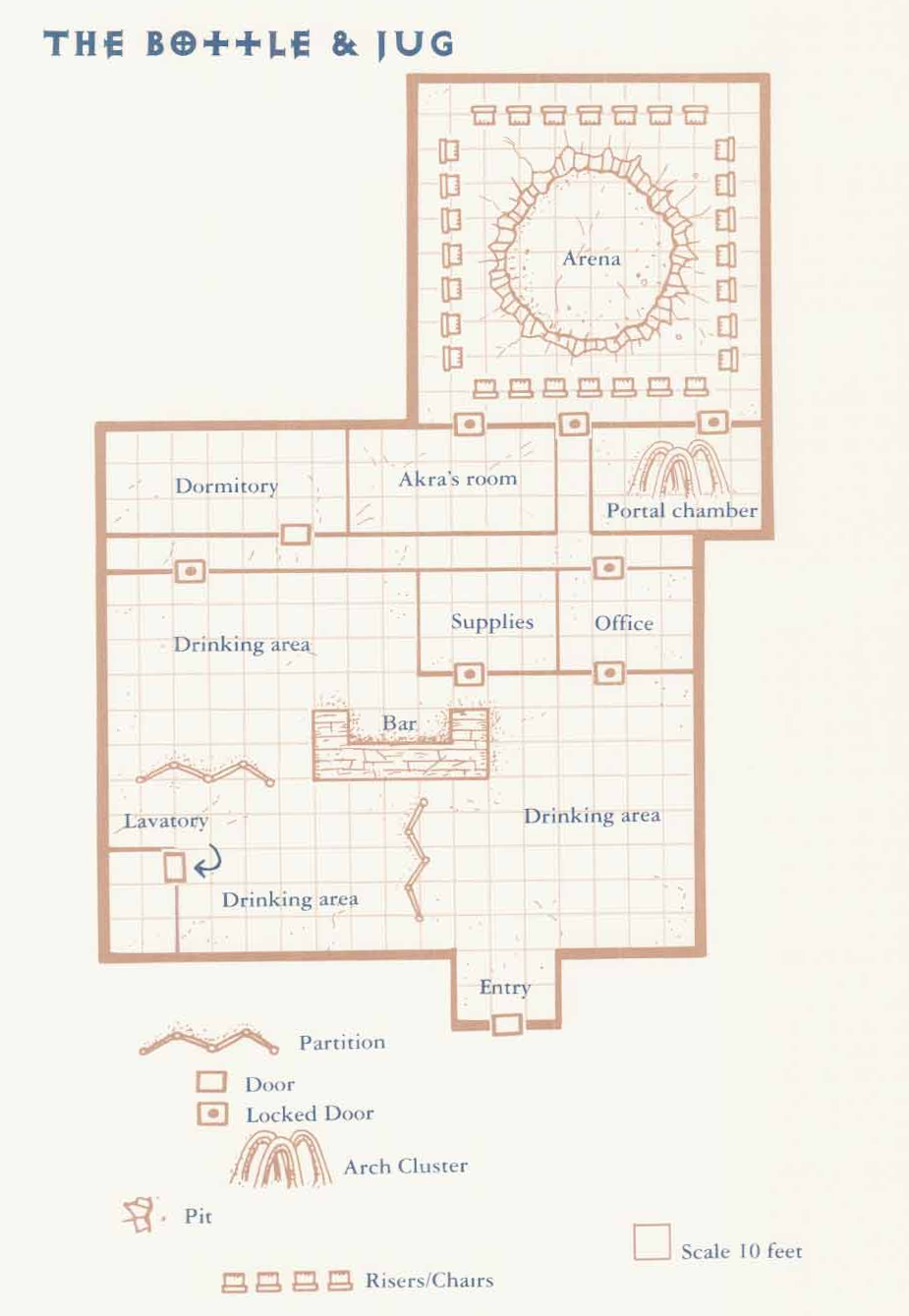
With its black granite walls, barred windows, and steel spires, the Bottle & Jug looks more like a fortress than a tavern. But it's not only one of the Hive's most popular watering holes, it's easily the most notorious. Those with jink to spend and who aren’t averse to a little blood... well, let’s just say there’s no place in Sigil like the B&J. Barl Hoxun (Pl/♂human/F5/Free League/ LN), a sour-faced cutter as big as a hull, runs the place and tolerates no nonsense; an attitude evidenced by the two snarling female fensir (Ysgardian trolls) that greet customers in the entryway. Inside, soiled red carpets cover the floor, while flickering oil lamps suspended from the ceiling keep the rooms as dark as Baatorian caves. Wooden partitions, painted with garish scenes of the Blood War, divide the main room into sections, segregating the bloods from the sods, the chest rippers from the skull crushers. A dozen more fensir, wearing black cloaks emblazoned with the B&J emblem, work as brewers, waiters and bouncers; Hoxun hires them on the basis of their innate skills with brewing and fighting.
Dirt on Dirt, that's the hive. And that's Sigil, the Outer planes, the Inner planes...
Inside the Bottle & Jug
A thick wooden door bears the symbols "B&J." A hand-painted sign announces that the tavern's hours are from 8 a.p. to 8 b.p., every day. Two fensir stand guard, refusing entry to obvious or known peddlers, vagrants, and drunks.
Movable wooden partitions divide the main room into three areas; one for first-timers and penny pinchers, one for regular customers and serious drinkers, and the third for Hoxun's friends and special guests. Two orc bartenders serve a variety of beverages, ranging from corn ale (2 cp per pitcher) to cherry wine (1 sp per glass).
Hoxun's office doubles as his personal quarters, with a brass bed, a wooden night stand, a wooden desk, and an iron lock box. He's usually here.
Two lavatories, one for patrons and the other for fensir and ores, contain an assortment of buckets and troughs (emptied hourly - more or less - by the orcs). The nonhumans' lavatory's guarded by a sleeping fensir, his head leaning against a crudely lettered sign reading "Out of Order."
Say what you will about the hivers. They've elevated drooling to a fine art.
The Gatehouse
The average Hiver doesn’t know a whole lot about the faction headquarters, but he knows where to find them and knows enough to stay away. The Gatehouse, so close to the Slags that the Bleakers can smell the rot, looks like an arched tower that's sprouted bat wings. Some swear they've seen the wings flap, but maybe that’s just the rotgut talking.
The sods wandering around outside are mostly madmen and addle-coves, dead from the neck up. Some are victims of the Mazes, which, chant has it, grow like weeds in the vicinity of the Gatehouse. Others have severed their ties with the real world, having accepted the Bleakers' creed - that all there is, is the madness that comes with inner self-understanding, that nothing makes sense nor is it supposed to - and now roam the streets spewing Bleaker babble. There's a hospital wing inside, and surprisingly it’s open to any and all comers. The Madmen don’t care what faction a berk names: If a berk needs help they're ready to give it, with a minimum of harassment. Likewise, a berk should think twice before patronizing the Gatehouse street peddlers; their flimsy daggers are about as durable as toothpicks, and the cheap booze ain't good for much aside from removing rust.
Gatehouse Night Market
A cutter wanting quality merchandise at reasonable prices from honest dealers - make that reasonably honest dealers - should go to the Market Ward. If a cutter wants to buy spider venom, hire a burglar, or sell a stolen necklace, though, then the Night Market's the place to be. Three tips:
- Don't ask for names.
- Don't ask for guarantees.
- Don't ask for change.
Say a cutter requires a service that’s not, strictly speaking, on the upland-up. No problem. He just needs to know where to go. If he wants to buy a sapphire ring, and isn’t concerned where it came from, he can go to the Night Market. If he has the urge to gamble, he can visit a dice house.
But if he needs a document - a special document - there’s really only one option, and that's Retzz (Pl/♂tiefling/Ro5/Free League/CN), a thin-lipped tiefling barely 4 feet tall who's elevated forgery to a high art. There's no handwriting or imprint that he can’t duplicate. In Retzz’s scrawny hand, a pen's more formidable than a tanar’ri death sword.
Me? I act a little, I write a little.
Though a cutter'll find Retzz to be as honest as a forger could reasonably expect to be, just finding him can be a problem. He has no permanent residence, no favorite tavern, no family or friends to keep track of his whereabouts. If a cutter makes it known on the streets that he's in the market for a little "pen work," Retzz may run him down. Otherwise, the best bet is to look for him in the Seawind Theater in the Market Ward. Retzz fancies himself a performer and often gives dramatic poetry readings under the name of "Linn Smester." He disguises himself when he performs, usually wearing a flowing black wig and dark velvet cape. A cutter slipping him a note about needing some pen work is likely to hear word within a day or two.
The tanar'ri death sword? It’s a 6-foot-long blade of red steel that inflicts a finger of death spell on anyone it touches. Since only a few show up in Sigil in any given decade, they’re nearly impossible to find. (But Retzz can supply a receipt for one.)
Retzz Who?
Green Stone Stables
Mounts in general are both very rare and very shortlived in Sigil, circumstances that make this business practically unique. At Green Stone Stables, a rickety warehouse with peeling green paint on Black Boot Walk, Bismen Yscoppel (Pl/♂human/F3/Fated/LN) rents mounts of all kinds, from riding horses (of which he has only four or five at any time) to spittle boars. Yscoppel charges bargain prices, but his animals aren't exactly top of the line. Some wobble along so slowly, they might as well have boulders in their guts. Some have spines that sag like lintels in the Slags. And some tend to drop dead in mid-stride, which ain’t necessarily a bad thing if they happen to drop near Orsmonder’s Meats.
Mounts
Orsmonder's Meats
Today's Specials
Chicken: 1 lb / 6cp
Horse: 1 lb / 5cp
Goat: 1 lb / 3cp
Cat: 1 lb / 1cp
Street meat: 3 lb / 1cp
The table to the right lists the mounts that Bismen Yscoppel has for rent or purchase. The table also indicates the maximum weight each mount can carry. Yscoppel accepts payment in coins or goods of equivalent value. (For example, he'll accept three glass bottles, valued at 10 gp each, for a horse.) In most cases, prices aren't negotiable.
If a rented mount isn't returned on time, the renter is charged the full purchase price. Likewise, if a rented mount dies, the renter must also pay the full price. Yscoppel employs three ogres to track down deadbeats and make sure they pay what they owe.
Sil Orsmonder of Orsmonder's Meats will buy a mount corpse for half the listed purchase price (a dead mule, for example, goes for 8 gp). At the DM’s option, street peddlers will offer to buy corpses for one-third of the purchase price.
| Mount | Rental Price* | Purchase Price | Max. weight** |
|---|---|---|---|
| Riding horse | 5 sp | 30 gp | 200 |
| Mule | 3 sp | 16 gp | 250 |
| Pony | 2 sp | 12 gp | 170 |
| Sand cow | 1 sp | 6 gp | 100 |
| Spittle boar | 5 cp | 3 gp | 300 |
| * Rental price is per day, payable in advance. | |||
| ** In pounds. (Note that the maximum weights Bismen's horses, mules, and ponies can carry are less than those of their normal counterparts*) |
The Hive
Parrs or the Hive - the Xaositect headquarters, not the ward - can he found within a few blocks of the Gatehouse. The headquarters itself is all over the place, a sprawl of empty tenements, abandoned warehouses, and decaying shanties. So where does the faction actually get together? Good question. Cutters should look for violet torches - the color comes from a special oil imported from Gith in the plane of Limbo - that the Chaosmen occasionally burn to alert other faction members to their presence. The interiors of headquarters units're rarely as ugly as the outsides; they tend to be grime-free and comfortable (though a Chaosman's definition of comfort might be different from the typical cutter s). Usually, each unit's got a specialty; one may be stocked with food, another with medicine, another with weapons. One holds a portal to Limbo; some say it occasionally sprouts legs and wanders the streets, 'porting away anyone in its path. (Then again, these are the same sods who say the Gatehouse wings flap.)
The Mortuary
Headquarters of the Dustmen, the Mortuary sits in one of the ward's dreariest sections, a neighborhood of empty streets and abandoned shops. The building's a duster of windowless vaults arranged around a black dome. Now and then, the Dustmen mount skulls on sticks and post them around the Mortuary to make a fence. Where do they get the skulls? From trespassers, of course. The adjacent streets are crowded with decaying taverns and gloomy boarding houses; the long shadows of the Mortuary provide plenty of cover for sods who don't want to be noticed.
Black spines radiate from the center of the Mortuary, giving the building the appearance of an immense insect. Inside its walls are Interment chambers paved with black flagstones, a memorial hall where bodies of notables lie in state, and a vast network of catacombs containing countless portals. How to get inside the Mortuary? Garnishes or bluffs might work. Resourceful berks might try to sneak in or play dead. The best bet, of course, is to be dead.
Life is grand in the Hive. It is like a funeral that never ends.
Scratch Wall
| symbol | meaning |
|---|---|
| XXO | No stag-turners |
| OXO | Blood with muscle |
| OXOXO | No peelers |
| OOXX | Cool jink for hot junk |
| XOOX | If you ain't ready for the dead-book |
| XXOO | Bye-bye, berk |
On the border of the Slags, not far from Allesha’s Pantry, stands a stone wall nearly a block long and as tall as a storm giant. It’s all that's left of a protective bulwark, smashed to pieces when the Blood War threatened to spill over from the Slags into the rest of the Hive, (See "The Slags," below.) The wall, made of a soft black stone from Gehenna, has proven to be an irresistible lure for every berk with a chisel or a piece of chalk and something to say. Embarrassing poetry ("When I get to Elysium/ I'll bring peace to 'em"), questionable boasts ("Mighty Queten killed him ten barghests before he could walk") and inane declarations of love ("H.F. would follow M.C. into the Abyss just to see her smile") cover just about every square inch of the wall.
For a basher with a few hours to kill, it makes for interesting reading. And the basher who looks close enough might pick up some useful information. For instance, near the bottom left corner of the wall, some sod has carved several sets of Xs and Os. A comment accompanies each set. This isn't the carver's idea of an: it's a list of house marks provided as sort of a courtesy to newcomers. What do the marks mean? Apparently, whoever put ’em up there figured that a basher who wants to know badly enough'll find a way to figure 'em out.
had never been inside one of these pitiful dwellings until I accepted the invitation of a friendly beggar woman named Ennis. A rickety stairway, the bannister having long ago been used for firewood, led to gloomy chamber the air of which was heavy with the odor of cooked carrots and a meat I could not identify. At least a dozen persons stood shoulder to shoulder in the tiny room, bowls in hand, too weak to speak. A shivering girl huddled in the corner, ribs protruding from her ragged gown. A boy curled near her feet, gnawing on a bone like a dog.
Ennis eased her way toward the soup kettle, then tossed in a handful of cabbage she'd found in the street. The boy with the bone pawed at her feet. She kicked at him, and he scuttled back to the corner, whimpering at
The Slags
The most miserable section of the Hive Ward - after the Hive itself, that is - is the Slags, an endless expanse of gray ash, raw sewage, and smoldering debris. Streets strewn with bones wind past mountains of bricks and nibble. Rats nest in tangles of razorvine. Spiders scurry in crevasses so immense that a basher might think a power had hacked up the ground with a meat cleaver.
Hard to believe that the Slags used to be like everywhere else in the Hive, a jumble of shacks, shops, and shoulder-to-shoulder sods. That was before that one little intrusion, one little aberration in which the Blood War seemed to spill into Sigil. In a matter of weeks, the place was crushed like a roach under a boot. Leastways, that's the chant. It explains lots of strange things in the Slags, like Scratch Wall. Kadyx, and the Prime Material vortices. Anyhow, the chant goes like this....
A few millennia ago, a portal the size of a tenement opened up smack in the middle of the Slags. Within days, a horde of abominations began pouring through - leathery skeletons with horns sprouting from their skulls, dog-faced monstrosities with pincers and bat wings, flame-enshrouded titans, humanoid insects, slime-spewing frog creatures. The skeletons attacked the insects, the dog-faces slaughtered the frogs, and the neighborhoods of the Slags became their battlefield. And woe to anyone who got in their way - for every insect and dog-face that bit the dust, a dozen Hivers went, with them.
So what was all the fighting about? The portal linked the Hive with a Blood War battleground, where the tanar’ri and baatezu have been at each other's throats since time began. The tanar’ri leaders got it into their heads that the portal was a gift from one of their two-bit powers. The portal allegedly led to some fantastic magical weapon in the Hive, so off went the tanar'ri in hot pursuit. When the baatezu leaders got wind of this, they rallied their armies and followed the tanar’ri into the Hive; they wanted the weapon, too.
The tanar'ri and baatezu spent the next six weeks tearing each other to pieces while looking for a weapon that, of course, didn't exist. By the time they figured this out, broken stone and dead bodies were all that remained of the Slags. The portal began to recede about the same time both armies decided they'd had enough. They abandoned the Hive as fast as they'd arrived.
The portal’s gone now, and except for a few stragglers, the armies’re gone, too. Left behind were hundreds of casualties and a community reduced to a junkyard. The magical forces employed by the invaders permanently disrupted the landscape; continual earthquakes make rebuilding an exercise in futility. Left-bebhinds include gangs of flesh-eating vargouilles and slobbering dretches.
And then there’s Kadyx, a creature developed by tanar'ri wizards to drive out the baatezu. But after dragging him all the way to the Hive, turns out they couldn't use him 0 too uncontrollable. And they couldn't take hint back to Carceri - too dangerous. So they left him in the Slags, where he remains today.
The tanar'ri (or whoever) didn't name him Kadyx. That's what the sods call him, for lack of anything better. Aside from the glimpse of a claw and the flash of a scale, nobody’s ever gotten a look at him, so nobody knows exactly what Kadyx is.
What they do know, however, is that Kadyx's got a big appetite (he apparently eats anything that breathes) and a sense of humor. Not tong ago, for instance, a flock or migrating aarakocra made a wrong turn and wound up in the Slags; Kadyx collected their heads and arranged them like eggs in a nest of weeds. A paladin in a full suit of armor decided he'd do the Hivers a favor and put an end to Kadyx: a basher found the suit of armor, all nice and shiny, with the paladin's skeleton inside.
Fugitives and barmies who fear Kadyx less than they do the law sometimes hide out in the Slags. Wizards scavenge the ruins for spell components. Dustmen scrounge for corpses. But is there any reason why ordinary cutters'd risk their necks in the Slags?
Yep. Two reasons, in fact.
First, as another consequence of the Blood War's disruption, the Slags occasionally give rise to vortices that serve as openings to the Prime Material Plane. Though they don’t last long, maybe a day or two at most, they’re easy to spot, appearing as swirling spirals of red mist.
Second, the tanar'ri troops hid dozens of emergency supply caches in the Slags. Some hold worthless tanar’ri rations, but others contain weapons, treasure, and magical items.
Supply caches resemble black sandstone cubes, about 6 feet per side. Observant cutters might notice the corner of a cache protruding from the ground or a pile of rubble. Otherwise, they might learn the location of a cache from a friendly sod or a map discovered on a corpse. Cutters lucky enough to find the right caches could he set for life - assuming, of course, they avoid the booby traps.
Hey, I got an idea! Let's head over to the slags and look for kadyx!
Weary Spirit Infirmary
Unlike normal persons, the residents of the hive are too dim to take care of themselves. Place a serpent and worm in a flame: the serpent crawls away. The worm burns to death.
A sick cutter or busted-up basher has few choices if he wants to get better: He can hole up in his kip and hope the powers repair him, or he can cough up some jink and hire himself a healer. Otherwise, he can lie down in the street and die, or head to the Weary Spirit Infirmary, the Hive's free hospital. Both these last choices are poor: either way, the basher's dead, but he’ll probably suffer a lot less in the street.
Its brick walls encrusted with dirt, its windows barred with iron rods as thick as a man's arm, the Weary Spirit looks like a prison - which ain’t too far from the truth. Not surprisingly, the Weary Spirit has difficulty attracting patients, so hot meals and free treatments are used to lure the unwary. The Honorable Kluppin Livesay, the judge at the Hive's central court, also sentences criminals to the Weary Spirit for "rehabilitation": the staff attempts to convert them into productive members of society with skull drills, brain needles, and shock therapy (for the hard cases).
Shunning magical healing in favor of experimental surgery, the infirmary staffs got the same relationship with its patients as cats have with mice. Flaying with their prey before killing it lessens their inhibitions. The staff is brutal, sloppy, and indifferent to pair (whether their own or someone else's). If a patient dies on the table, no matter; there’re plenty more in the waiting room. Treatments include bleeding, amputation, and bone-straightening, the latter a cure-all prescribed by Ridnir Tetch, the man in charge, for everything from fevers to intestinal upset.
It's doubtful that a Bleaker would be anyone's first choice for a healer. After all, a basher who believes the secret of the multiverse to be that there is no secret, that the madness that comes with complete acceptance of this meaningful meaninglessness is the meaning inherent in it - well, he's not the kind of person you want tinkering with your innards.
Ridnir Tetch (Pl/♂human/C9/Bleak Cabal/NE) not only qualifies as a certified innards tinkerer, he’s also a Bleaker through and through. As chief of the Weary Spirit Infirmary, he oversees treatment for dozens of ailing sods every month. And as far as anyone knows, he's never lost a moment's sleep over any of them. Empathize with a mugging victim? Shed a tear for a dying old man? Not Tetch. Like a mean little kid who pulls the wings off flies just to watch them flop, Tetch loves to prod, singe, impale, carve, and crush his patients just to see what happens. If they get better, that's fine. If they don't, that's fine, too. Tetch always has some new techniques to try. And he has plenty of flies.
Because his parents were killed by an incompetent cleric when he was a boy. Tetch has no use for magical healing. He believes that all disorders can be corrected by manipulating the body. It’s just a matter of figuring out which part to cut off or stretch, or where to drill the holes. Rumor has it that Tetch is financed by wealthy Takers from the Clerk’s Ward, who hope to profit from any medical breakthroughs he happens to stumble upon.
Tetch stands nearly 7 feet tall, as thin as a straw, with a mop of greasy blonde hair and eyes like black peas. He wears a blood-stained smock that he refuses to dean: he considers the grime to symbolize his years of experience. He speaks in a whisper, and unless he’s trying to coax a reluctant patient into an examination room, he never smiles.
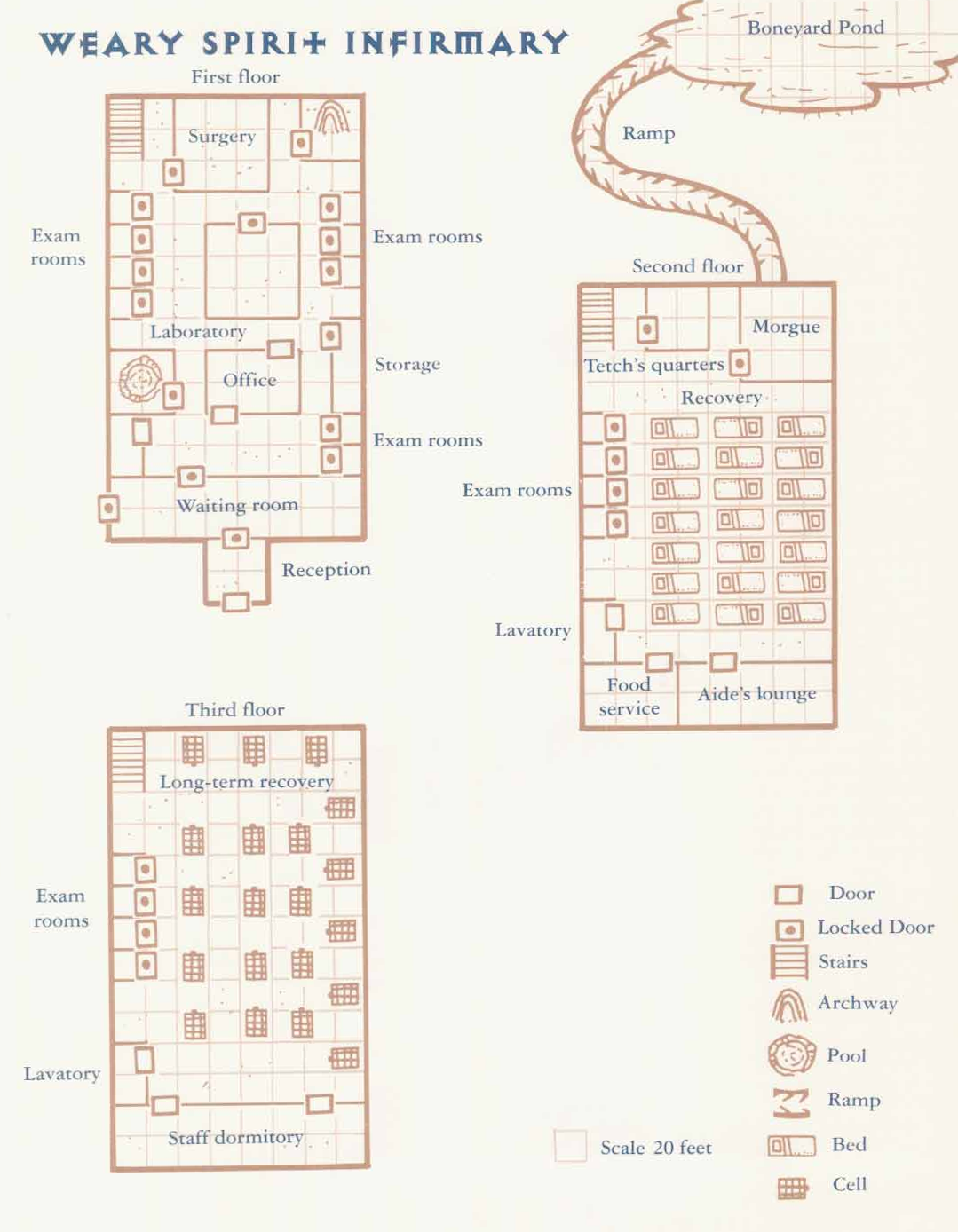
The three-story infirmary sits in the middle of Whisper Way, halfway between Allesha’s Pantry and the Butcher's Block. First-timers to the Hive should make note of the location. If one of their buddies turns up missing, there's a good chance he may have been "admitted" to the Weary Spirit.
Life is too hard to be softened by tears.
Inside the Weary Spirit Infirmary
The infirmary's made from gray granite blocks, the floors covered in black ceramic tiles smudged with scuff marks, iron rods bar all the windows, and iron strips reinforce the doors.
The most attractive room in the infirmary. The foyer boasts oak-paneled walls, a polished tile floor, and a smiling half-elf steward seated behind a white marble desk. He interviews incoming patients, then relays the information to Tetch via an administrative aide. Generally, only dangerous felons, extraplanar creatures of unknown origin, and Tetch's enemies are refused admittance.
The waiting room stinks of the sweat of dozens of patients sprawled on the bare stone floor. A body could wait a full day or more before being shown to an examination room. Patients who die while waiting are carried through the west doors and dumped near the street for the Collectors to pick up.
A pit 20 feet in diameter filled with brown water serves as a bathing pool. Filthy patients are required to bathe before they're taken to an examination room. Aides occasionally refill the pool with water from Boneyard Pond.
the patient, a young man barely out of his teens, shrieked for his life as the healer's aides strapped him to the operating platform. "You!" cried Tetch, pointing in my direction. "We need your help!" Before I could protest, he placed a thick rope in my hand, the opposite end tied to the young man's wrist. "Now pull!" Tetch commanded. We did as we were told, pulling the rope while the young man continued to scream. This, a treatment for stomach cramps? I wondered, and then the rope gave way with a pop. I flew backward, slamming against the wall.
A month later, I chanced to encounter the young man on a quiet side street. But before I could inquire about his health, his eyes widened in recognition. He turned and ran, his empty shirt sleeve flapping in the wind as.
Why Suffer?
End Your Torment at the
Weary Spirit Infirmary
Skilled healers provide services to all at no charge.
Fully equipped,
modern techniques,
respectful care.
Free Beds Free Meals Free Baths
Patients admitted daily.
Open all hours.
No appointment necessary.
Some waiting
Patients are examined in small rooms, each containing a wooden platform covered with a frayed blanket (for the patient) and a wooden stool (for Tetch). A small wooden cabinet in each room contains knives, probes, and other tools. In the corner sits a bucket of water and a stack of rags for mopping up blood.
Wide wooden tables filled with dissection equipment and human bones dominate the laboratory. The west wall holds shelves filled with jars containing brains, hearts, and other organs. Shelves on the east wall contain iron cages of rats and frogs. Tetch practices surgical techniques and performs autopsies here.
In the surgery chamber, patients are strapped to a raised stone platform. Tetch ties thick ropes (looped through iron rings imbedded in the walls) to the patient's limbs, then pulls 'em tight to "straighten" the bones. A wooden table holds his razors, needles, drills, and knives. Next to the table sits a basket of raisins, his only nourishment during surgical marathons. (Chant’s that someone once exchanged the fruits for dead flies; Tetch didn’t seem to notice, or if he did, he didn't care.)
Tetch has an arrangement with Orsmonder's Meats to receive 50 pounds of leftover meat (of Orsmonder’s choice: horse, cat, dog, rat, etc.) every day; he pays half the normal price. From this questionable provender, staff cooks prepare meals for patients and workers alike.
Tiny holes drilled in the recovery room aides' lounge allow staffers to observe and make fun of the people in the waiting room below. Most of the aides are humans of no higher than 1st level. Six aides work during a typical 8-hour shift.
Recovery at the Weary Spirit means lying on a bed consisting of a bare wooden platform with a pillow made from a bunch of rags, under a sheet the size of a towel. (Well, all right - it is a towel.) Most recovering patients are restrained with ropes, leather straps, or iron chains (for their own safety, of course).
Tetch’s personal living area's furnished with a brass bed with a wool quilt and a feather pillow, a polished oaken desk, a marble bed table, and rows of wooden shelves. The top drawer of the desk contains a duplicate set of keys for every door in the infirmary. (Tetch carries another set with him at all times.)
Aides stack the bodies of deceased patients in the morgue. Once a day, Tetch examines the bodies and marks their foreheads with charcoal; bodies with one slash are returned to the lab for further study. Aides slide "two-slashers'' down a long wooden ramp into Boneyard Pond. Occasionally, a corpse catches on a splintered section of the ramp ; an aide's got to climb down to free the corpse, then climb back up to the morgue's window.
The fetid pond, about 150 feet in diameter and 30 feet deep, is filled with brown rainwater and the remains of countless corpses. Local sods sometimes approach gullible out-of-towners and offer to dive into the lake and recover treasure for a fee of 1 gp, payable in advance. The sod dives in, slips through an underwater passage, and hauls himself out on the other side, leaving the out-of-towner to assume the poor sod must’ve drowned.
None is so poor as he would not be rich or so rich as to not be poor. Or vice Versa.