Travelling the Multiverse
Source: Planewalker's Handbook pg. 34
Planewalking implies movement, and for good reason. Most bloods don't stay in one place too long. Multiple lifetimes worth of sights wait on the planes, along with treasures to gain, secrets to learn, and adventures to undertake.
For every site, there’s a way to reach it - whether it’s by portals, gates, spells, conduits, vortices, magical items, or more esoteric means. A few planar creatures and beings can simply travel the planes at will; most require some external impetus.
It’s important to remember that even to an experienced planewalker, how a body gets from plane to plane isn’t as important as what she does once she arrives. Whether she travels to a place via a portal, a cubic gate, a conduit, a plane shift, or simply by following the Great Road, her main concern should be how she’s going to survive once she’s there - although it’s not a bad idea for her to spend a moment thinking about how she’s going to get back.
Conduit, Portal, Vortex . . . Who cares? It gets me there, right?
Portals and Gates
Originally (a long time ago), the term “portal” referred only to a doorway leading to and from Sigil itself. This distinguished portals from gates, which were any magical links between two areas. If one end of the link wasn’t anchored in the Cage, then it wasn’t really a portal, it was a gate. Nowadays, “gate” and “portal” are virtually interchangeable terms. A few people stick with the strict original definitions, but most see no reason to do so. The portals of Sigil work in the same way as gates everywhere else. Planewalkers rarely make the distinction and use both words, except the doorways are always called portals when found in Sigil and always called gates when found in the gatetowns of the Outlands.
Another point of disagreement among planars revolves around where a portal can be found. Some sources say they’re found only in doorways, at least in Sigil, but bloods know that they can exist in any archlike opening or hounded space. Examples include holes, windows, arched roof supports, sewer grates, barrel mouths, and hatches. When activated, portals remain open for only a limited time (except for the permanently open gates on the Great Road and a few other paths, as noted below). Also - again with a few notable exceptions - portals and gates always require a magical key to activate them. So here’s as good a definition of a portal or gate as a body’s going to get: a doorway that must exist within a bounded space, is open for only a limited time, and requires a key. Other methods can take a planewalker from one plane to another, but they’re not technically gates or portals. (They might still be called gates by those who aren’t hung up on nitpicky terminology, though.)
Portal travel has two tricks: finding the portal and determining its key. No, make that three tricks (as per the Rule of Threes, of course) - the third is determining what’s on the other side and figuring out how to survive there.
Portals - Those blessed little holes in the fabric of the Planes. They're a thief's best friend, a planewalkers livelihood, and a record-keeper's worst nightmare.
Finding and Opening Portals
Portals are usually found in a fairly distinct arch or doorway, especially in Sigil. The arch can be hard to find, though; sometimes the branches of two trees form an archlike aperture that can be activated as a portal. Or the portal might be a cave mouth, the underside of a bridge, or between a statue’s legs. At least portals are usually man-sized, so a body doesn’t have to worry about squeezing through. Most portals are also nonmobile, although plenty of exceptions exist (barrels, wardrobes, chests).
Planars can detect portals naturally with a Perception check when looking. This ability doesn’t grant the knowledge of gate keys or where a portal goes. Magical true sight or warp sense also reveal a portal’s existence warp sense can determine the key, as well). A body can only see portals that’re actually there, though. Sounds like an addle-coved thing to have to say, right? Well, think on it a minute - portals can shift and fade, and if this happens, the portal isn’t there anymore. A portal’s either there or it ain’t, and if it’s there, it can be detected. If not, it can’t. An active portal is one that’s been opened by a key (rather than just being there), but a portal doesn’t need to be open to be detected.
Once a portal has been found, a planewalker still has to discover its key and (unless she’s a real addle-cove) where it leads. To learn the right key, a basher’s got to use warp sense, or she’s got to know who to ask. Spells like legend lore and contact other plane can help reveal a gate's destination as well.
A gate key isn’t always obvious, either. Usually it’s an object, like a bone, a flower, a spoon, or a boot. Sometimes the key is a singular object, such as a specific dagger. Occasionally it’s one of a general group of things, such as any wine glass. At still other times, a gate key is a far more esoteric thing, such as a word, a gesture, a musical note, or an emotion. Gate keys often relate to, or at least suggest, the destination plane of the portal. It’s not always that easy, though.
Activating a portal with a key isn’t an exact science. Usually, a body simply has the key in her possession, and walks through the gate. Sometimes a key must be physically used in some way, such as holding it forth with a particular attitude or touching it to the gate a required number of times. Obviously, if the key’s a word, sound, action, or thought, it must be performed accordingly. A basher doesn’t even have to want to activate a portal. If she’s got the key and uses it (inadvertently or not), the portal opens. Sometimes the berk with the key doesn’t even have to be the one who goes through the portal, although most of the time (especially when the key’s an object) the key must be carried through the portal by the first person going through - that’s the action that activates the gate in the first place.
Once a portal’s been activated by the key, it crackles with energy or some other visible effect that anyone, prime or planar, can see. Further, if a body looks closely, the destination can be seen through this open gate, at least as a faint outline.
Well I suppose you could try to ride out of town, sir, but first, you'd have to find a horse - then, you'd have to find a portal big enough to ride through.
As stated above, the portal stays open for just a few seconds, usually long enough for six (or so) individuals to pass through it. If a berk hesitates, he might not make it through.
It’s also a possibility that he might get caught passing through as the gate closes. What happens then? He gets thrown one way or another out of the portal - a body can’t exist in between. There’s a 50/50 chance of being tossed to the portal’s destination or back to the starting point. As a barmy Cager game, some bubbers activate portals and jump in just as they close, wagering on whether they’ll go through or not.
A portal’s always in an enclosed space, like a doorway, right? Well, every doorway has two ways to cross through it - that’s what makes it a doorway. Some activated gates can be entered from either side. If a tavern’s doorway in Sigil holds a portal to Acheron and a leatherhead with the key activates the portal from outside the tavern, some bubber stepping out of the tavern through the doorway at the same time might find himself on Acheron (poor sod). A body needs to take a modicum of care when he activates a portal — not a few addle-coves have ended up on planes they didn’t want to be on because they didn’t use a gate correctly or carefully (or they didn’t know they were using a gate at all).
Finally, note that spells such as hold portal, knock, wizard lock, and the like have no effect on portals at all! Only spells created specifically to deal with planar portals - such as Gate Seal and Warp Sense - have any effect on portals.
Portal Types and Destinations
To further complicate matters, it’s a fact that all portals aren’t permanent. Some temporarily appear or disappear. Some change their keys. Shifting portals move one (or both) ends to different locations at different times, either following a set pattern or simply changing randomly. Many bashers make their living by mapping the patterns of shifting portals and selling the logs to planewalkers, but some just have no pattern at all.
Portals can be one-way or two-way. One-way portals offer travel in one direction only, so a body going through a one-way portal to any given plane has to find another way back. Two-way portals provide transportation to and from a given point, and often require a different key for each way of egress.
In Sigil, most portals are two-way, and many require the same key both ways. The Lady of Pain has complete control over the portals in the Cage, closing or opening them as she desires. Further, she prohibits any other means of leaving or entering Sigil. Sometimes she creates new portals where none existed before, and changes the destination point of others at her whim. Whether powers out on the planes can do this to gates as well is unknown. It is clear that no power can enter Sigil by any means - the Lady keeps ’em out.
The portals on the Great Road, the World Ash, and Mount Olympus don’t need keys to open them. They are, in a sense, always active. The gates on the Great Road, due to their usefulness, become centers of commerce and sometimes military strategy. Towns and military camps often form near or around them. Occasionally some local leatherheaded lord claims to own one of the gates and sets up guardians or even walls around it.
Specific Portal Dangers
If a body finds a gate to the Astral Plane, he should expect trouble on the other side. Portals leading to the Astral have a way of grounding themselves in or near githyanki fortresses. In fact, portals generally tend to ground in solid, often occupied areas, and civilization springs up near them by their very nature. This doesn’t mean that all portals move - bar that. It just means that if a portal leads to a particular plane, the specific site of arrival’s usually in a civilized area with the most stable terrain possible.
Due to Limbo’s fluctuating nature, portals to that plane are rare, and their locations constantly change as the archways supporting them morph, change, or disappear altogether. Established gates on the Lower Planes often serve as staging grounds or common battle sites for the Blood War. A wandering berk can accidently find himself in a yugoloth camp by stumbling through a portal on the dark portions of the Great Road.
Planewalkers using one-way portals always run the risk of stranding themselves on the destination plane. Canny cutters know that this is particularly true for one-way portals to the Prime. Some prime-material worlds don’t have many portals. A few practically have none. A planewalker finding himself hipped in such a locale... won’t be a planewalker any longer.
Portal Tricks
Naturally, planewalkers have learned a few tricks to bypass or take advantage of some of the restrictions related to portal use.
Peeking Through. Normally, folks can’t simply stick their heads through a portal and pull it back to see what’s on the other side. Once a body puts part of herself into a portal, she’s committed and can’t pull anything back through. Why? Well, lots of portals only function one-way. They allow a berk to pass through, but not return. Further, many two-way portals require separate keys depending on which direction a traveler passes through the gate.
But if a planewalker has both required keys for a two-way portal (or if only one key is needed for both ways), then it’s possible for her to peek through (by sticking her face through enough so that her eyes appear on the other side), stick a finger in to test the temperature, or otherwise put part of herself into the gate and bring it back.
Pushing Someone Through. A sneaky way to get rid of an enemy or a troublesome berk: Subtly plant a gate key for a one-way portal on the rube and push or trick him through the portal. He can’t return unless he’s got the ability to travel the planes on his own. This is sometimes known as “peeling someone through a gate.” or even "hipping a rube."
Sneaking Through. When a portal activates, it stays open for a few seconds. The amount of time varies for each portal, but it’s never shorter than one or two seconds and never longer than 10 (unless it’s permanently open, or an otherwise exceptional portal - every rule gets broken, as all planewalkers know). Still, that’s usually enough time for a quick spiv to leap through the portal. This means that a body can wait near a portal and dive through when someone else brings the proper key. Invisibility works well here, so that the cutter can slip through unnoticed. Otherwise, the sneak has to deal with those he traveled with (uninvited).
If a portal is two-way, and the same key activates both directions of egress, a body can even wait on one side until a bunch of berks come through from the other side and then slip past them, assuming he doesn’t bump heads with someone as they cross over.
A few Exceptions
If a body searches long and hard enough, he’ll certainly find exceptions to the general rules defining portals as explained above. Portals without keys, not enclosed in a bounded space, or permanently open (or all of the above!) aren’t outside the realm of possibility - after all, it’s an infinite multiverse, full of infinite possibilities. But these exceptions are certainly far rarer and probably more dangerous than a cutter wants to bother with.
For a closer look at a specific exception, curious planewalkers can jaunt onto the prime-material world of Toril. As noted previously, Toril holds a great number of keyless gates leading to various planes. These artificially created portals were constructed using a high-up mage spell called worldwalk and some kind of permanency magic - which, by all rights, should be impossible. After all, mortals can’t create permanent gates, right? And if they can, then why doesn’t some enterprising blood set himself up in the portal-making business?
Simply put, it doesn’t work - not out on the planes, anyway. Somehow, the process that produces those Torilian portals just can’t be recreated. It's a peculiarly Prime-specific spell, or maybe even a Toril-specific spell (not an unreasonable assumption, as the power that oversees magic in that crystal sphere is a particularly generous one). Planewalkers are simply stuck with the inconveniences of portals and keys, or with the other traveling methods described below.
Spells and Magic Items
If a cutter can cast spells enabling travel from plane to plane, she’s well ahead of the game (so to speak) as far as getting around is concerned. Planewalking is much easier if a body can make her own paths. These high-up spells include Astral projection, Plane shift, gate, and even word of recall Many magical items allow planar travel, not the least of which include the amulet of the planes, cubic gate, and the staff of the magi.
Regardless of the method, though, spells or magical items won’t take a body in or out of Sigil. A sod still needs to find and use the right portals to get there (and to leave). Without exception, the Lady of Pain's control of travel to and from the Cage is absolute. This means that fiends and the like are safe from gate spells and summonings there quite a boon if they desire uninterrupted peace. They also cannot be banished by any means. The benefits of staying in Sigil encourage fiends to behave while they’re there.
Lastly, it’s worth pointing out that the spells and magical items mentioned here aren’t actual gates and portals in the strictest sense. Only an archway-bound doorway activated by a specific key is a portal or gate. Anything else is a magical interplanar transport, but not a gate or portal. So a gate spell is not truly a gate at all - it doesn’t need a key, and requires no arch. But terminology quibbles are for scholars, not planewalkers.
Conduits
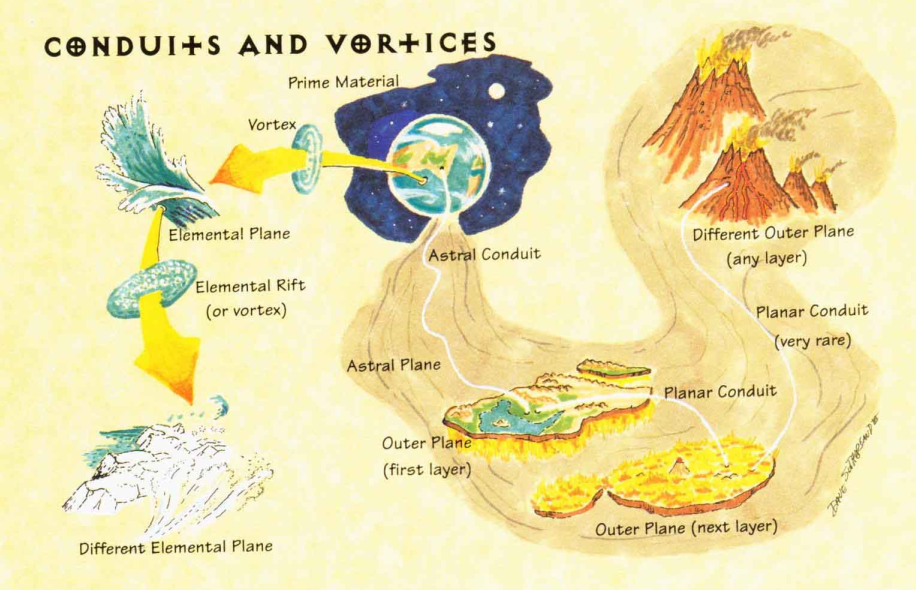
Looking for another way off the Prime Material Plane besides dealing with portals and spells? Search for a conduit. Astral conduits tunnel through the Astral Plane, leading from the Prime to one of the Outer Planes. They only touch the topmost layer of any given plane, as only these layers border the Astral. Conduits seem as instantaneous as portals and gates, but planewalkers who’ve been on the Astral know that conduits are infinitely long, wispy tubes that stretch through that plane. These arterylike passages whip, twist, and writhe about the Astral, making them hazardous to approach.
Although it happens extremely quickly, bashers who use astral conduits physically travel through these tubes to reach their destination. This fact is important because some astral monsters, storms, and certain spells can interrupt the natural workings of a conduit and grab a body as he moves through it. In the Astral, a conduit makes a vibratory hum as it’s being used, alerting anything nearby. Further, although conduits constantly weave and ebb through Astral space, they buck even more wildly as a body passes through them. These signs tell inhabitants and travelers on the Astral when a conduit's “occupied,” giving them an opportunity to interfere if they wish (and are able to affect the conduit). Despite the danger of interference, however, most conduit travel is perfectly safe. Fact is, it happens so fast that berks mistake it for instantaneous transport, not realizing they’re made a long trip.
The difficult pan of using a conduit is finding one in the first place. Invisible on both ends to normal sight, it’s possible - even common - for things to get drawn into them accidentally. (With a spell like true seeing , a conduit appears like a smoky mirror or a reflective cloud.) This explains the presence of some prime-material monsters on the planes and planar creatures wandering the Prime, especially in the case of young conduits (see below). But because they do move and are hard to find, it’s highly improbable that any primematerial town will be invaded by conduit-traveling fiends.
Further, there’s no way to peer through the conduit or to predict where one leads without a spell or magical item designed to do exactly that.
Those in the know refer to conduits by their age, since their age determines their stability. Young conduits only work in one direction — they dump a body on another plane with no way back. Young conduits aren’t yet fully stable, and sometimes one or both ends move or shift slightly — not to another plane, but to another location on that same plane. Mature conduits remain firmly anchored at both ends, offering two-way passage between two set points.
Rare in the extreme, ancient conduits once again become unstable, causing them to shift and eventually even fade completely. The conduit ends ground themselves randomly, making them unreliable at best. Thing is, a body can’t tell the age of a conduit just by looking at it, so using one may become more of an adventure than a berk expected.
Conduits usually begin and end in unoccupied spots in the middle of nowhere. In one instance, a mature conduit was found linking the Prime Material and Elysium. A bunch of primes set up a small trading village around their end, and some folks on Elysium did the same. After a year or so, however, the conduit moved. It appeared miles away on the Elysium end and on an entirely different Prime world on the other end. Folks figured that the occupation and activity around its ends (or maws, as they’re sometimes called) repelled it somehow. In any case, the tendency for conduits to ground in unoccupied territory means that a planewalker can be fairly sure that if he leaps into a conduit, he won’t end up in the middle of Dispater’s palace.
Those bashers who care, like the Guvners, theorize that while somebody - probably a power or some such - put all the portals and gates in place, the conduits formed naturally. Perhaps they’re some normal outgrowths of the Astral Plane, or just simply proof that the planes were intended to be connected and interrelated. A more oddball theory suggests that conduits are alive in some sense - although they certainly ain’t organic. This’d explain their maturation, since they seem to age like living creatures. Whatever their origin, conduits are fairly stable in general, and so maps of some of them can be bought in Sigil and other locales. The accuracy of the map depends on the trustworthiness of the seller, of course, but a great many conduits have been reliably documented and recorded.
Although conduits don’t require keys (which is certainly a relief to weary gate-key-seeking planewalkers), their use is limited as astral conduits link only to the Prime Material Plane. A body just isn’t going to find an astral conduit leading from the Beastlands to Mechanus. If a basher knew the location of an astral conduit to the Beastlands and another to Mechanus, however (assuming that they were either two-way conduits or one-way the necessary way), he could travel from the Beastlands to the Prime and from there to Mechanus. Unfortunately, this plan requires a trip through the Prime Material Plane, which isn't always easy or quick. If the conduits are really far apart - like on different crystal spheres — a planewalker might have to travel on a special craft called a spelljammer to reach it. And not all prime-material worlds are even aware that other worlds exist, or have spelljamming technology...
A few planewalkers tell of conduits that branch, the passages they create splitting off one or more times as they meander through the Astral. This means that if two bashers use the same conduit, they might end up in different places, and probably on completely different planes. Such reports have never been confirmed, however.
Planar Conduits
Aside from the fact that planar conduits link different layers of the same plane, these* re just like astral conduits: invisible clouds of reflective haze connected by a wispy tube (which is also invisible unless true sight magic is used), just like those described above. Planar conduits can be young, mature, or ancient, and they usually terminate in isolated locales.
Sometimes travelers believe planar conduits to be keyless, always-active portals. Other times, they appear on paths and take a berk to the next layer without his knowing that he even jumped layers. Portal, path, conduit - in the end, there’s not much difference, so it probably doesn’t really matter what they’re called.
Now, here’s a fact that starts to drive people a little barmy. A few conduits - in defiance of all natural laws - actually seem to connect different layers of different planes. It’s said that on the 492nd layer of the Abyss, there’s a mature conduit that leads to the first layer of Ysgard. This fact seems to slap the previously mentioned rules governing conduits right in the face. Well, it's things like this that keep the scholars of the planes busy. No one knows why a few exceptional conduits seem to fly right in the face of the laws thought to bind them. A Xaositect or a Bleaker, of course, would see nothing wrong with this, but the exceptions confound folks who expect to see order in such things.
One explanation is that these aberrant conduits are actually a series of linked planar and astral conduits that take a berk from a deep layer of a plane to the upper layer of a plane, from there to the Prime Material, then into another conduit to the upper layer of the destination plane and down a planar conduit to the ending layer. No one knows exactly how these linked, consecutive conduits are supposed to work. The idea of consecutive conduits arose from the discovery of a conduit that was originally thought to lead from the Elemental Plane of Fire to the first layer of the Abyss (obviously breaking the rules). It actually was an elemental vortex connecting the plane of Fire to a spot on the Prime Material where a young astral conduit had formed linking the Prime and the Abyss.
Vortices
Vortices directly connect the Elemental Planes and the Prime Material. Planewalkers usually avoid using them for transport, however, because they tend to form in inhospitable locales directly related to the element of the plane they connect to. A deep volcano's crater might hold a vortex to the plane of Fire, while a vortex to the plane of Air might be many thousands of feet above the surface of a world.
Most vortices lead to one of the four major Elemental Planes (Air, Earth, Fire, and Water); while not common, these are both permanent and stable. The Para- and Quasielemental Planes don't sport permanent vortices. The arctic poles of some Prime worlds occasionally beget vortices to the plane of Ice. A terrible thunderstorm on a Prime world might contain a vortex to the plane of Lightning at its heart, hut it disappears when the storm passes. A vortex to the Quasielemental Plane of Radiance might be found only within a sun as it blazes within a crystal sphere. It's said that vortices to the planes of Magma and Ash sometimes overwhelm and briefly usurp vortices that normally lead to the plane of Fire, adding further danger to their use. Likewise, vortices to the Quasielemental Planes of Dust and Mineral may temporarily take over vortices deep underground that normally lead to the plane of Earth.
| Vortex to | Where Found | Occasionally Usurped by |
|---|---|---|
| Air | Cloudy heights | Steam |
| Earth | Mountain hearts | Dust, Mineral |
| Fire | Volcanoes | Magma, Ash, Smoke |
| Water | Ocean depths | Salt, Ooze |
| Ice | Arctic poles | - |
| Lightning | Storms | - |
| Radiance | Sun | - |
| Vacuum | Unknown | Unknown |
| Positive Energy | Unknown | Unknown |
| Negative Energy | Unknown | Unknown |
Vortices don't require keys, and they're always active. They’re also extremely simple to use, once a basher’s protected from the appropriate element. A traveler enters an area of the corresponding element on the Prime Material. He moves deeper and deeper into that element (into the very heart of a volcano, for example, so that lie’s surrounded by lire) until all of his senses can detect only the singular element. At this point of the extreme, he moves into the appropriate Elemental Plane.
It’s almost assuredly vortices that are responsible for the appearance of creatures such as xorn, water weirds, and salamanders on the Prime Material, for all vortices work both ways. A vortex is completely indistinguishable on the elemental side, except for a slight lessening of the intensity of the environment. Though normally mildly repelled from such an area, a few elemental creatures still wander through and onto the Prime.
Inter-elemental vortices (a variant type of vortex) work exactly as described above, but they’re found on one Elemental Plane and lead directly to another Elemental Plane. These vortices don’t rely on an extreme amount of elemental material, as the presence of a large quantity of foreign elements in an Elemental Plane is rare at best. Rather, they appear as more intense and volatile concentrations of elemental substances, actively drawing material from one plane into another. (To tell an inter-elemental vortex from a simple elemental pocket, look at the surrounding area. If there's a slight "whirlpool effect, it’s a vortex. If the foreign material simply floats in place, it’s a stable pocket.) Usually, only one or two inter-elemental vortices exist on an entire plane. They always provide two-way access, with both sides having a concentration of the corresponding foreign element on their respective sides.
Lastly, it’s impossible (at least for a mortal being) to create any kind of vortex artificially. They occur in nature at the extreme ends of the environment. No known power can deactivate or block a vortex - spells such as Gate Seal have no effect.
Paths and Pools
Probably the rarest form of planar travel, paths nevertheless sometimes prove to be the most convenient. Mount Olympus, Yggdrasil, and the rivers Styx and Oceanus are the four best known paths (see the previous chapter). Paths usually lead to many different planes, but they also require some period of actual physical travel, so they’re not instantaneous like portals, or nearly so like conduits and vortices.
Paths are also the most difficult means of travel to understand. In many cases, they shift and change as a traveler moves along them, so that one minute a cutter’s on one plane and the next he’s on another with no idea when the changeover occurred. Even if a canny basher can ascertain at which point he switched to a new plane on the path, there’s no guarantee that it’ll be the same point the next time. The Styx and Oceanus work this way, although some barmies claim to be able to understand and predict their unfathomable, always-changing routes.
Yggdrasil and Mount Olympus are slightly different. These have colorful, circular gates along their lengths that mark the doorways to other planes. These keyless, always functioning gates remain opaque, so that a body can’t see through them to the destination plane. Since they are two-way portals, however, a body can stick his head through for a quick peek and pull it back to his side if he so wishes. Yggdrasil’s branches and roots lead right through these gates.
One might say that Mount Olympus and Yggdrasil aren’t true paths, but just a series of gates like the Great Road, or the gate-towns of the Outlands. Olympus and the World Ash are more expedient than either of those other options, however, since there’s less travel time between the gates. No matter how a body looks at it, they are nonetheless considered two of the nine great planar paths.
The Astral and Ethereal Planes are modes of interplanar transport in and of themselves. The Astral Plane is tilled with color pools, which appear and function identically to the gates found on Yggdrasil and Mount Olympus.
These open to all of the Outer Planes and the Prime Material - assuming a body knows where to find them and can determine where they lead. The Ethereal, meanwhile, connects and filters through all of the Inner Planes and the Prime Material. Anyone with the ability to become ethereal can travel through the Deep Ethereal and into any of the Inner Planes.
Within the Inner Planes, things are a bit more complicated. Since few standard portals exist, planewalkers depend on the crossover points between the Elemental Planes - the “leaks” or “cracks” where elemental matter of one plane seeps through into another plane. Unfortunately, like the aforementioned paths, there’s no set point where one opens into the other. A traveler just moves along and the next thing he knows, he’s somewhere else. It’s a much easier means of travel than an inter-elemental vortex (a gentle path rather than a violent one), so it’s worth the extra time it may take to find the seepage point.
Caravans
A simple, relatively safe method of planar travel, particularly to or from Sigil, is to hook up with a caravan of merchants. These cutters know safe portals and paths, and the dark of their travel routes and destinations. They know where to stop to rest and where to hurry past quickly.
Caravans often use paths and even the Great Road, although they’ll use faster portals if they know where to find them. Merchants tend to avoid conduits, as it’s sometimes difficult to carry large amount of cargo through them quickly and gently. Many planar merchants have standing deals with boatmen on Oceanus and the Styx to provide transport down these plane-spanning rivers. Others garnish guardians and other potentially dangerous sorts to allow safe passage.
Traveling with a caravan usually requires some kind of compensation, often in the form of service to the merchants as guards or even work-hands. Sometimes a bit of good old-fashioned jink allows a basher to tail along with a caravan, no questions asked, no responsibilities given.
That's a good-sized tree.
Interplanar Travel
Once a cutter gets to the right plane, the journey’s pretty much over, right? Not by a long shot. Remember, the planes are virtually infinite, and a portal or other planar road can drop a sod off at any point on that infinite space. With enough time and luck, a planewalker might find a portal to the exact layer, realm, or location desired. Most of the time, however, simply reaching the right destination requires some additional travel.
On a typical planewalking journey, a cutter usually has a specific location in mind - say, the burg of Grenpoli in Maladomini, the seventh layer of Baator. Now, if that cutter starts on the Outlands, he could make his way to Ribcage, the gate-town to Baator. However, he knows that the gate there leads to Avernus, the first layer of Baator. Since Maladomini is the seventh layer, that means a lot of intraplanar travel - and travel through Baator is for sodding idiots.
Luckily, the planewalker knows of another portal in a nearby realm on the Outlands that will take him to Malbolge, the sixth layer of Baator. Once he uses the gate, though, he’s still got to worry about getting one layer down. Planar conduits are useful here, but if the gate into Malbolge puts him far, far away from the conduit, he’s got a lot of walking ahead of him - and through dangerous lands. (Fact is, he’s probably better off catching a portal to Sigil and looking for a portal there that’ll drop him directly into Grenpoli - but that could cost him even more time and jink.)
Fortunately, most planes have intraplanar paths that shorten distances across their infinite expanses. Thus, a traveler can use these minor paths to cross distances that would normally take a body many lifetimes to walk. This means that realms and towns within planes might be virtually infinite distances apart, and still accessible by walking or riding. Roads such as those of Arcadia allow a body to cross planar distances in a layer without finding portals or resorting to spell use. 'Course, these minor paths are always subject to the nature of the plane; a fiend hoping to use them to travel across Elysium, for example, isn’t going anywhere anytime soon, due to the magic of the traveler’s way.
Some of the paths leading from one layer of a plane to another are said to incorporate planar conduits that work so quickly and so subtly that a traveler doesn't even realize she’s been through one.
Some planes have intraplanar gates as well. Acheron, a plane made entirely of floating cubes, has a network of such gates that allows travelers to move back and forth from cube to cube. Other planes have similar gates that allow a basher quick access to faraway places. Even the Prime has gates such as these, linking places on the same world, or more rarely, two different worlds.
Lastly, a few planes require travel by floating ships, flying carpets, spelljamming, or other means by which to cross vast distances very quickly. For example, travelers on Carceri might need to purchase unique transports such as ferrous sleds or skin balloons to travel between the orbs of a layer. These methods are specific to the planes they’re encountered on and are typically fairly rare, expensive, or both.