The Athar
Source: The Factol's Manifesto p. 6
Today I met with another young priest who feels he's among the Lost. I decided to see him, as I did all the others, because he makes me think of my own temple life - it seems so long ago. I promised him I'd inform no one he'd been here or talked with me. He seemed so worried his superiors would discover his faith had been shaken, I had not the heart to tell him that, once shaken so profoundly, that same faith never returns.
This youth had the same questions that bring all to the Athar. He looked pitifully dependent upon my having the answers. He’d been wondering why the powers seemed so distant at this, a particularly difficult time in his life. Even his own Yen-Wang-Yeh felt like a mere shell of the grand, divine presence he once was. Why did his god's Palace of Judgment and his fellow priests remind him of the offices and underlings surrounding faction high-ups, he wondered? Why do the tithes resemble the taxes imposed by lords and their ilk?
The pattern is always the same. I had these initial, sneaking doubts before awakening to the truth. This priest seemed desperately relieved to hear that I had experienced such feelings myself, and that I had answers for him. ‘Do you remember a time in the past when the window in your case refused to open?’ I asked. ‘Hmm? You pushed and pushed: the sash didn’t budge. So what did you do? You calmed your mind, took a deep breath, and gave a concerted heave. The sash rose, didn’t it, under your burst of sudden strength?’
He nodded but didn’t appear anymore at ease. Certainly such a commonplace occurrence didn't mean anything, he must have thought.
'Think back to that moment not too long ago when the crowd jostled you on the Fhurling Bridge and pushed you through the gap in the railing.' I said. 'Your hands caught at the gargoyle adorning the span, and you dangled from the creature's horns. When you prayed, you were rewarded with another burst of strength, which you used to hoist yourself to safety.' The youth's eyes grew wide, and all the color drained from his face. The question in his expression was clear: How could I possibly know such a thing? Of course, this child had no idea of the Athar s far-reaching influence, He'd be equally shocked to hear that we'd learned of his crisis in faith a while ago. Indeed, I had been expecting him to visit me for quite some rime.
But I didn’t give him time to ask his questions. He certainly was not ready to learn our methods. Instead. I went on. 'Believe me, that sudden surge of energy you felt both times sprang from one source. Yen-Wang-Yeh never granted you the vigor to open the window, nor the vitality that saved you on the bridge, That strength was yours, is yours.'
The youth looked peery, hearing that. Oh, why do I waste my time with these leatherheads? They can see the truth right before their faces - they even know it, deep down. But they refuse to accept the fact that all they'd built their lives around comes to nothing more than a grand falsehood perpetrated throughout the multiverse. I wish I could give all these questioning, obstinate berks the kind of instant enlightenment I experienced. Instead, I have to think of something to say to this shattered priest who comes to me, the factol of the Athar, thinking that my advice would reassure him that the Athar are wrong, and that his power remains true, 'You want to know whether all the powers are frauds,' I said, and I’m afraid I sounded rather short. 'Do they really milk worshipers or gold and belief to sustain their influence? Certainly, we have no proof. Yet, don't the circumstances look peery to you? If the powers are truly divine, why do they need wealth? They require followers to keep death at bay. Even Yen-Wang-Yeh has these needs.'
Then, cringing, he asked me the question they all ask just before the final break. 'Are there no gods, then?'
I pitied the poor berk, 'Well, I wouldn't go so far as to say that divinity does not exist. Who knows what might lie beyond the veil of our limited awareness? What might the visage of that mystery look like? Perhaps mere mortals cannot fathom it But I assure you, this divinity bears little resemblance to the powers who cavort here in the Great Ring.' I almost told him that, as a priest of this Great Unknown divinity, I still have access to spells, as any other priest has. But that is a dark I don't reveal lightly. And, I didn't want to influence him any more than I already had. He had a choice to make.
He left then, thanking me politely but without animation, Of course, what did I expect? I had crushed his last, foolish hope. Now comes the young priest's hardest challenge. Usually, when faced with the truth, these struggling doublers do one of two things; They come back for the Athar to stay, or they write themselves into the deadbook.
I think well be seeing this one again.
Defiant from the Start
The Athar have been around as long as most factions, so don’t go askin' For the entire history of their doings (or undoings). If some basher were to recount this group's saga start to finish, his listener's hair would've turned old-man white with the tale only half told. But a few events of note live in any Defier's gray cells,
The faction began centuries before the Great Upheaval, soon after two cutters - Dunn and Giro - encountered one another in Sigil amid the ruins of the Shattered Temple. The shrine existed in its broken state even back then, but Dunn and Giro looked at its decay from very different viewpoints. See, Dunn had been bilked of everything he possessed by the jealous god Poseidon. His wealth lay in the treasury of the sea god's temple in the gate-town of Sylvania. His wife, lured from him by the chief priest, now graced the enclosed pools of that cleric's Arborean pavilion. His daughter had been swept away to die plane of Arborea by the power's proxy. Dunn eyed the Shattered Temple, seeking a way to make Poseidon as dead as Aoskar, the power once worshiped there.
Giro had more of a philosophical bent. He, too, had lost his possessions to a god - Loki - and the god’s religious hierarchy. But he'd found he liked his unencumbered life. Roaming the multiverse as an itinerant sage suited him more than slaving in a counting house to maintain a modest town house with its oak furnishings. But Giro wondered why a power should need to bribe his priests with gold, should require the belief of worshipers to feed his immortality, if he were really a god. Surely divine beings, if they existed, followed different rules than the mortals of the planes. They’d be stronger, yes, like the powers are. Yet deities ought to possess fewer weaknesses, too - they shouldn't need faith as men needed food, and they should ably support their priests through divine means, rather than stripping poor mortals' hard-earned jink.
Athar historical texts say that Giro, adrift in mental meandering, would have overlooked Dunn completely had not that basher mistaken the philosopher for a last surviving believer in Aoskar and attacked him! The outcome is well-known: the duel of swords, followed by the duel of words, followed by a mutual pledge to meet among the ruins again in half a year bringing tales of their deeds against the powers, along with a few like-minded recruits.
Their numbers grew slowly, and obscurity marked the early years of the Athar - a fortunate fact for a group with such controversial ideas as destroying worship of the powers. Eventually, the Harmonium, which uses religion to generate conformity and harmony, tumbled to the full weight of Athar philosophy. The Hardheads diverted their patrols to make a full-scale attack on the Shattered Temple, the faction's de facto headquarters. The Lady of Pain soon put a stop to such blatant proceedings - all it took was sending the factor behind this movement to the Mazes, However, the Harmonium continued the war with discrete guerilla raids for a long rime. When physical efforts failed, they moved the dispute into the Hall of Speakers, pulling the Mercykillers and Fated into the fray on their side. (The Fated figured that since might makes right, the powers - clearly able to hold their own as deities in the multiverse - must be what they claim. And, if the gods were frauds, then the Red Death gained new targets far too powerful to bring to justice: not a good thing for the Mercykillers' status and reputation. They figured Defiers must be wrong. - Ed.)
The members of the Athar fought back, both on the streets and in the Hall, but reserved the bulk of their efforts to attack the minds of Sigil's populace. One of the most notable initiatives - during a peak of political clout and material resources - was a tour the Defiers gave of their headquarters. The tour culminated in a pass through a portal into a portion of the Astral Plane where floated the dying bodies of six different powers! The crowds loved the spectacle, but few abandoned belief in their favorite god. After all, Zeus (or Annam or Loki or Odin) had greater power than those pitiable specimens, and so could never die. The tours had to end due to lack of results.
So, the Lost turned to publishing anonymous propaganda pieces designed to "prove" the gods were frauds through reason, comic illustration, or the stories of individuals bilked by the powers. The tracts continue to appear according to fashion and the degree of censorship imposed on written materials.
Long, long after the Campaign of the Silver Cord, the Believers of the Source created new trouble for the Athar. The Godsmen began erecting small shrines honoring their more prestigious members. Though initially the shrines centered around the Great foundry (the Believers’ headquarters), construction soon moved toward the Shattered Temple. The Godsmen's invasion of both the Defiers' mental territory and physical precinct did not sit well.
The Athar responded by training proselytizers of their own to wait at the false altars and accost would-be worshipers. Their first tactic? Distraction. Defiers made up stories to convince the erring berks that they had business elsewhere, perhaps giving them "news" of a friend newly returned to Sigil. If distraction failed, the Lost attempted direct persuasion, elaborating on the folly of revering normal beings as gods. Only when both distraction and persuasion produced no effect might the proselytizer resort to physical violence. The Defiers grew so skilled at turning away prospective tithers, the Godsmen declared the cost of maintaining the personal shrines prohibitive. The altars abandoned, the two factions forgot their hostility; the similarity of their philosophies brought friendlier relations.
Under Factol Terrance, Athar bloods fight a defensive campaign on the philosophical battlefield. Always alert to attacks from the other factions, they can devise strategies in response very quickly. Mostly, though, they limit their aggressions to two less-than-flamboyant battle plans. Both require heaps of paper, gallons of ink, and armies of scribes and copyists.
The first marks a new twist in the ongoing propaganda campaign, Since a lot of the Clueless walking Sigil's streets cannot read, current Defier tracts skip the paragraphs of rousing prose. Instead, a single rune, activated by a glance, triggers a voice that recounts the tale devised by the Lost for that week's distribution. Seems membership is up, so the talking leaflets, called whispering runes, must be working.
Agents involved in the second initiative spend their time gathering information on the flow of funds through the temples of all the powers. Where does the jink come from? How do the priests get it? How much do they keep in reserve? How much do they spend and on what? Faction members organize these facts into a rather unflattering picture of religious allocation of funds. Tidbits from this espionage campaign show up in the Defiers’ tracts, but Terrance envisions a more sinister long-term use of the information. See, once the Athar understand the flow of wealth through the temples, they can disrupt that golden stream quite nicely. The factol believes poverty'll make a lot of priests, sisters, and brothers hear new calls. 'Course, that'll cut the size of the flocks. Pity.
Factol Terrance
Male Human Planer
Terrance seems much less bitter than many of the Athar. He feels a trust in the multiverse at large and in simple existence. He'd like to leach his viewpoint to all the Defiers and to the denizens of the Great Ring, but this desire is a muted one. See, Terrance is no fire-eater. As he guides the Athar through the maze of intrigue enmeshing Sigil, he can enlighten a Few deceived sods along the way. That's good enough.
The factol realized the fraud of godhood more gently than most. The second son of a rich man, he was well educated and destined for the religious life. His father's garnish to a temple of Mishakal on Elysium ensured a warm reception for the new novice. 'Course Terrance used his natural leadership and organizational skills to capitalize on this promising beginning. Inside of 10 years he'd become patriarch of the community of healers.
Nothing terrible happened to him there. Sure, he had troubles - any basher does. But all in all Terrance had a rewarding and comfortable life. No complaints. Then one day he awoke to the hidden dark: His own intellect and intuition had given him the solutions to every problem he'd faced in life. No power ever gave him divine guidance or strength. 'Course, as patriarch, he’d enjoyed a few moments of communion with his deity, Mishakal.
But he'd sensed no halo of the divine in those exchanges - really, just simple conversations, with a frill or two the power threw in to excite his mortal capacity for awe.
With a dry chuckle, Terrance acknowledged the new dark within himself: He no longer revered Misbakal as divine. Sure, he still respected the power's sphere of interest (healing) and the extent of her influence, but felt no "proper" religious fervor. The patriarch's faith had turned a corner, and, as a man of integrity, he resigned his post. Why guide a hunch of berks to Mishakal when he himself had departed from the goddess's teachings?
Terrance came to Sigil joined the Athar, and became quite popular with other Defiers. Most of the Lost embrace bitterness to themselves like a lover, Terrance, an island of quiet serenity and moderation, came as a welcome relief. His skills made him popular as well. Once Terrance proved he could gain spells through meditation and fervent belief in the Great Unknown - which Athar claim is the source of all priestly power - he quickly rose in the ranks.
The ex-patriarch gets on well with Factol Ambar of the Godsmen; he likes the half-elfs compassion and lack of the self-centered redness that plagues most Believers. The two often cooperate on initiatives in Sigil, out of friendship and because both their factions believe in power beyond the powers.
Terrance pities Factol Pentar of the Doomguard, but views her as an enemy. She seems to personify the passion for extremes that he deprecates. Nor does her faction currently pursue goals in the least compatible with those of the Athar. The epidemic of random violence she seeks likely would dispose the populace to lean harder on their false gods, moving them ever further from the Athar’s blessed self-sufficiency.
Peace via fraud is unacceptable.
The Shattered Temple
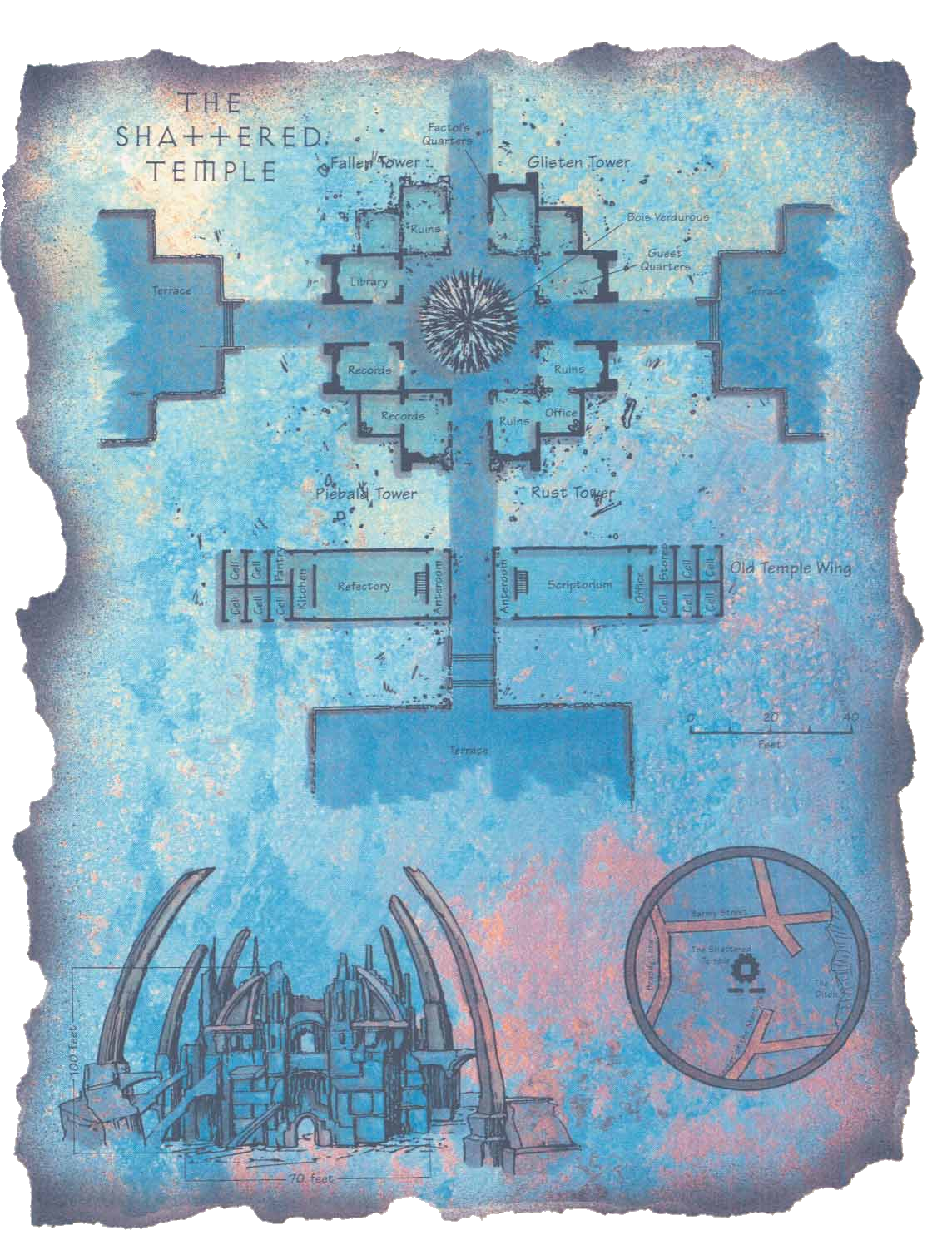
Not a lot of bashers are lining up to visit the Athar's headquarters. Sure, the Clueless tramped all over the place back when the Lost still gave tours that included a look into the Astral, but those that don't have faction business there generally avoid the whole area on account of its bad omens. After all, there's a reason it's ruined. Looks like a cataclysm - some say the Lady’s wrath - razed not only the Shattered Temple, but the entire surrounding neighborhood in a blocks-wide area.
Folks still live just at the edge of the devastation, though: visitors there come upon freshly cobbled streets and tightly clustered houses, shops and inns. The beams and stones of these buildings look old, bobbed from the tattered remains in the area, but the construction seems new and tidy enough. Heading toward the temple, a body might note the Soused Duck on the right, with copper tubs of periwinkle at its door. This tavern and the Generous Coin mercantile next door popped up long ago to serve faction members.
The bustle and hubbub of the Cage fades as a body approaches the temple. A breeze whispers through coarse grasses littered with tumbled stone and splintered wood. Some of Sigil's poor wander here and there, gathering loose stones and beams from the surrounding falling-down buildings. The sods look more than a little uneasy, and they don't linger.
The tilted skeleton of the Shattered Temple looms above these and other, lesser ruins. Razorvine curtains its ragged walls, listing buttresses, and cracked towers. The Lost have shored up the remains of the crumbling sanctuary, but they like the ravaged mood of the place. They gain comfort from this mute witness to the fact that powers can die - as did Aoskar, The near-forgotten god of portals once worshiped here when the place was still called the Great Temple of Doors. ('Course, sages’ll fell a body that the destroyed husks drifting in the Astral, like Aoskar, are neither dead nor alive, but linger somewhere in between. - Ed)
Ar the end of a nameless Lower Ward street off Brandy Lane stands a decrepit outbuilding made of worn, moss-covered stones. Two guards bearing the Athar’s insignia watch the entrance (and similar faction guards wait at three other crumbling guardhouses at the edge of terraces around the temple’s perimeter). They’ll likely seem surprised at a visitor’s approach at first, then recover enough to remember to put their hands to their weapons and demand to know the berk’s business. If they’re in a good mood, one of the guards'll summon a guide from the temple, signaling with a shrill line of notes from a little reed pipe.
One of the regular guides, Caylean, is a las with intense dark eyes, a thin face, and a grin that accords strangely with her lethal, wiry frame. (The temple still offers tours, but they don't let folks peek into the Astral anymore, as that portal closed several years ago. - Ed.)
Caylean
Female Tiefling Planar
Caylean is an enthusiastic, cheerful basher - the exact opposite of most Defiers. She sings, he laughs, he cracks jokes, and tends to trust her host of acquaintances. The Athar would've ousted her 'cept for two things. First, the factol likes this blood and views her as proof that a more benign attitude can mix with Defier philosophy without diluting it.
The second reason brings up the interesting story behind Caylean's decision to join the Lost. See, the tiefling spent her childhood as a cripple, unable to walk due to the withered legs she was born with. The day she denounced the gods as frauds and joined the Athar. Her limbs became whole and healthy. The Lost saw it as a sign that a force beyond mortal understanding could operate once a body'd banished the interference of the powers. The way they see in Caylean's dear proof that the Athar philosophy has the right of it.
The ranger has no place of her own to call kip - she stays at the case of a poor namer and his family. Before she came, this basher's brood went hungry most days, and their scrawny elbows poked through holes in their too small clothes. But, Caylean has made their lives a sight better. When she comes in, she tosses the kids on his knee, sings a nursery rhyme, or swoops them away to eat meat rolls from a street vendor. His efforts have given the children rosy cheeks and have made their parents smile.
Caylean's faction duties involve guiding guests through the headquarters and carrying messages for his factol. This is one cutter with a future in the faction, and she knows it. For now, she revels in the experience of standing, walking and running on her own two legs.
Leaving the guardhouse with their guide, visitors to the Shattered Temple emerge upon an expanse of rough grasses humped by mole tunnels and pocked with thistle and dock. A careless berk could lose his footing on the uneven walkways that lead from the peripheral outbuildings toward the incredible pile of stone that is the temple. Guards patrol the grounds, from the four overgrown terraces to the decrepit temple itself. The Lost didn't break much of a sweat fixing the place up, but visitors can see why the faction members like the place so: Its ragged heights suggest the irregular battlements of a mountain fortress. When it rains, a body can tell that every stone in the Piebald Tower on the left seems a slightly different color.
A quick walk across the grass leads a party to the Scriptorium, where the Defiers create their books and, of course, the propaganda tracts that always seem to be blowing like leaves in the streets of the Cage. Those entering this detached Old Temple Wing first notice die gaping, glassless windows in its upper floors and its distinct lack of a roof. The ground floor seems sound enough, though. Beyond the anteroom is a light-filled chamber where nearly 50 scribes sit at tables stacked high with paper. The scratch of quills and the murmur of lowered voices sounds as long as light lasts. Makeshift shelves and old tables hold pots of ink - scarlet, cobalt, verdigris, and gold for the books that become part of the faction's library. The tracts get only black. Seems the Athar know how to spend their jink.
Back outside and over into the other side of this building, visitors step into another anteroom. The long oak tables in the chamber beyond suggest the room's purpose: the refectory. The Lost don't eat too bad, goes the chant. The kitchen beyond has the same tall but glassless windows as this dining area,
The dearest path up to the most sound Shattered Temple entrance winds left around die central building. Heading up the path and into the buttressed bulk of the temple itself the curious pass under a massive arch. Some say going in there feels like entering a tomb. In the vaulted entry hall, ornate portals stand to the left and the right, and a light shines through an opening at the far end.
A quick look into the room on the right reveals nothing but a maze of falling-down shelves holding boxes of papers and piles of ledgers. The left portal leads to what was once a shrine. Now, books and more books fill the shelves lining the walls, A ladder (attached to a rail that encircles the room at head height) gets a body up to a narrow balcony, from which yet another tier of shelves springs upward. A visitor's likely to encounter a thin blood in hooded robes flipping through the pages of some thick tome at one of the tables in the center of the floor. This is Hobard, a grouch of a mage who'll spare a moment to grumble at strangers under his breath before poking his nose back in his book.
Hobard
Male githzerai planar
Hobard, a pessimistic, drab Defier, possesses a knack for getting the job done. He'll complain enough for three while he goes about his business, forecasting doom for whatever activity he’s about. Thing is. success usually finds the cranky githzerai anyway. Fellow factotums often ask him to join their adventuring parties - 'course, then they have to endure his whining with gritted teeth.
A mess that requires a sneaky, underhanded approach - now that's Hobard's delight. He’ll create a leak in the undercroft of a monastery and follow it up with rumors that the sudden dankness invading the wine cellars stems from undead. The basher'll install a blight of bats in the bell tower of a cloister, then spur the carillon player to test the keyboard. Many a temple, abbey, and shrine has suffered his ploys, 'Course, Hobard handles a lightning-fast raid or extended slug-fest with the best of 'em - he just enjoys petty nastiness more.
This talk bony cutter has the thin face, long nose, and yellow eyes of his race. He wears olive robes with the draping sleeves cut away to accommodate leather vambraces set with agate studs. He shaves most of his head, leaving only a strip of black tresses down the middle of his scalp.
After meeting Hobard In the library, visitors to the Shattered Temple generally find themselves drawn to the light at the end of the entry hall. Is it a courtyard? Perhaps a fountain plays there. From some 20 feet away, a body can see something glistening in the chamber beyond, like water or dew. Passing through the opening, one suddenly emerges into the daylight again. This is no courtyard, but the old sanctuary of the temple, its elaborate vaulting lost long ago. Cracked ivory and lime tiles cover the vast expanse of floor, punctuated in the exact center of the huge room by a great tree. Its dark green leaves shine so, they reflect the light like a mirror. Or does the tree itself glow? Deep red fruits nestle among the foliage along with pale silver blossoms. A scent of citrus blended with sweetness rises from this living fountain. This is the Bois Verurous, the pride of the Athar. (And the reason for the guards patrolling the grounds. For more on this magical free, see "The DM’s Dark" - Ed.) After laying eyes on the enchanted tree, visitors leave the temple thinking that maybe the Defiers have something to believe in after all.
Safe Houses. On the Outlands and the far reaches of the Great Ring, the Defiers use abandoned religious buildings for refuge: any place the powers have left a footprint. When the faction’s enemies've got the upper hand, the Lost find inspiration in reminders that the works of the false gods don't last. Ruined abbeys, empty convents, toppled hermitages, and decrepit chapels form a network of places to go to ground. They stock their rundown sanctuaries with food, wine, bedding, clothing, and extra weaponry. The more perilous or vital spots have resident caretakers.
Many of these ruins are haunted - so goes the chant among the locals, 'Course, the Athar only encourage such superstitions by impersonating ghosts or other undead. If the natives avoid the area, the chances of anyone unearthing the hideaway are few.
Within the Ranks
Nearly all the Athar fed a need to show the deluded, who still have faith in the powers, the error of their ways. However, most of the Lost feel peery of priests of specific deities and avoid their temples. Why should a body expose himself to the one place where the enemy is strongest? Defiers steer away from overt hostilities against the various faiths: The survival of their faction depends on discretion. After all too many open attacks on established temples will simply unite their foes into a force the Athar could never withstand.
Role-playing the Athar
Not all the Lost are bitter, but most have had a power turn stag on 'em. That’s why folks join the Defiers, and a lot of them carry around a heavy load of cynicism, paranoia, and resentment. Whatever their attitude, Defiers follow the Rule of Three by having three main goals: to prove publicly the Falsity of the so-called gods, to lessen or destroy their influence, and to part the veil of the unknowable to glimpse the truth.
Alignment. Defiers of various ethical systems all look at the Athar philosophy a little differently. A basher with a bent toward charity wants to save the "Faithful" sods from suffering the pain of the inevitable betrayal by their powers. A few Lost value honesty, and so find motivation in a love of truth. Self-centered Defiers hope to pull down the powers to leave more room for their own schemes to gain wealth, pleasure, or even revenge: Strip the false gods of power by stripping them of believers. 'Course, the Defiers who naturally refrain from passing judgment still detest shams, What is, is - and fraudulent gods only muddy the waters.
Lawful Athar think a berk who follows the rules of rite powers follows the wrong guidelines: he needs to see past the powers to the order of the Greater Unknown. Chaotic Defiers insist that tint multiverse has no rhyme or reason and think the powers just form part of a false veneer of order. The neutral Lost believe the phonies distort the balance between law and chaos.
Class. A basher’s profession determines the reason for joining the faction and the methods used to pursue its aims. Fighters and Monks seek combat with all who serve the powers and believe that the truth will out in melee. Rangers consider deities who enslave animals more vile than others and claim that animals in their natural state provide clues to sublime truths. Paladins hope to convert all beings from worship of their idols to reverence for the true (though unknown) source of all majesty. Clerics also look beyond the powers in search of the Greater Unknown god. Druids insist the powers interfere with the natural cycles of the multiverse and want to see them operate without these interlopers. Wizards and Artificers claim the powers deliver Tainted magic, and rogues want ecclesiastic wealth for themselves.
Race. Many planars in the Great Ring serve a power and would never join the Athar (nor find Themselves welcome). This fact makes the Lost less multiracial than some other factions, such as the Believers of the Source and the Free League. Bariaur, half-elves, humans, tieflings, dwarves, elves gnomes, and halflings are all well represented, Githzerai seem few and far between, though: The majority revere either their race's nameless wizard-king or the legendary Zenhimon as a god.
Why don't you try bringing some of your justice to the "Powers"?
Athar Membership
Folks can join the Lost just by presenting themselves at the Shattered Temple.
Some of these namers find jobs at the Temple. (See The Chant - Ed.) All of ‘em must provide room and board for needy factotums, since the temple itself offers no housing. The faction treasury gives them a bit of jink for this service, but not enough to cover all the costs. The excess? Consider it the namer's contribution to the cause.
Defier factotums are called athaons, a term meaning "godless" in the sacred tongue used by priests of the dead power Aoskar. A namer becomes an athaon in a night ceremony in the Shattered Temple. The basher must bring three articles (weapons, books, or symbols) imbued with the magic of a fraudulent god and destroy them all at the proper time during the rite.
In addition to the room and board an athaon can receive from namers, a Defter factotum receives steady work from the factors. Low-level athaons generally function as guards, messengers, or technical experts. Mid-ranked athaons (4th to 7th level) serve as envoys, independent operatives, or overseers.
Athaons wanting to advance to factor rank must cause a significant victory over a power or its proponents. Routing a battalion of devas from Elysium or a legion of hellhounds dispatched by Hecate might do. Slaying a paladin of Ra? Definitely.
The factors choose the replacement Factol when the office-holder dies, resigns, or grows incompetent. Candidates for the top position must defile an active chapel or temple before assuming the factol's dignities. (Methods of defilement depend on the deity the temple honors. They may he as simple as uttering a profanity or as challenging as stealing the temple’s most sacred item and burning the place down. - Ed) For all too many factors, their first attempt at this requisite is also their last. See, when a body pushes a power too far, if pushes back - hard.
Faction Abilities
All Defier ranks are immune to the following spells when cast by a servant of the gods (like a cleric, proxy, or angel): augury, bestow curse, divination, divine word, enthrall, geas. Also, They can spend Inspiration as a reaction to gain immunity to a single spell cast by a servant of the gods. Accepting aid from a servant of the gods is considered beneath an Athar, and prevents them from gaining Inspiration until you atone or otherwise prove yourself to your faction's cause.
Athaons receive the following feat:
The Chant
Know how to read and write? Need jink? The Defiers hire scribes. 'Course, their Scriptorium's overflowing with scribbling namers, so they've had to usurp the tables in the refectory and even set up trestles in the old meditation cells. Not a bad way to turn a copper.
But a body warning to witness a little legislative excitement as a member of the Athar should swing by the Hall of Speakers. A new ordinance the Hardheads propose would make it illegal to distribute or possess pamphlets mocking the powers, Factol Terrance could use extra supporters as he argues before the speakers.
'Course, cutters with the dark can find excitement away from the Cage, too. The chant talks of a new fountain just sprung up in Marduk on Arcadia. Seems the Harmonium’s bathing converts in it night and day; one dip, and namers obey Hardhead dictums without question. Does the water cause such fidelity? The facial needs to know, so someone's got to go.
"Leaf in gilt, leaf in copper, green flees the harleydown, and Lost is lost forever." whispers a stranger on a bridge. Could it be a plot against the Bois Verdurous? Who knows the significance of the tree, save the high-up Defiers? Why would they seek its death? And how would they do the deed? Factol Terrance has a few ideas, hut he bides his time.