The Dustmen
Source: The Factol's Manifesto p.48
Good evening. So, you have decided to accept that "life" is a grand falsehood? That is well, for only now can you begin to move on, to explore this stage of your death and move toward the next. Yes, all stages of existence are levels of death.
You do not seem excited by your acceptance into our ranks: that also bodes well. To join us, you must work to forget your passions. Emotions reveal you as one who still clings to the illusion of "life." Remember this: Without passion, a body has no pain. Divest yourself of all passions, and you have achieved the final stage of death - you have become one of the True Dead. That is our goal, and not an easy one, at that. All the while, remember patience. Experience the stage in which you now exist.
Many of the Dead cannot take their existences one step at a time, unfortunately. Instead, they long for a return to Life. They know, as we do, that all the multiverse consists of the places and planes where creatures come after they have lived. Yes, this means that True Life occurs on planes unknown to us. The impatient among the Dustmen "hope" that achieving ultimate death will lead them back around to the mysterious multiverse of Life, our planes of origin. After reaching True Death, perhaps one can return to Life, I do not know. I do know that one cannot reach the ideal state, total acceptance of death, until one leaves hope behind - the very hope that fuels the desire for Life. Clearly, I still have yet to reach the ideal myself, for I appreciate the irony in this foolish presumption.
Primes seem the most ignorant of the ways of death. We call them the Clueless; after all, they still consider themselves alive. Planars understand some of the stages of death - though most still call them stages of "life." Look at the Sensates, who try to recapture bits of the multiverse of Life by foolishly clinging to the trappings. Were I capable of pity, I would offer it to them, for they certainly seem the most pathetic of creatures. And then there are the Believers of the Source, who try to inspire passion in members to improve themselves toward their grand goal. At least they see we must ascend to an ideal state, facing rests along the way. But Believers want to "ascend" in the wrong direction.
Petitioners have advanced to another stage of death entirely, but seem to have hit a dead end - so to speak. They desire to merge with their plane, when they should focus instead on moving on to become one of the True Dead. Proxies also appear unfortunate; they follow beings of power, working to further the goals of these powers without regard for their own stage of death. I find the powers the worst of all. They believe they have achieved the ultimate purpose of existence and, as a result, encourage others to believe in the sham of "life."
Why desire life...
when one can embrace death...
join the True Dead...
...yesssss...
...Hmm? Oh, you are still here.
Ah, True Death, The walking dead approach this final stage. Obviously, the undead are more dead than most of us. But passions still can prove their undoings. Were I one to fed, or to weep, I would do so at the thought of the hundreds of vampires, liches, and ghosts clutching so fiercely at the trappings of "life,’ when they have come so close to True Death. As long as they cling to the illusion of "life," it will cling to them, preventing them from ever reaching the ultimate stage of existence. In many ways, the lesser walking dead - the unthinking, passionless undead - seem better off; but because they do not think, they cannot know how close they come to the ideal. Still, all undead creatures understand The nature of existence enough to recognize that we have the right of it. They do not harm us, according to the tenets of our Dead Truce, which allows them to recognize any Dustman as a fellow Dead.
Do not enjoy your stay with us. I would be alone now.
They think they're dead, but they've sure got their finger on the pulse of the cage.
A Short History of Death
The Dustmen are a very old Faction, predating even the Bleakers. Fact is, many claim this was the first faction, old as death itself. One thing’s sure: There's no factol older than Skall, nor one who's reigned longer. See, Skall's not only the factol of the Dead, he is the founder.
'Course, no Dustman would make such a claim himself. That'd resemble bragging, which a body might take as a sign of emotion. The Dead, known for their stoicism, can seem a boring lot. They seldom talk about anything except death, so they never bother to discuss the "birth" of their faction. It's not even fun to call one a "berk" because he won’t bristle, won't take offense. A cutter gets depressed just thinking of this lot.
It's odd - the Dustmen never seem to get depressed themselves, at least most of 'em don't. While a body’d never call them "happy" the Dead appear kind of satisfied with things. Never cheery or sad, never angry or joyous, they exist in a weird equilibrium.
And that's the way ifs always been, at least as far as scholars can tell from books about the faction s history. No one can recall when the Dustmen weren't around - though maybe the powers could, if a body’d care to ask 'em. The Dead have always gotten along pretty well with other folks and most other factions. It's hard for someone so boring to offend.
But it can happen, as it did some years ago, when Sensate high-up Karilla Mavasll wanted to taste death, the "ultimate experience" She went to the Mercykillers, who helped her along - but then the Dead wouldn't give her back. The whole thing would have started a war if the Dustmen had actually cared when the Sensates stole Karilla's body out of the Mortuary, the Dead's Sigil headquarters. 'Course, they might've said something if they'd known the Society planned to resurrect her.(Dustmen don't support intentional regression. - Ed.) Instead, they quietly shook their heads, sighing. And Karilla eventually joined them anyway.
Most factions besides the Sensates ignore the Dustmen, as the Dead make few waves. (Lately, though, they seem interested in creating problems for the Godsmen in the Hall of Speakers. - Ed.) A few factions even admire the morbid viewpoint of the Dead. The Bleakers and the Doomguard both like the Dustmen, for varied reasons. Members of the Doomguard also view death (though of a different sort) as the goal of the multiverse. Thee Bleakers - well, they like the hopelessness of the Dead's cause.
The Dustmen can't claim to like any other factions, nor do they really dislike any. 'Course, namers are more likely to have these emotions than high-ups. Still, even high-ranking faction members have been known to feel mild pity or amusement at the meaningless activities of other factions. If they could dislike other factions, their top choices would include the Sensates, Godsmen, and Signers, all of whom value the two great falsehoods of self and life. The Fated, Harmonium, and Anarchists also fail to find favor among the Dead, because they want too much, work too hard, and feel too strongly. Mercykillers prove less welcome as allies than a basher'd think: While they support death, they fail to acknowledge that they're already dead where they stand. High-up Dustmen disdain the Mercykillers' passion for justice and their penchant for speeding up the natural death process,
The Guvners, Indeps, and Ciphers all show potential, say the Dustmen, because they value learning. Eventually they'll discover the truth and admit they're Dead too. The Arhar and Xaositects do tend toward hopelessness and grim attitudes but remain a bit too enthused about their viewpoints for most Dustmen's comfort. If the Dead wanted to admire anyone, they'd pick the Bleakers and the Doomguard - the three factions form a neat little triad of fatality.
Don't go expecting lots of new plans for the future to crop up at the Mortuary, Change among the Dead happens only slowly. They retain their stability because they've looked to one leader for so long, and also due to their noncombative philosophy. As the saying goes, the only sure things are death and taxes; while the Fated collect the latter, only the Dustmen have the dark on the former. Everybody either will die or can die, so everyone is a potential faction member.
Factol Skall
Male lich planar (former human?)
Everybody really belongs to the dustmen - but not everyone knows it.
Not a lot of people know Skall is a lich. He usually spends more time at the faction's headquarters on the Negative Energy Plane than in the Mortuary. Skall almost never attends factol meetings in person - he seldom visits Sigil at all. Instead, he uses an advanced form of project image ; it has a longer duration than the normal spell and lets his image cross planar boundaries.
When Skall projects himself, and when he travels in person, he cloaks himself in illusion - usually several illusions, lopped with disguises generated by spells like alter self or polymorph self to fool those who can see through illusions. Skall usually wears the guise of a human male, leading a body to believe that's what he used to be. For factol meetings, he likes to appear as a simple black robe with the Dustmen's symbol floating above, (Only a few high-ups have seen him undisguised.) All his forms speak in a dry, echoing monotone.
It's s no surprise that Skall can keep his true nature relatively quiet. See, the Dead don't talk about him much. They just take for granted that he's advanced along the road to True Death. And if folks do find out, so what? It’s not like Skall wants to hurt anyone. Sure, he's evil but only in the eyes of people who equate "goodness" with a respect for life. Though determined to have his own way Skall's in no hurry to accomplish his goals, so he seldom behaves in an evil fashion.
Most Dustmen know Skall's walking the road to becoming one of the True Dead, but that he stays around out of a sense of duty. He feels compelled to enlighten as many berks as possible about the way of death, so they eventually might reach True Death. Meanwhile, he keeps striving to know everything but feel nothing. Those who harm or offend the factol tend to disappear - sometimes right away, sometimes a year or more after the fact. Did Skall arrange their advancement to the next stage of death, or was it simply their time? And who can predict what'll offend a being virtually without emotion?
The Mortuary
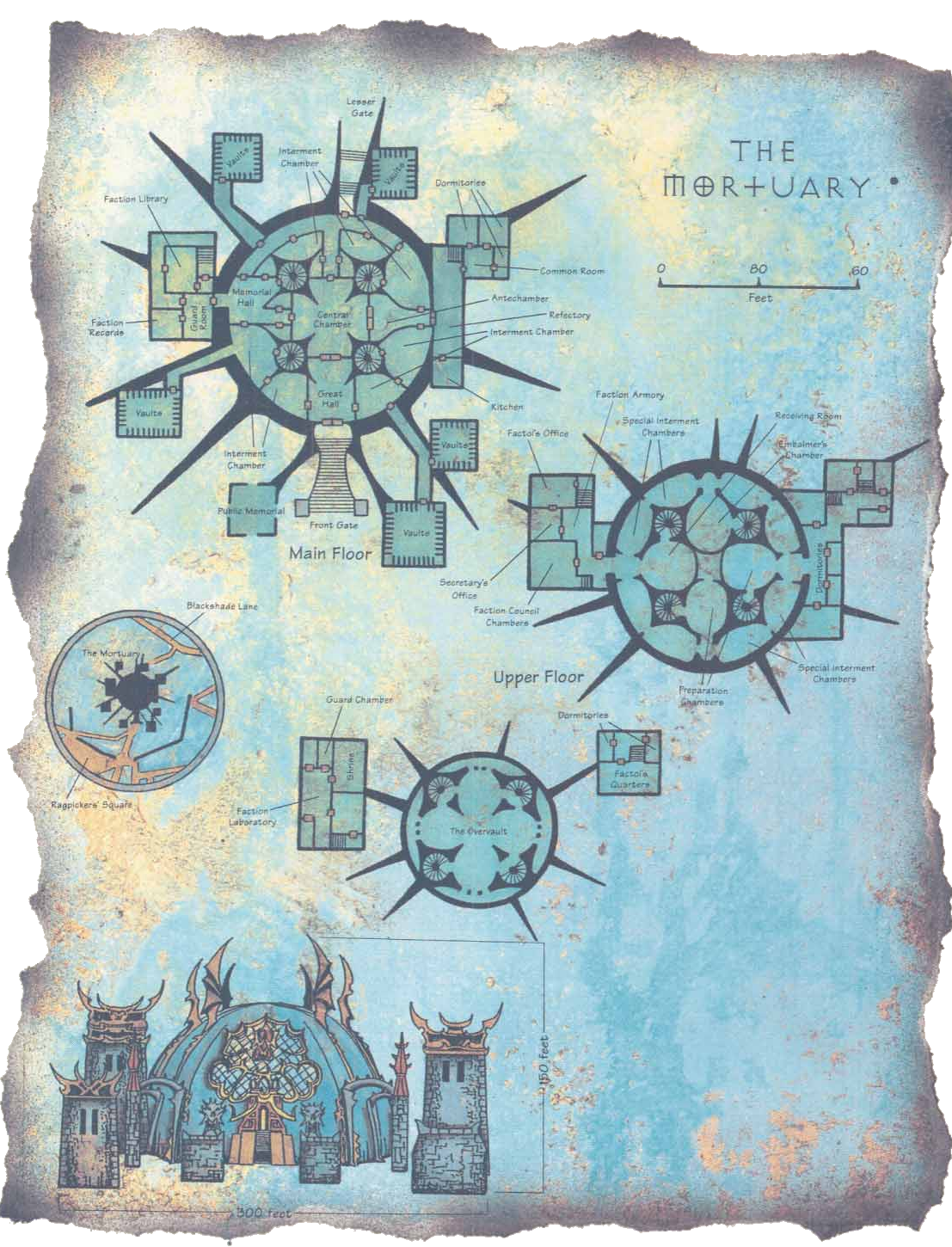
Die and let Die
The streets around the Mortuary, home to Sign's unclean, seem crowded with cheap taverns and boarding houses. Many of the areas poor earn a little extra jink by bringing corpses to the Dustmen, These Collectors, as they're called, get paid a pittance for each body they bring back; several small groups regularly patrol the Hive and Ditch, where people die in droves every day.
The Mortuary sits between Blackshade Lane and Ragpickers Square in a dismal part of the Hive. The whole area immediately around it feels somber and shadowy; perfect for the colorless Dustmen. The foreboding structure resembles a low, menacing dome, with cluster of windowless vaults jumbled around if. Spiky black buttresses radiate from its center. Though nearly 250 Dustmen can live there in reasonable comfort, the Mortuary normally houses only 50 to 200, making it one of the most sparsely populated faction headquarters offering housing at all. Many areas stand empty for hours at a time: however; the faction offices in a tower remain very busy during the day, and the sleeping Dead fill the dormitories at night.
The Mortuary holds quite a few portals - an important feature, since the Dustmen prepare corpses (through mummification, embalming, etc.) and dispatch them to cemeteries on other planes or send them to the Elemental Plane of Fire for cremation. Without the Dead, there'd be no room for the living in Sigil!
Bashers approaching the Mortuary for a funeral first spy an open-air monument or public memorial. For a fee, the Dustmen’ll add the names of lost cutters to this Roll or the Dead. Folks have been filling the memorial with tiny carved names for centuries.
Passing through the front gate and climbing the main steps leads visitors to the Great Hall, Important guests or funeral parries are received here, (The bodies themselves are delivered through the lesser gate at the hack of the building, - Ed) This spotless hall’s reserved for ceremonial use only. Five Dustmen stand guard here all day (only two at night) and also act as guides for any visitors with business elsewhere in the building,
A basher won’t get far without noticing the hordes of undead roaming the Mortuary, Free-willed undead such as wights, wraiths, and more powerful specimens usually avoid public areas. Lesser undead like skeletons and zombies serve the faction as laborers. Blame them for the antiseptic smell of the place - seems the Dead like things surprisingly clean. Yet no amount of scrubbing can remove the dusty smell age has lent the Mortuary, nor its underlying odor of decay.
Funeral groups pass from the Great Hall through a central chamber (reserved for Dustman gatherings) to view the departed in Memorial Hall or an antechamber. The party then moves into one of the half-dozen or so interment chambers ringing the perimeter of the main floor. A chill rises from the black flagstones of these dim, quiet rooms. Portals here lead to prominent prime worlds and to sites in the neutral Outer Planes: Arcadia, Mechanus, Acheron, Limbo, Ysgard, and Pandemonium.
In addition to the guards in the Great Hall, six Dustmen stand duty in a guard room near a Dustmen-only area on the main floor. A records room here stores information on interments and faction membership. It opens onto a library, whose hundreds of books and scrolls concern undead, philosophies of death, burial practices, lists of grave sites, and necromantic magic. At the far end of the Mortuary (also accessible only to faction members) lie the kitchen, refectory, a common room, and Dustman dormitories (each with ld20 Dead). Right upstairs are more dormitories and common rooms.
The Dead perform most of their work in the central portion of the upper floor. In one room they receive, inventory, and sort corpses before sending them to the adjacent embalmer's chamber. Also nearby are two chambers where the Dead prepare bodies for burial. (One contains a portal from the Prison; the efficient Mercykillers send dead prisoners straight to the Mortuary. - Ed.) Several special interment chambers on this level hold portals to the Upper and Lower Planes.
In one wing lies a council chamber, where the factol's secretary conducts meetings. Dark paneling covers its walls, interrupted by a massive copper Dustman symbol. The table of deep mahogany dominating the chamber has a secret lever that opens a trap door to the faction records room below.
Also in this wing waits the faction armory, which can equip some 100 Dead. (The faction can also equip members from its main armories in the Mortuary's catacombs, heavily guarded by undead. From there, a body can wander clear to the necropoli and crypts the Dead maintain beneath the Cage. The Mortuary's catacombs also are said to hide countless portals, especially to the realms of the powers of death. - Ed)
Adjoining the armory is Secretary Trevant's office. This lavishly appointed chamber brings to mind a coffin its polished wood is accented by brass fixtures and soft fabric drapes. During the day, Komosahl Trevant - Skall's appointment secretary and second-in-command - works here with two high-level bodyguards. Trevant handles daily business and Sigil matters, allowing Skall time for long-range planning and factol meetings.
Komosahl Trevant
Male human planar
Trevant is a serious and scholarly mage of middle age who typically wears robes of rich black velvet and deep purple silk. While many Dustmen act cold and distant, Trevant seems relatively charismatic - at least on the surface. Underneath, he is hard and manipulative.
Skall hasn't had such a good second-in-command for centuries. Trevant knows Skall's a lich, and he can't quite keep himself from looking forward to the day the factol will initiate him into the next stage of death. Fact is, though, Trevant seems too attached to passion to achieve this goal. Skall uses him for his administrative skills: letting the secretary handle details gives the factol time to contemplate his current stage of death.
Trevant doesn't mind his position: he takes things as they occur. Though he wants to achieve True Death eventually, he considers leading the faction a destined part of this stage of his existence. This Initiate of the First Circle (see "Dustman Membership") is favored to become factol if Skall steps down (not likely). He's always fair to Dustmen - and harsh to the faction's foes. (Trevant considers crossing the Dead a sign that a sod's reached the end of his current stage of death, so he'll help an antagonist along to the next one. - Ed.)
Next to Trevant’s office sits the factol's office. A desk dominates the room: a block of what looks like marble, with red veins running through it. They seem to pulse, as if blood were pumping through them. Shelves lining the walls hold rare art, potions, and scrolls, and conceal secret safes that hide rare treasures. A body can find Factol Skall here about 25% of the time. He spends much of the rest of his hours at the Dustmen’s citadel on the Negative Energy Plane: a portal leads there from the eastern closet here. While the factol's absent, six ju-ju zombies guard the room. At night, after Trevant leaves, symbols of fear guard all the office's entrances. However, just because the secretary's gone, the room's dark, and the zombies are present, don’t assume Skall’s not here.
The top level to the Mortuary, the Overvault, features a huge chamber just beneath the structure's dome. From the narrow galleries along its perimeter, portals lead to the Elemental Planes. The factol's austere quarters on this level hold some of his personal goods. While the factol doesn't need to sleep, he keeps a bed here for appearances. The room seems impervious to unwanted visitors, with its arcane locked door graced with a symbol of fear, its windows barred by walls of force and warded with symbols of hopelessness, and its walls and floors constructed with special mortar to prevent the passage of phased or ethereal creatures. Further, the factol's glabrezu familiar (Pl/♂tanar’ri/10 HD/Dustmen/CE) usually stays in Skall's quarters.
A laboratoty across the Overvault is reserved for Dead wizards. The Dustmen store normal alchemical equipment here, as well as spell components and potion ingredients. Curious bashers also will find a few wizards and a handful of ju-ju zombie guards in the lab. A glowing doorway graces one stone wall of an Overvault guard room: a permanent portal to the Outlands town of Xaos. (On occasion, the Dustmen use this portal to smuggle people out of the city at the behest of the factol - Ed) Six Dead on guard here make sure only faction members use the portal. Clerics of the Dead visit a shrine next to this guard chamber for their devotions to gods of death and related subjects. An altar of black stone stands in the shrine's center, purple and black tapestries decorate the walls, and braziers smolder in the corners. Clerics conduct rites regularly, day and night. The High Priestess of the Dustmen, Oridi Malefin, lingers here when not busy with various interments.
Oridi Malefin
Female tiefling planar
Dusky-skinned Oridi has an extra eye in the center of her forehead and a long, scaled tail. Her gaunt face looks fairly old, but comes nowhere near reflecting her two centuries of life. Once, Oridi may have worshiped one of the death deities. However, long ago she became a channel for the force those powers represent. Of all the Dustmen a basher might meet outside the Negative Energy Plane, she stands closest to True Death.
Faction members see the high priestess performing regular rituals for the Dustmen and wandering the halls. She appears more dead than many of the undead around her. If a body can get her attention - only a Dustman has a chance - Oridi might share her thoughts on necromancy, burial procedures, and the nature of death, She's spent many decades at this particular stage, thanks to her phylactery of long years, because she felt it should be her last before True Death. She accepts that she’ll reach this Final goal in another decade or two.
A Dustman experiencing a crisis of belief usually seeks Oridi's counsel. 'Course, she may ignore the sod. Then again, she might turn and explain things, in a slow voice that resembles a cold, moaning wind. Talking to Oridi helps a Dustman understand the way of the Dead though it sends chills up his spine at the same time.
Safe Houses. Dustmen consider graveyards, catacombs, and mausoleums places of refuge. The Dead enter such sites without fear of their undead guardians, who wilt attack any pursuers. (See "Dustman Membership." - Ed.) Many faction members gather at taverns like the White Casket in the Lower Ward and the Speckled Rat, where they sign "the Contract" with sods desperate for jink: The Dustman pays a gold or two for ownership of the poor Cager's body - after the sod dies, of course.
Within the Ranks
Life among the Dead - interesting phrase, ain't it? Though Dustman characters hear a lot of cracks about their faction’s name, they really don't care one way or the other about nicknames. After all, they've supposedly shucked off all emotion. So they don't mind being called the Dead, or Dusters or even Dusties (the last not used often, and never within earshot). One story going around the Cage, though, tells of an odd prime who thought herself funny calling them the "Dustbunnies." She stopped the morning she woke up next to a zombie. (Folks say the zombie had on rabbit ears, but it's tough to credit the Dead with such a sense of humor. - Ed.)
I do not strive for the ideal state, for to strive is to fail automatically. Still, I will not soon advance to true death, for my sense of duty keeps me at this level.
Role-playing the Dustmen
What's a body to do among the Dead? Depends on a few things, like race, profession, and ethical inclination. Yet despite the differences among the faction's various alignments, classes, and races, Dustmen hang together. They all respect death and seek knowledge. Disputes in the faction seldom last long - 'cept for one.
See, some Dustmen hope for a return to Life, These so-called Hopeful agree with the Dead's primary philosophy: Everyone exists in a multiverse of death. The celebration of life occurs only in a universe that bashers on this side of the fence can't find. The Hopeful, stuck on the wrong side, reach for the passionless state of True Death because just beyond it lies the reward: Life, Other Dead consider the Hopeful view foolish and see the group as just a quiet splinter sect. A return to Life might come in time. If not, who cares?
Race: Most Dead are humans. Some factions say that's because only humans are gullible enough to follow Dustman beliefs, but that doesn't explain the minority of nonhuman faction members from other short-lived species. Seems folks with short life spans tend to sympathize with the Dustman philosophy; they see death more than others do, so i hey feel closer to it.
Most other prime races seem too connected to life to consider the Dead philosophy. For instance, it's a rare thing to see a Dustman elf, since elves're a longlived and generally life-loving bunch. A prime elf who joins the Dead has come to embrace death and considers his connection with nature and life a disadvantage, one that hinders him from moving forward to the next stage of existence.
The severe githzerai might seem naturals for the Dustmen, but they have a tot of passions to overcome, like their hatred for the githyanki. Tieflings and planar half-elves, both "misplaced people," often accept the way of the Dustmen. However, bariaur prove too carefree, outgoing, and happy for this faction, A bariaur has to get awfully depressed to even consider joining the Dead, and usually that depression keeps him out, as such an emotional tendency would make him unsuitable.
Class. Many wizards, as scholarly, intellectual types, favor the introspection of the Dustmen. This quality also attracts clerics, though the ones who actually join have devoted themselves mainly to gods of death. Dustmen clerics all eventually hit the blinds, however: Religious devotion requires some amount of passion, yet progressing among the Dead means letting go of that passion. Clerics (like Oridi) slowly become less devoted to specific gods and more devout to Death as a force.
The Dead attract few rogues or fighters, since these professions encourage flamboyance and emotion. The infrequent Dustman warrior, a guardian rather than a crusader, becomes a strong, implacable foe. Though the Dead thief loses the passion for stealing, he still can skulk with the best of'em. The unusual Dustman bard - in demand at funerals - devotes himself to odes and dirges that honor death rather than celebrate life, and he analyzes music and lyric, instead of enjoying it.
Now, some claim druids don't "belong" in the Dustmen any more than bards, yet a surprising number of them do join. See, druids revere nature and see death as a natural progression from life. All life ends in death, right? Once a druid looks at things this way, he's ready to accept all "life" as merely a stage of death.
Alignment. Druids also lean toward Dustman views 'cause they don't get distracted working toward good or evil, law or chaos. This neutral position proves common among the Dustmen. Fact is. the longer a body stays in the Dead, the more his alignment shifts toward true neutral, and only neutral characters can achieve True Death. Chaotics may try to play Dead for a while, but any group whose philosophy centers on "we" (as in "we are all dead") can’t attract chaotic folks long. Revering death ain't popular with good people, for that matter.
Still, a few Dustmen remain chaotic, or good, or both. A chaotic Dead believes that each person must find a separate path to True Death, And, as thinking everyone is dead doesn't exactly conflict with good, a good Dustman guides himself and others patiently along the path to the next stage of existence. The Dead's belief in an orderly pattern to the multiverse attracts many who favor law, but the group's apparent lack of respect for "life" attracts the evil. Well-intentioned Dustmen want their neighbors to advance in death - but most folks believe it evil to hope for someone's demise. Go figure.
Dustman Membership
Most Dustmen are just namers, folks who join the Dead by promising before witnesses to serve the faction and declaring their knowledge that they, like all in the multiverse, have left Life behind. They try to leave their passions behind as well, and succeed in varying degrees. However, the majority of 'em never approach True Death. Namers work as Collectors and Mortuary aides.
Those with promise (and of at least 4th level) become factotums, whom fellow Dustmen call Initiates. The lowest-ranking factotums are Initiates of the Fifth Circle. They serve guard duty, perform missions on assignment, and escort visitors and funeral parties. For induction into the Fifth Circle, prospective factotums attend their own funerals, detaching themselves from worldly possessions and making peace with family and friends. Factotums who perform well go through a new initiation to gain the Fourth Circle, then presumably another to proceed straight from Fourth to First. The chant has little to say about these secret ceremonies.
The First Circle holds the factol and his factors, and cutlers like Trevant, advanced there directly from the Fourth Circle. So what about the Third and Second Circles? No one knows, not even other Initiates. (Except, presumably, those of the First Circle. - Ed) The chant around the Mortuary says the Third Circle consists of lesser free-willed undead, like ghasts, wights, and wraiths; liches, spectres, and vampires supposedly make up the Second. One thing’s sure: No living basher can see through this dark.
Faction Abilities
Dustmen members benefit from the Dead Truce, an ancient compact between the Dustmen and undead which prevents undead from attacking a member of the faction unless the Dustmen initiates hostilities first. Normally this does not apply to a Dustman's companions; however, they can spend Inspiration to extend the Dead Truce to companions within 10 feet as long as they maintain concentration, though this only reliably applies to mindless undead like wraith, skeletons, and zombies, not free-willed undead like vampires and wights.
Initiates of the Fourth Circle gain the following feat:
The Chant
The Dead don't have a lot of plans these days. Never did. A body can bet they’ll continue their Mortuary duties and work to reach True Death. And they will exist. Their only real concern surrounds a brand-new Dead chant.
Now, maybe folk're just rattling their bone-boxes 'cause they like the noise, but rumors in the ranks whisper of "Skall's Master Plan." Story goes, Skall wants to convert everyone, everywhere, to his way of thinking. Seems he’s discovered that for anyone to reach True Death, everyone has to reach True Death - not a simple matter for bashers who consider themselves alive.
What’s the easiest way to get a body to accept that he’s dead? Kill him. So Skall says, and he’s reportedly collecting bodies out in the Dustman citadel on the Negative Energy Plane: hundreds of free-willed undead, as well as thousands of lesser undead and a like number of corpses waiting to come back to serve their faction. Supposedly, the body of every Dustman ever ('cept those that got disintegrated or were already made undead) wails out at the black citadel for Skall's call.