Rogue Modron
Source: The Planeswalker's Handbook p. 76
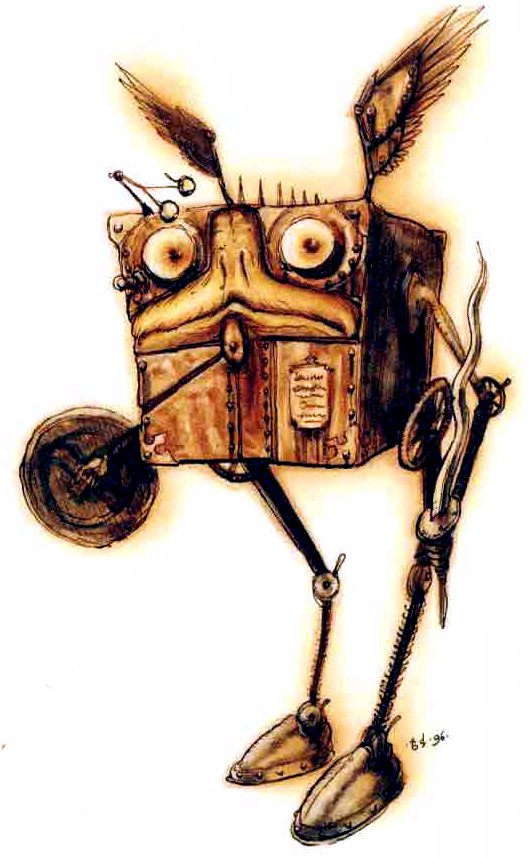
- Ability Scores: Choose one of: (a) Constitution +2 and +1 Intelligence; (b) Intelligence +2 and Constitution +1
- Size: Medium
- Speed: 30 ft.
Traits
Age
Rogue modrons are effectively immortal.
Size
Rogue modrons measure 3 feet by 3 feet, weigh 500 pounds, and stand 6 feet tall.
Darkvision
You can see in dim light within 60 feet as if it were bright light, and in darkness as if it were dim light. You can't discern color in darkness, only shades of grey.
Living Construct
You are both a construct and a humanoid. You are immune to disease, and you do not need to eat or breathe, though you can ingest food and drink if you wish.
Truesight
Your darkvision allows you to see in magical darkness as if it were dimlight. Once you reach 3rd level, you gain advantage on saving throws against visual illusions and Intelligence (Investigation) checks to detect a shapechanger or creature transformed by magic. Once you reach 5th level you can cast See Invisibility once per day.
Vestige of Primus
Choose on of the following features:
- Articulated Legs and Vestigal Wings: Your base speed is 35 feet. When you make a running jump, increasing the distance you cover by 10 feet.
- Built-In Tools: Choose two small pieces of equipment which are built into your construct, such as a hooded lantern and thieves's tools. In addition, you have a small built-in storage space in which you can conceal a small object.
- Hardened Shell: Gain a +1 bonus to AC.
- Modron Investigator: You gain proficiency in Investigation checks, and double your proficiency bonus to active and passive Investigation checks. You also have a built in magnifying lens.
- Quadruple Arms: You can interact with two objects or features of the environment for free on your turn (e.g. draw or stow two weapons).
- Translator: Learn 3 additional languages.
Languages
You can speak, read, and write Common and Modron.
Discription
Modrons are the clockwork caretakers of the gears of Mechanus, virtually unthinking in their strict hierarchical order. No beings’ minds are as focused on law. stability, repetition, and the security of harmonious regulation. But the multiverse isn’t perfect - not even in Mechanus - and sometimes things go wrong. Sometimes a modron receives conflicting orders from two or more superiors, or is confronted with incontrovertible proof that all is not orderly. Sometimes a modron’s mind just snaps. These circumstances create rogue modrons.
When modrons go rogue, they lose most of their special abilities and even the normal modron form that designates their position within the clockwork hierarchy. They find themselves cast out of Mechanus, the heart of law and the only world they have ever known, and plunged into the cold, lonely, and (worst of all) chaotic multiverse. Rogue modrons have the forbidden and reprehensible glimmerings of self awareness, the only thing that allows them to survive in this new sphere.
Most rogue modrons are not crazed lunatics craving chaos and destruction. On the contrary, most folks can’t tell a rogue modron from a "normal” one just by listening to it talk about the multiverse. It still is an extremely ordered being, with law at the center of all of its thoughts and in¬ grained in the way it feels, acts, and reacts. To another modron. the differences are obvious, and the rogue is some sort of chaotic wild-child; but to other folks, the rogue modron still seems the epitome of order.
Modrons are formed front the stuff of order and given clockwork limbs and other parts. Both mechanical and fleshly parts comprise a modron, but the parts meld together to form an orderly whole. In fact, modron bodies aren’t much different from any other basher’s, other than in their odd appearance. (So curative spells, for example, work just fine on them despite their mechanical components.) Otherwise, modrons are genderless, ageless, and very difficult to distinguish from one another. Thankfully, the latter problem is solved by the fact that very, very few rogue modrons wander the planes.
Rogue modron player characters present a number of problems and special situations. These beings had no childhood, family, social rank, or even any real history. In fact, rogue modrons begin to lose what memories they have of Mechanus as time passes; as beginning player characters, they have even forgotten what rank they once held in the modron order.
Role-playing rogue modrons requires special attention to their personalities and motivations. As beings of near-absolute order, they need organization, rank, authority, regul tion, and harmony to be content. Modrons would never join a group that didn’t make its organization and hierarchy clear, including an adventuring group. Modrons need to know exactly where they stand in the group - who ranks above them, and who below. While not as interested in being on top as some berks, they don’t necessarily follow orders blindly and won’t appreciate being taken advantage of by some peeler who thinks he understands how modrons operate.
Once modrons set a course of action, it’s difficult to divert them. They don’t become sidetracked or distracted. Modrons have a focus that no human can match in intensity. Most modrons also have no concept of self, but this is only partially true of rogues. Though still less motivated by con¬ cepts such as greed, personal happiness, and even selfpreservation than a human would be, they do recognize and (vaguely) comprehend these ideas.
Rogue modrons don’t believe in, or even understand, the concept of chance. They never use words or embrace ideas like "luck.” To modrons, everything is structured, nothing is random. All creatures abide by a set of rules and regulations - whether they realize it or not. In fact, while mod¬ rons might not be able to describe exactly what all the "rules of the cosmos” are, they may try to figure the rules out - a lifelong task at best.
Essentially, rogue modrons are refugees from a completely alien society and world, with completely different outlooks - at least at first. As PC modrons explore the multiverse, they continue to learn and adapt to the rest of the planes. Although they may never accept that there isn’t an order to everything, they may adjust the way they view order. Rogue modrons try to impose their own brand of order on everything around them, or simply rationalize ex¬ planations that place a veneer of order over the chaos of the multi verse.
Curiosity may be the one downfall of modrons. Emotions, humor, friendship, and many other concepts familiar to humans and other humanoids are new and very strange to modrons (at least until they find or impose order within or upon them).
Modron Names
Clanker, Cubit, If-Then, Nines, Stripes, Three-by-Three, 2π r, Watcher, unit 39
Does your over-exuberance in attacking these slavers have anything to do with the fact that it rained yesterday?