Arborea's Joys (and Sorrow)
I'll try anything once. Well, maybe twice.
Arborea is named after its end less, rolling forests, but half of it's a land of fields, orchards, and meadows. Most of Arborea is harmless, and most of the time a cutter's as safe as a sheep in the fold. But there's wolves in the hinterlands, and even prowling powers. Arborea doesn't have the wild, bloody dangers of the Beastlands or the obvious deathtraps of the Abyss, but all the same, a cutter'd better watch herself. The powers and the nature spirits demand their due, and woe to the berk who doesn't appease them - or worse, scorns their might.
Arborea's a land of deep emotions and powerful curses, loves, and hatreds. Petitioners are quick to react with anger, lust, greed, and envy. The good news is that charity, love, justice, and kindness run just as strong on the plane. Enchantments and charms function very well in the emotionally charged atmosphere of Arborea. 'Course, like emotions, the backlash is stronger if a spell fails.
Magic requires small sacrifices to the nature spirits that rule every brook and grove of the plane. Spell keys in Arborea take the form of ritual offerings to the earth and nature spirits that make the spells function. Wine, oat cakes, milk, gold, olive oil, fine idols, unblemished animals, and a mage's blood are typical offerings that make magic possible. Unfortunately, each school and sometimes each spell has its own offering that serves as a key, enough to make even a mage's head ache.
Arboreans live unrestrained lives of hedonism. Lots of bashers think it's because Arborea is the home of the Sensates, but that's only half the chant. After all, the curses of the powers can bring about tragic ends, including such ugly fates as exile, slavery, patricide, and blindness. Comparing oneself favorably to the gods, failing to make a sacrifice, offering an insufficient sacrifice, breaking an oath - these things are all trouble. Sad truth is, any sod can make a mistake, but in Arborea the powers might hold it against him. That's chaos, but it ain't pretty.
The greatest numbers of petitioners are the elves of Arvandor and the humans of Olympus. Sensates can be found in both camps, and the faction seems to rule the plane. In addition, the petitioners of Arborea include almost all sylvan races from centaurs, elves, gnomes, and humans to satyrs, nixies, and harpies. They're the commoners of the plane, tending to the good of the woodlands and meadows. Though not as wild as the Beastlands, Arborea still has many ancient groves in need of care. The Arborean petitioners treat this work with as much diligence and concern as peasants treat their crops elsewhere.
The petitioners are just pikers compared to the nature spirits that rule the land: every tree, every brook, and every hillock of Arborea. The elfin asrai are the water spirits, the powerful oreads rule every peak - including Mount Olympus - and dryads and sylphs rule the woods and the
The spirits require sacrifices in many springs, sacred groves, and ancient caverns of prophecy and judgment - small shrines alert travelers that a spirit lives nearby. Ignoring them brings bad luck, and any traveler barmy enough to give 'em the laugh pays the price.
Worse are the bacchae: roving gangs of bubbers, capering half-mad mobs of pleasure and destruction that roam the countryside. If they tell a basher to drink with them, she drinks. Trouble is, she's like to become one of them if she starts to enjoy their company and they accept her. Petitioners in Arborea don't always stay petitioners until they merge with the plane - they become bacchae as often as planars do. How it happens isn't clear, but the magic of music and dance is said to trigger it. The powers blame the creation of the bacchae on Dionysus, though Pan is sometimes named as well. Whatever their origins, they're a danger to all travelers, especially those who provoke them. Most anything provokes the bacchae: failure to offer wine, offering inferior wine, or failing to' be as joyous and drunk as they are.
Philosophers of Thrassos and the Guvners still argue whether petitioners who become bacchae ever regain their normal form. 'Course, what really matters is that they lost it in the first place. A basher should just be grateful that no planar's ever become one against his will.
Grandfather Oak
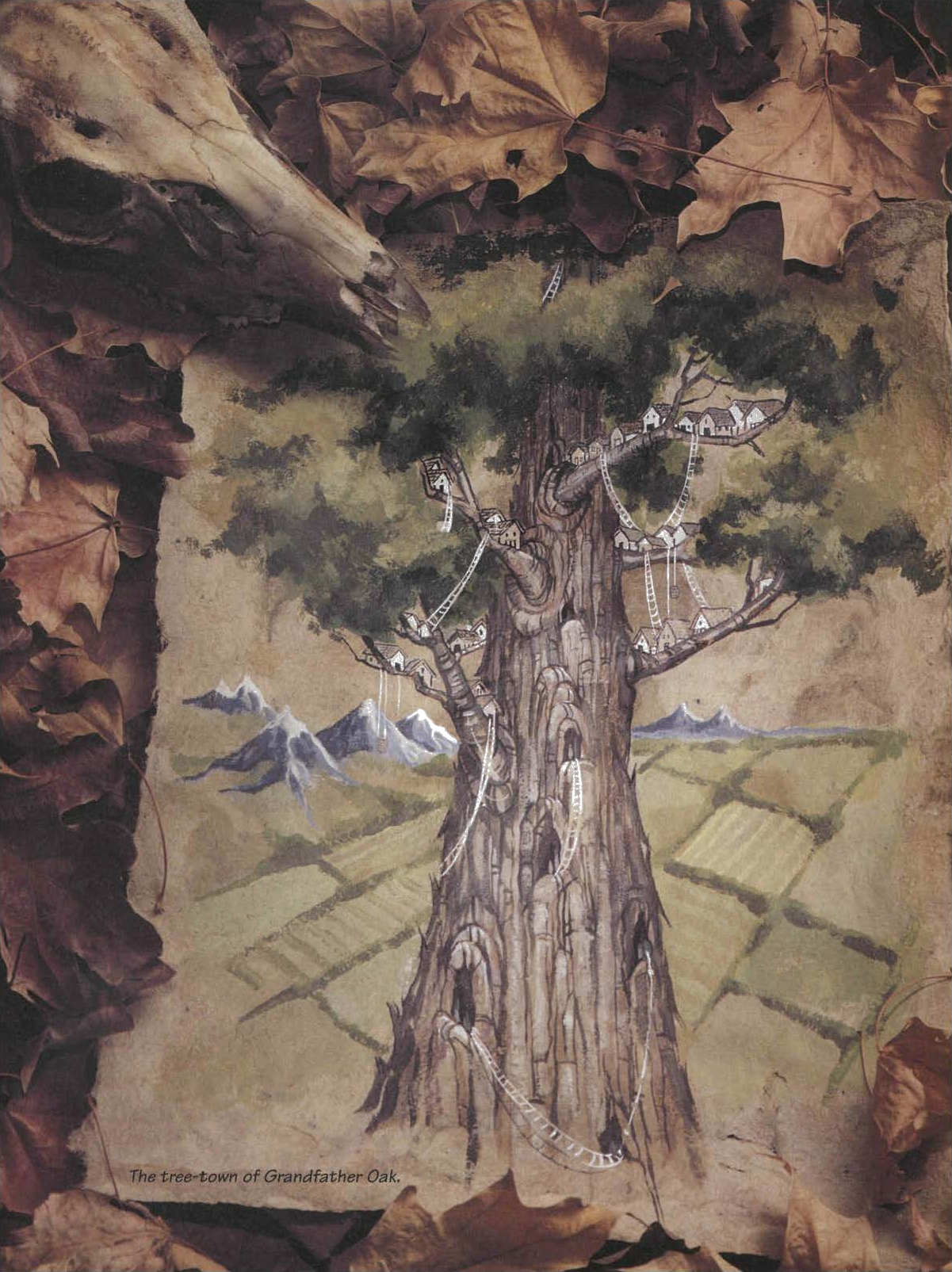
First thing to know is that only the Clueless ask to meet Grandfather Oak. It ain't a person, it's a town, though a cutter wouldn't know that from all the elves who go about calling it "him" or "our grandfather." Entire villages are nestled in his branches, and each one of his flat leaves can bear a dozen elves' weight. The elves'll rattle their bone-boxes about Grandfather's moods, whims, and wishes, but the plain facts are that Grandfather Oak is the greatest and oldest tree of Arvandor, a gigantic tree with entire tribes of elves living in the leafy top and in the wide hollows between trunk and branches. A great dell between two of its roots is a chapel to Labelas Enoreth, the elven god of longevity.
Grandfather Oak's name and respect ain't so strange; just think of the lonely astral sailors who refer to their ship as a woman. The elves have shaped his living wood for countless generations, and elven generations at that. Grandfather's living quarters are built in the higher branches using deadwood brought up from the forest floor. The oldest shelters have become overgrown with Grandfather's wood. The elves also keep many guest chambers, small entrances carved into the trunk itself, like squirrel holes. Food grows on vines and orchards up and down the trunk.
Before rushing off to see Arborea's wonderland, remember that there's a sweaty side to living at the top of an oak. Criminals and visitors are sometimes pressed into pulling up water, earth, and deadwood on the tree's ancient winches and pulleys (if a sweet elven lass asks a cutter to help her, he'd best say no). Since hauling water up the tree is such back-breaking work, the elves also use rain-gathering gutters and huge collection barrels. When an elven cook turns a wooden spigot, water rushes through the spliced branches and pipes and into the pot.
Gnarled and ancient, Grandfather Oak's high-up is himself an ancient treant named Moss-Among-His-Roots, Wind-In-His-Leaves. He's creaky and weathered, even for a treant, with cracked bark, yellowed leaves, split and patched limbs, and a single remaining arm. Lots of berks think that Moss-Among-His-Roots, Wind- In-His-Leaves is dying, but the old tree has life in him yet.
Most planewalkers find that Moss-Among-His-Roots, Wind-In-His-Leaves is too slow about his deliberations (even a yes-or-no question may take a day to answer). A typical preamble to one of Old Mossy's answers runs something like, "Become one with the woods, we are all trees in the forest. Hear the song of the forest, and thrive as the forest thrives. Ponder each action, and grow slowly into the path that leads to joy. Slow and steady, do nothing in haste." And that's him just clearing his woody throat. For quicker action, they turn to Trillamir Evensong, a refined and clever half-elven warrior with an eye for character. His judgments are recognized as just and binding within the limits of Grandfather Oak, though some treants grumble at his "hurried, slap-dash" approach. Tree-folk, of course, outlive even the elves, so most bashers understand that their view of time is more patient than practical.
The gray elves who live around the oak are bound by their own laws, appealing not to Trillamir but to their High King, Labelas Thenorean, and his court. They keep to themselves near Grandfather's roots. King Thenorean's wise rule has been a blessing to the often isolated gray elves, and his many children, grandchildren, and great grandchildren are sought after as advisors in all the elven courts. His warrior priesthood keeps Grandfather Oak safe from giants, titans, and the giant predators that roam the forest floor of Arvandor.
Knights of the post beware: Sharping and robbing are risky here. The entire town turns out for a week of drill and archery practice twice a year, so everyone's a constable. The gray elves post a permanent guard at the roots who catch those who hope to slip away. Patrols wander up and down the trunk both day and night, and even the quickest cutpurse can't outrun arrows. The elves also depend on the warning of the nearby forest creatures; the cries of birds and squirrels are taken seriously.
A berk can't just light a fire wherever he pleases: Boulders have been brought up into the higher branches as fire platforms for cooking, tanning, and metalworking, and building fires elsewhere is forbidden. Since the oak's wood is green, fires don't spread easily except in late autumn, when dry leaves still hang from the branches. Instead of fire, Grandfather Oak is lit with magical light, so he has a soft, golden glow even in windy nights.
All services requiring fire cost more than usual; ironmongering, laundry, hot bathwater, and brewing and distilling all cost double. Leather and horn are rare in town; the elves substitute feathers and a forest form of flax taken from Grandfather's acorn husks.
The Oak was famed for its spider silk eons ago, but the trade died after lolth's followers were banished. The entrances to those workshops have grown over, and, though no high-up has ruled against it, no elves go here. No one knows what remains in the empty spaces under the bark.
The town's elven woodcarvers are exceptionally talented and their work doesn't cost a wagonload of jink. The greatest is Woodmaster Morellian, famed for his black walnut carvings. Morellian is venerable even among elves, for he's seen more than 1,000 summers. He carves only one piece a year, auctioned off at midsummer. Morellian 's apprentice, a strange pale elf named Pomeriel of the Birch, is expected to carry on his work and is said to be a sorceress besides.
Mount Olympus
The Olympian powers themselves dwell in halls and temples on Mount Olympus, which towers above all other places in the realm of Olympus. Far above the clouds and cares of petitioners, a lucky wayfarer may catch a glimpse of the powers as they send their proxies up and down the mountain to their many supplicants. The legends say that just being closer to the mountain brings a faster answer to a worshiper's prayers.
Travelers claim that just by standing on the peak, a basher can see for miles in any direction. Just by focusing right, the Guvners declare, a soul can see almost anything going on within a hundred miles, and sharp-eyed cutters who squint just right can sometimes see into the other two layers of Arborea, to the stormy waters and spiral sea-city of Elshava, in the second layer and white sand wastes of the only realm the third layer.
Mount Olympus is a cloud-wreathed land of plenty, its slopes strewn with abundant olive groves, its lush foothills echoing with bleating sheep and clear shepherd pipes, the south slope home to fertile vineyards, and everywhere the small orchards of oranges and apples. Its woods and defiles re filled with the laughter of satyrs, nymphs, and sylphs.
The best path up Mount Olympus is on the gentle southern slope, where fine springs and vineyards sprout on either side of the path to ease a traveler's thirst. Hidden paths lead through the mountain to other planes; a wrong turn can lead a pilgrim to the depths of the Gray Waste or to a random prime world. The spirits of stone guard these paths, for the powers are jealous of their shortcuts.
The portals of Olympus are open to anyone brave enough to travel them, the way the branches of Yggdrasil are. There's a dark to them, though; Some of the secret paths reveal themselves only to worshipers of the Olympian powers. Others attempting to follow a worshiper on one of those hidden paths are led astray into the Gray Waste. Further, the roads on Mount Olympus are guarded by monstrous hounds, the spirits of the mountain, and per, and the temples admit just the faithful. The mountain's pretty to see in an Arborean sunset, but it's a maze and a waste of time worse than the Hive for those who ain't worshipers. Considering that the portals of Olympus only lead to three Lower Planes and a number of odd Prime worlds, though, doesn't give a basher much reason to go poking around where he doesn't belong.
Each temple has a small outer shrine for offerings and sacrifices, a huge statue of the deity made of ivory, gold, silver, or precious stone. The temples and homes of the powers themselves are the site of many portals to other planes; the entrance to the power's actual home is usually well disguised, some say by Hermes or Pan, the trickster gods, others say by Hephaestus, the smith.
Zeus's domain is the greatest of all, a citadel of polished marble and gold that stands at the highest peak. Here the father of the Olympian gods rules alongside Hera, his wife. Oddly, only their worshipers can see the entrance to their temple.
Aphrodite lives in a nearby palace of mirrorlike quartz and gems, where every surface reflects her own beauty. The entrance is hidden within a magical mirror, and at least one of its paths leads to the Gilded Hall of the Sensates. The stories tell that few who enter can find their way out, and those who do are vain forever after. For many of Aphrodite's worshipers, that don't seem like much of a change.
Apollo's temple and stage of beaten gold radiate internal sunlight. The Sensates love this place, and their poets are often found here declaiming verses to honor the god of poetry. Plays are often in progress in Apollo's amphitheater, a white marble semicircle carved into the southern mountainside.
The lair of Ares is a massive battlement near the portal that leads down from Mount Olympus to all the spheres where the pantheon is worshiped, mirroring the hall of Athena, who dwells in a palace on the far side of that portal. Ares's citadel is said to be made of bone, Athena's of iron. Berks who rattle on about visiting the palaces are probably pulling a cutter's leg, for both are as difficult to enter as any fortress.
Dionysus's palace is overrun with vines, each hanging heavy with grapes. Bacchae keep the hearth burning and the festival going even when the power's away, but few others would dare.
Hermes lives in a den of gambling within the mountain itself. This hall is perpetually shrouded in darkness to the eyes of all visitors except his worshipers, and the entrance to Hermes' cavern sometimes leads somewhere unexpected - after all, he is a power of travel.
Poseidon lives on the second layer of the plane, though he maintains a seaside shrine near Mount Olympus. Hades rules in the Gray Waste and rarely visits Mount Olympus. The lesser powers - such as Artemis, Demeter, Nike, and Tyche - have smaller homes among the huge and dominating temples and estates. Pan and the titan Prometheus live in the hinterlands of the realm, and they rarely come to Mount Olympus at all.
The Gilded Hall
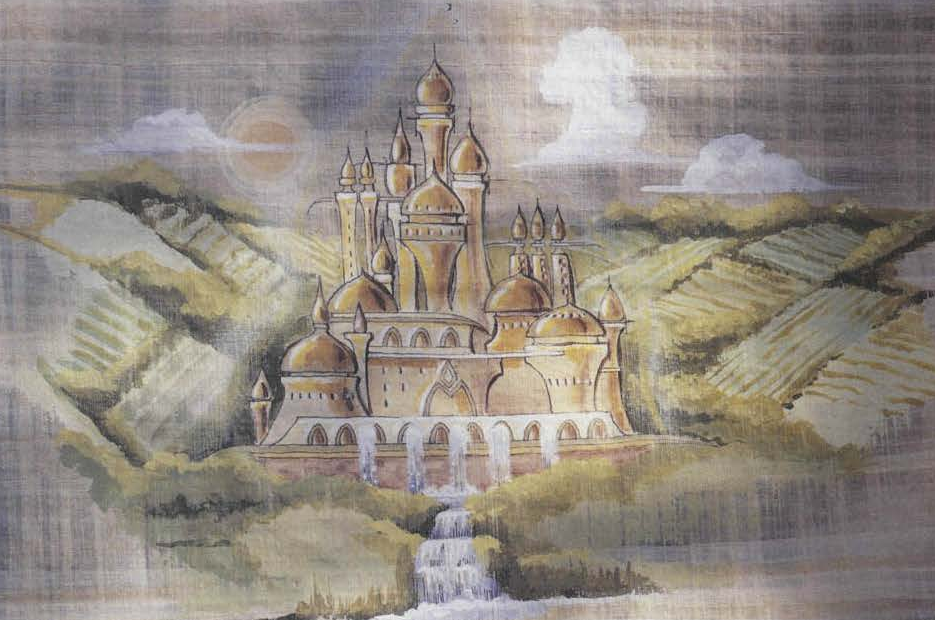
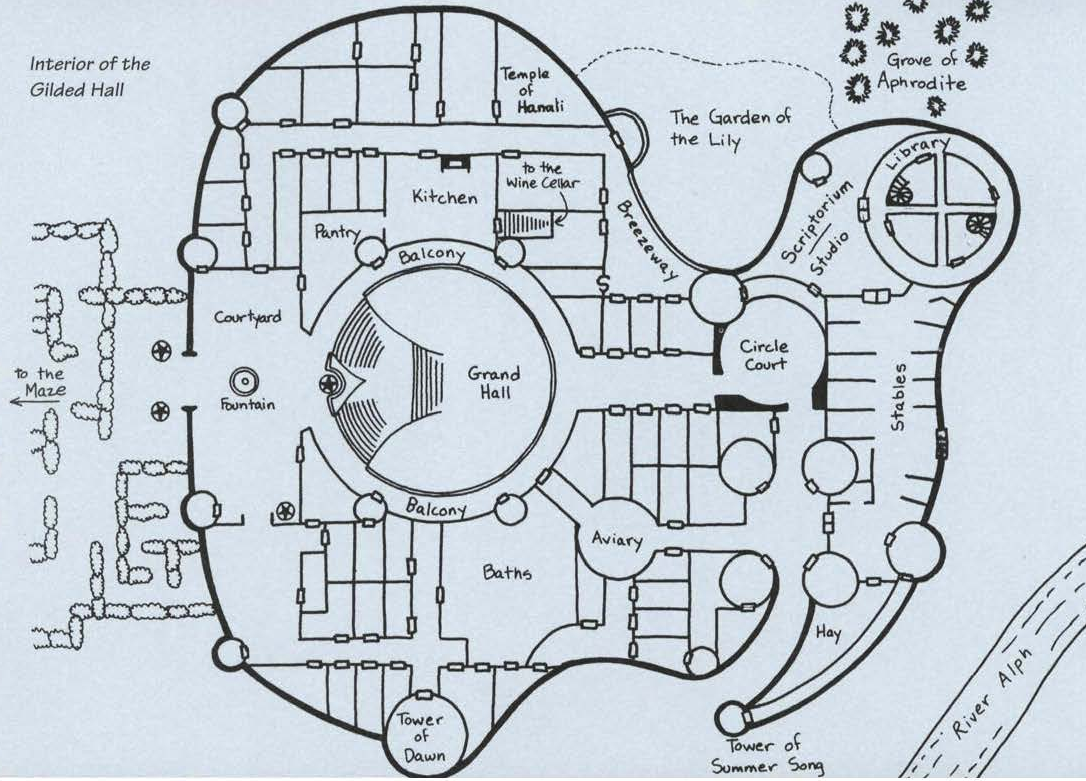
Between Arvandor and Olympus, near the city of Brightwater, lies the Gilded Hall of the Sensates, a place devoted to beauty and pleasure. The festivals never stop here, every race can speak to every other, and all sadness is banished within its gleaming walls.
The Olympians say that Aphrodite herself crafted the achingly beautiful spires and gracefully curving halls of the Gilded Hall, and that the waters of Canathas, the fountain of youth, were used to mix its mortar. Fiends have been killed by the sight of it, so powerful is the Gilded Hall's sharp and piercing beauty. Miraculous cures have been achieved by those who've been allowed to stay by the hall's ecstatis, its magical restoration of the spirit.
The elves have their own name for the Gilded Hall: They call it Perlamia, and visit it as pilgrims. The elves claim that Hanali had a hand in building the hall, laying the enchantments that create its shimmering beauty. Their poems speak of Perlamia as a person, a creature that does nothing but spread joy. Their sagas say that Perlamia sings when the hall is empty or silent, and that it speaks to the downhearted, telling them how to recover what they have lost. Others claim the palace of the Sensates ain't alive, but haunted by the spirits of those caught by its splendor.
Describing the Gilded Hall is a thankless task. It stands midway between the realms of Arvandor and Olympus, and though it lies in the valley between the two, it seems to command the surrounding countryside as surely as if it were atop a hill. The palace of the Sensates has an overwhelming, thundering glory that stops viewers in their tracks and strikes each heart in a different light, as if it were magically tailored to appeal to every eye differently. Bariaur compare it to a tine rearing filly, and dwarves speak of it as being constantly smelted and recast. Elven poets say it lives, constantly breathing, reborn, and they have despaired of finding words for its beauty, its radiance, and the joy it brings to even the most downcast of souls.
The Gilded Hall has been the target of fiendish attacks because of its beauty, which the tanar'ri and baatezu alike cannot abide. Least fiends are slain by the sight of the Gilded Hall, but all others are just enraged by it. Raids from the Lower Planes are common.
In purely architectural terms, the Gilded Hall is a palace of melded, flowing domes and eighteen large and small towers, all thrown together in a way that leads the eye from point to point. Its entrances aren't obvious at first; the visitor must follow a path of discovery toward the entrances, which are hidden behind hedges, walls, or curving paths. Its enormous gardens are always blooming, and the smell of flowers is enough to make a basher sick after a few days. Sensates seem immune to the stench.
The view from inside is almost as dazzling as the outside - wrapped in mirrors and gilded with sheets of gold on every surface. The view is rich, luxurious, and open to all visitors who agree to obey the rules of the Sensates - which are not rules at all, but the motto of the hall : no compulsions, only persuasion.
The party never ceases in the Gilded Hall. Different wings wake and sleep during the night and during the day; dinner parties, hunts, picnic outings, garden parties, masked balls, and all-night drinking binges are all part of the hall's daily schedule. Oddly, the Gilded Hall never becomes overwhelmed with dirt and trash.
Though it brings out the beast in most visitors, the Gilded Hall is one of the few places where the bacchae seem tamed, even civilized enough to bathe. As long as they are within the palace walls, they neither destroy property nor convert others into bacchae.
The Sensates have trouble leaving the Gilded Hall; it traps them like flies in its web, for what fool would want to leave paradise? Some Sensates have lived out their entire lives within the mirrored halls, and it's said many are buried on the grounds.
When the Hall's Sensates aren't drinking and dancing, many of them spend their time looking for Canathas, the pool of beauty that the elves call Evergold. Evergold is the Fountain of Youth, the elixir that halts all corruption. All it takes is a single sip and the years fall away, and a berk becomes a driven man, as commanding and inspiring as a factol. The Sensates are always yammering about it.
But a berk's gotta think: If it were that easy, everyone and his brother would already be as handsome as a Deva, and one look around Sigil shows a basher that ain't the case. The trouble with the Evergold is that its effects are temporary and only the powers seem able to find it - which don't stop every empty-headed Sensate from looking for it in Hanali's crystal palace in Arvandor, or in Sune's sector of Brightwater, or elsewhere. Regardless of where it is, the pool always shimmers and shines with a rich golden luster that make it impossible to mistake for ordinary water. The basher who brings some to the Gilded Hall can name his price.
More Wine? Thank you, I think I will.