The Battlefields of Ysgard
Ysgard's got three layers: Ysgard itself, Muspelheim, a fiery home of the giants, and Nidavellir, the abode of darkness where the dark dwarves dwell. All three consist of earthbergs burning on one side, but the earthbergs grind together constantly in Nidavellir, whereas in the other two layers the earthbergs rarely collide.
The battlefields and mountains of Ysgard are strange; it's weather is as fierce and proud as its petitioners, as stubborn and as violent. Its soaring mountains, deep fjords, and dark caverns are home to the most bloodthirsty petitioners of the Upper Planes. Because Ysgard's petitioners have been slain in battle a thousand times, they have no fear of death: They know each of the valkyries by name. Since the petitioners have no care for their own lives, they live for battle, and they treat all visitors as potential kills. Fortunately, Ysgard's sparsely settled.
This is a plane of biting winds and sharp seasons. Winter's a time of darkness and bitter killing cold. Summer nights bring mild breezes and the midnight sun though the light shines from the burning underside of the great earthbergs. When the earthbergs collide, earthquakes shake the land. Getting from one earthberg to the next is no mean feat: flying mounts and magic help, but the terrific winds of the void are dangerous. The valkyries glide across the void on their winged steeds, but for most sods it's not that easy.
Ysgard's magic is contained in the runes, carved mystic symbols that govern spells. For a few spells, a cutter's got to know not just runes but also kennings, a sort of word play that calls a ship a "sea-steed" and calls an eagle the "vulture of battle." The Ysgardians may all act like warriors, but scratch the surface of a warrior and find a failed poet.
The best-known realms are the realms of the Norse: Alfheim, Asgard, Jotunheim (home of the Norse giants), and Vanaheim. The realms of Ysgard are built around the halls - places of feasts, rich ale, and good company - located near traditional battlegrounds. Don't go to their halls expecting an easy time: Ysgardians are stubborn berks, and they think charity's an insult.
Few towns exist in Ysgard; the rugged petitioners prefer to make it on their own, in small settlements and scattered villages. When they do gather together they meet in the great halls of the plane for mead, song, and battle. Many Ysgardians are members of the Fated. The Fated's fortress, called Rowan's Hall or the Heartless Hall, is a single great citadel of stone and timber, rising like a mountain from the midst of a great forest. Some say there's a conduit to the Outlands from there, leading to the grove of the Norns.
Outside the halls of the Norse, the bariaur, the fensir, and giants live on the fringes. The fensir are an intelligent but secretive race, excellent herbalists but shy despite their size and strength. The herds of bariaur: and clans of giants roam the plains between the Norse halls. The bariaur flocks roam from hall to hall, never staying anywhere long, and always ready to defend themselves from the bloodthirsty petitioners. Most petitioners leave the bariaur alone, but a few leatherheaded, glory-seeking fools never realize that the bariaur aren't reborn each morning. As a result, the bariaur shoot first and ask questions later. They travel a fine line between the good grazing of the plains and meadows and the desolate safety of their lonely winter steadings in the hills and highlands. Like all nomads, the bariaur are difficult to track down. No one knows where they'll show up, and that's the way they like it.
It ain't all Norsemen in Ysgard. Far from the Norse halls, the moon gods rule a silver realm on a milky sea, a place called the Gates of the Moon. Rumors say that the waters surrounding their realm are slowly drawing the River Oceanus over the boundary from Arborea, connecting Ysgard to the planar highway, but the link is as changeable as the tides. The whole place is guarded by werebeasts and a race of snake-women proxies called the lillendi. The cat-goddess Bast also keeps her realm here, a place of celebration, pleasure, and stalking, sharp-clawed denizens who'll spring at a cutter the moment she turns her back. Ysgard may be counted among the Upper Planes, but not all of its inhabitants are as upright as devas.
The World Ash, Yggdrasil
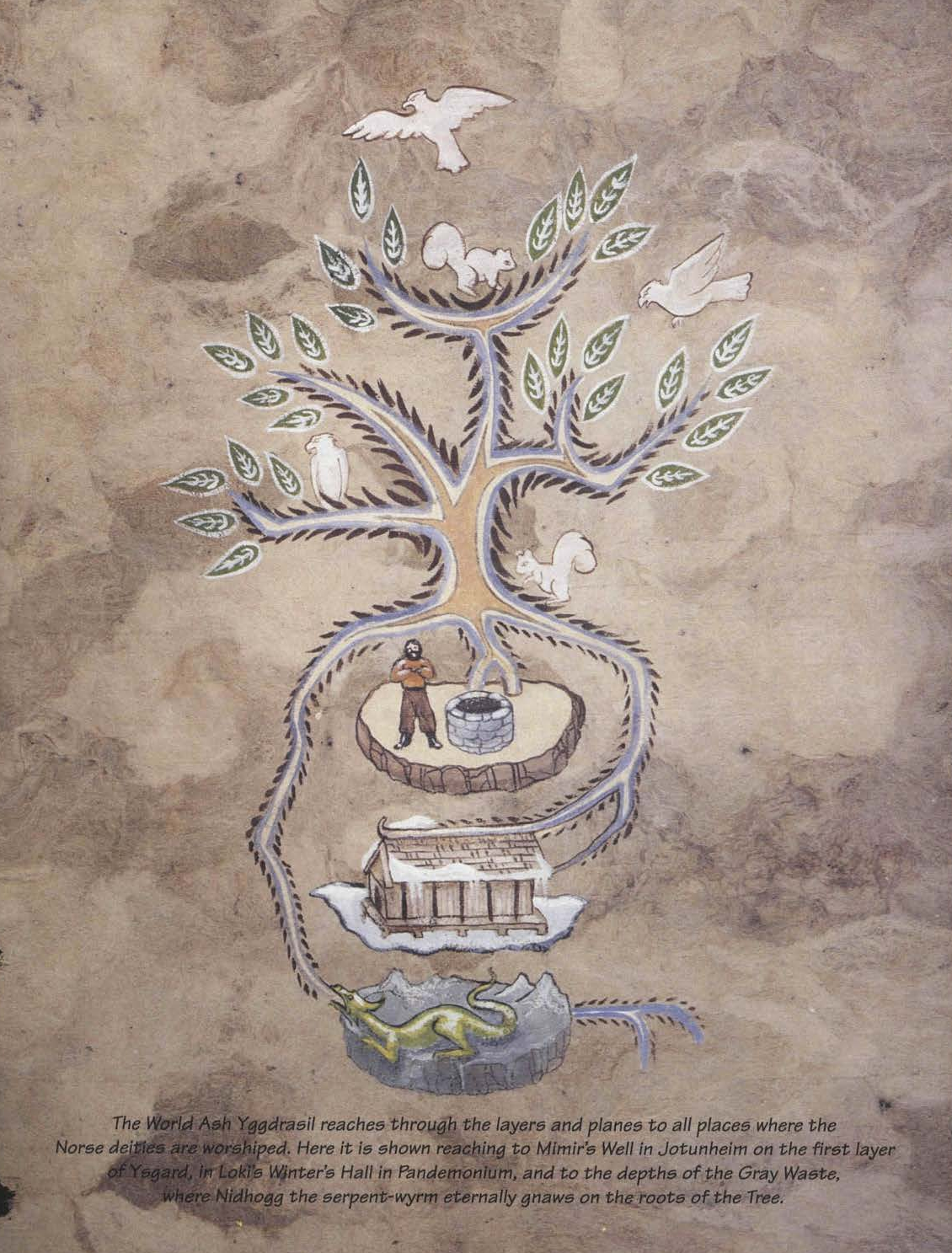
Yggdrasil's an odd place, even among the planes. It's a tree, but it's also a portal, a great highway between the planes. It's the home of the ratatosk, the squirrel-folk. Never give one of the scampering little monsters a handout; he'll follow a berk forever waiting for another. Instead, hire the ratatosk as guides, for they know every branch and portal of the great tree, even the root that is said to lead into the rafters of the Carpenter's Guildhall in Sigil - though some say it ain't the guildhall but the gallows.
Bloods among the Athar say that the Norse pantheon gained its power from the World Ash; every cutter knows the story of how Odin, their high-up man, hung from Yggdrasil for many days and nights until the runes were revealed to him. Less know that when the final days and Ragnarok is at hand, the prophecies say that Nidhogg the serpent-wyrm will gnaw through Yggdrasil's root. When the tree falls, so do the Norse powers.
Yggdrasil is a silver-barked ash, a tree with shimmering blue-black, oval leaves and a very rough, flaking bark that resembles a plowed field of gray clay. Footing can be treacherous, though spiked boots help. The branches rise from Yggdrasil's trunk like... well, like enormous trees. Branches are miles long, and not all of them have portals at the end, so long dead-end detours are common for groups traveling without a guide or directions.
The World Ash is guarded by creatures that never leave its shade, creatures that live and die on its bark. Yggdrasil's eagles and the ratatosk are the least of them. All along its length, Yggdrasil's bark and heartwood are home to enormous burrowing beetles, and its leaves and fungi feed entire herds of wild boar. The biggest and most terrible guardians are at the gates, where the roots and branches reach across the planar boundaries - for instance, at the World Ash's access to Niflheim. Called the land of mists, Niflheim is a layer of the Gray Waste that lies below Yggdrasil's roots and is guarded by Nidhogg, a fell dragon that'll put a berk in the dead-book and crack the bones he leaves behind. Even the battle-hungry Ysgardians think twice before making those trips.
Besides Nidhogg, other guardians include aasimon in the upper branches, yugoloths in the lower ones, and Heimdall's petitioners near Ysgard. Many a high-up wants to control the entrances to his realm, but, because Yggdrasil's branches are often shifted by astral winds, the gates move from place to place, as a tree's branches sway and bend.
Mapping out Yggdrasil's branches is difficult work, but the list below covers the best-known and most reliable portals of the ancient ash: to a cavern near Glorium, into the heart of Ysgard, deep into the foggy wastes of Niflheim, and to the Prime. Its smaller roots reach Loki's secret Winter Hall in Pandemonium, the Nom's well in the Outlands, the sunny glades of the elves of Arborea, and the cold plains of Jotunheim among the giants. In fact, Yggdrasil's branches reach through the worlds and planes to every place where the Norse gods are worshiped, so there's more branches than taverns in Sigil. Just because a cutter knows where he's going doesn't mean that he'll get there.
Yggdrasil connects planes very quickly and directly, and few journeys on the World Ash take more than a week. However, traveling along the trunk isn't without risks. Other than its creatures, the risks include falling into the Astral and walking down the wrong branch to an unexpected plane.
Falling is a problem because gravity shifts along Yggdrasil's mountain-sized trunk. Along long sections it's simply toward the center of the trunk, but as a planar portal approaches, the great tree's gravity slowly matches local gravity. What this means is that a traveler can suddenly find herself walking along the bottom of a branch and plummeting to her destination much faster than she intended, head-first. A smart traveler watches to see where the moss is worn into a path to see which side of a branch-portal is safe.
A traveler can fall into the Astral if he loses contact with the plane-spanning wood. Unless he can grab it again quickly, Yggdrasil usually dumps the victim into the middle of the Astral. Companions leaping off after him, and ropes thrown out after him rarely snake through the planes to quite the same spot. Ratatosk and other native creatures are immune, but others need to keep a tight grip.
Walking along the wrong branch can lead a berk out into a forest that ain't part of Yggdrasil, a forest of viper trees in the Gray Waste, or the High Grove of Alfheim, or even a scrawny woods in the Prime. To get back, turn around immediately and climb the nearest tree; sometimes it works, sometimes it don't. This is what the ratatosk call "falling off the Tree."
Down the tree is easy; back up is hard.
The Ring-Givers
(Bargainers, Beggars)
Sect Philosophy
The universe belongs to those who can give it up. A berk only gets as good as she gives: Whatever a great blood gives away comes back to her. If she can give her last morsel and convince others to do likewise, all the universe will be laid at her feet. Barmy as this might sound to a tiefling on the streets of Sigil, in Ysgard it actually seems to work.
The lust for material things binds a soul to the universe, keeping a berk in debt to it; poverty releases it from bondage to the world. The multiverse is a set of sticky traps to catch the greedy. A berk who ignores it can control herself and the universe.
Through poverty, a cutter gains her heart's desire: peace, power, or affinity to the gods. A great leader gives everything to her followers. A great magician spends all she has to gather knowledge, and a great priest devotes her life to a power.
Primary Plane of Influence
The Ring-givers are slowly gathering power around the Great Ring, but at the cost of seeing their beliefs interpreted differently on other planes. They are powerful in Ysgard and Limbo, and rapidly gaining followers in Pandemonium (if a basher doesn't have much, it isn't hard to give it up) and - oddly enough - among tieflings and bards in the Abyss. Abyssal Ring-givers believe the universe owes them something in exchange for their gifts. These Ring-givers can make pacts with tanar'ri that the fiends (sometimes) honor for a time, and for this reason they are sought after as guides in the Abyss.
Allies and Enemies
Though they share the same plane, the Bargainers and the Fated hate each other. The Fated can take what they want from the Bargainers (and do), but they always seem to pay for it in the end. The Bargainers consider the Sensates depraved, willingly throwing themselves into the universe's traps.
The Ring-givers are allied with the Ciphers; both agree that action is the key. The Ciphers just don't know that giving is the right action.
Eligibility
The Ring-givers are open to all races, classes, and alignments, though lawful and evil members are less common than chaotic and good ones. Most rogue members are bards, not thieves. Its priests serve powers of ideas and abstractions. No Ring-giving priest serves a power of material things, like creation, wealth, or the elements.
Benefits
Anyone who accepts gifts is obliged to the Ring-giver. The Bargainer gains a +1 to +4 bonus to her skillchecks with that person, depending on the gift's value. In addition, a Ring-giver can spend inspiration to claim a favor from an NPC no more powerful than twice her own level. The favor depends as much on the NPC as on the Bargainer: Abyssal lords provide much smaller favors than petitioners. The DM must judge the Ring-giver's generosity and lack of material things and adjust the NPC's obligation accordingly.
Restrictions
Ring-givers never own anything; they accept gifts and wealth but always pass them on. They share spells freely and even give magical items away to strangers after a few days. Ring-givers neither buy nor sell anything - others provide food and shelter, or they make them for themselves. Evil Bargainers never give gifts without claiming favors later.
The High Grove of Alfheim
The elves of Ysgard gather for two great fairs each year in Alfheim. Both take place at the High Grove, at the spring and the autumn equinoxes. The spring festival, Freya's Fest, is a dance that celebrates the return of the land's fertility, with the petitioners leaving two by two until dawn, when the field is empty again. Frey's Fest, the harvest festival in the autumn, is a huge gluttonous feed, a chance to show off riches, a time for wasteful display by the richest cutters, and a chance to see old friends and make new ones before the days grow short and winter sets in. Every elf is welcome to share the revels.
The High Grove itself is a stand of more than a hundred enormous sequoias, redwood trees standing hundreds of feet tall and as much as 50 feet wide. The trees are connected by rope bridges, and platforms circle some of the larger giants. These platforms are the dancehalls of the elves. The staircases that lead up to the platforms wind around the outside of the trees to the first branches, a hundred feet above the ground. At night, the visitors curl up in softly lined nests carved into the trees, or sleep on the gently swaying branches.
It's a bit of a secret that both gatherings serve a higher purpose for the elves, since they provide spell energy for quest spells for the high priest and priestess of Frey and Freya. Sometimes these quests are for rich harvests, sometimes for revenge, and sometimes for protection from enemies, but the elves always keep them as secret as they can. If a visitor ain't an elf, he ain't welcome at their private parties, though a few berks say there's a way to creep in undetected. If there is, no one's rattling their bone-box about it - and no wonder, since the elves would surely feather the poor idiots with arrows as soon as they heard about it.
In the summer, a small pack of ratatosk come to guard the High Grove. In winter, a great and powerful druid called Lindissen of the Bent Oak watches it, and the elven powers a watchful eye out as well. The grove may be silent most of the year, but it's never empty.
Breidablik
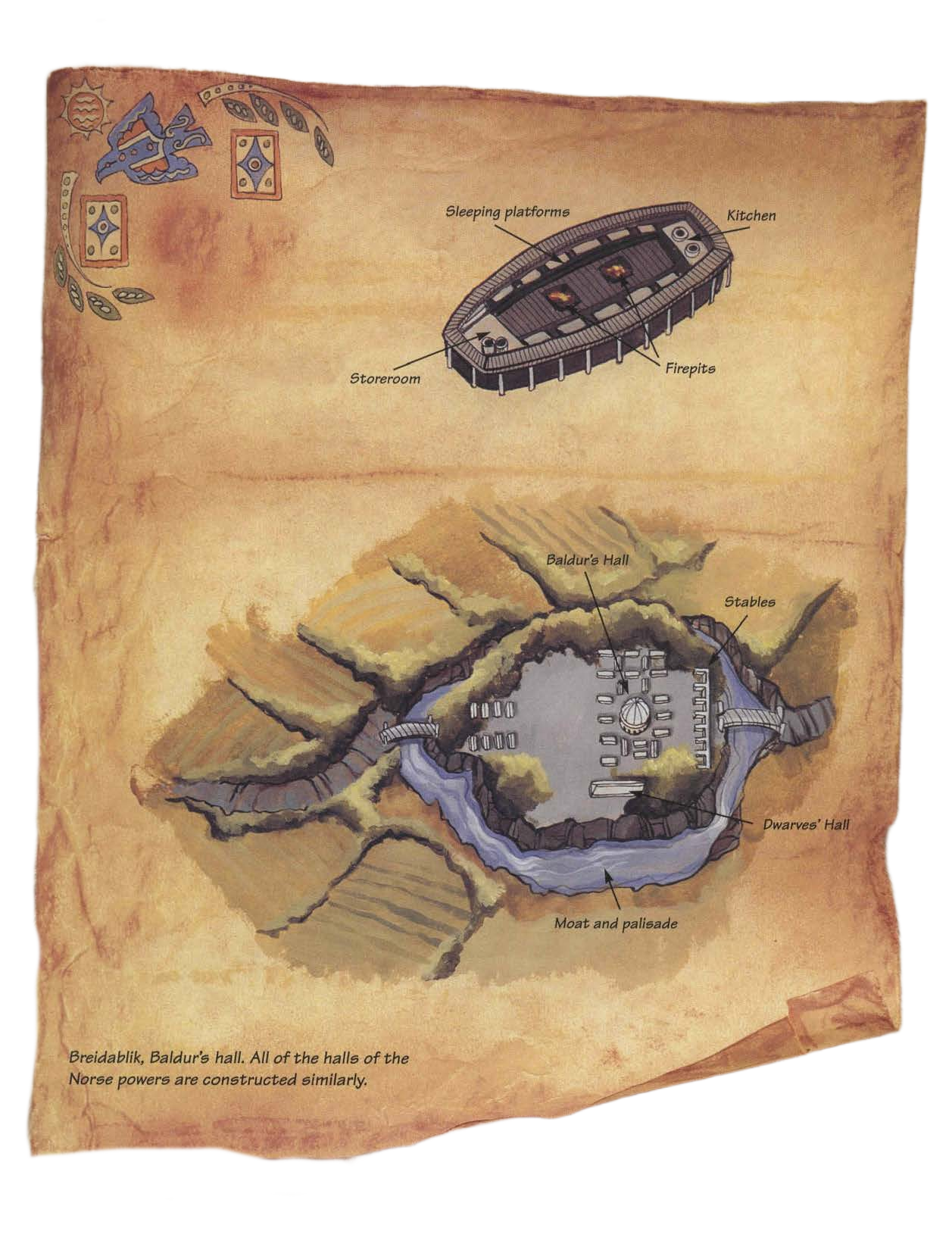
Every basher with a pair of eyes agrees that Breidablik, or "Broad Splendor,'' is the most beautiful hall of the plane. Baldur's standards are very exacting; only the most beautiful petitioners are found here, all others are turned away. Though they are as capable of feats of valor as others, they're more vain, and mocking their fear of scarring is a sure way to start a fight.
Those who know say that Breidablik is as beautiful as the Gilded Hall of the Sensates, but rowdier, more full of life, blood, and spirit. Breidablik has an unconscious beauty, a handsome face that doesn't know or care about its power over others. Even with a black eye, scars, or a broken nose, Breidablik is fair, graceful, and proud.
Though Baldur, the god of beauty and charisma, owns the hall, he spends little or no time here, occupied as he is elsewhere wooing beautiful powers and rewarding his followers. The Wise Councilors of Baldur the Beautiful act as the hall's rulers in his stead. There's one councilor for each of the aspects of Baldur the Beautiful: a warrior, a sage, and a handsome man. At the moment, these three are Jarnskeggi the Snow-haired, Nauma the Hair-splitter, and Toki Melnirson.
The entire eastern wing of Breidablik is an enormous stable, where Sleipnir is said to have been born. The white horses are famous for their patience, their loyalty, and their intelligence, but they aren't for sale. All the white horses of Breidablik are loaned to heroes of the hall by the Wise Councilors, much as a liege loans land to a vassal. At Baldur's whim, he provides his horses as favors to his champions when they go on a quest.
Each pillar is carved with the faces of Baldur's bravest and most handsome followers, thousands upon thousands of them. Some of these are overlaid with hammered gold or silver, and the sagas say that each face is a petitioner who now lives on, absorbed into the plane. It's said that a priest of Baldur can call upon the knowledge of any of them by casting a Speak with Dead spell; since many of them were great warriors or mages, this is no small feat.
The goblets in Breidablik are all jewel-encrusted, even if only with mica, agates, or pyrite; a toast is a bright, glittering thing in Baldur's hall, where it is truly, as the kenning has it, a "feast of stars." The poets claim Breidablik's toasts are blinding, but they've been known to stretch the truth.
The soldiers of Breidablik are the only militia in Ysgard with uniforms - but none of the uniforms match. Every petitioner carries a blazing spear, Baldur's weapon. Bright cloaks with gold stitching are common, as are weapons with gold inlays. Though the dazzling look of the troops make some addle-coves think they're easy marks, in fact Baldur's petitioners are as fast and strong as any. Their bards claim that they are even more dangerous because Breidablik's petitioners place more importance on battle magic than most Norse petitioners.
Fine clothes, rich jewelry, and other beautiful things are sold from the long tables in the Dwarves' Hall. More than anything else, the Dwarves' Hall is known for its goblets and embroidery. One old crone by the name of Lena Svavasdottir sometimes wanders the outer chambers and courtyards of the hall selling potions of invulnerability to any champion who undertakes a quest for her, but when she does she's mobbed by willing heroes, so striking a bargain with her is as much a matter of luck as skill.
Breidablik's bards are, without question, the best of the Norse skalds. Unlike the bards of other halls, they sing of the glory of wealth, beauty, and love as well as the glory of battle. Novice bards can learn much from Baldur's followers, especially the art of insult and satire, but these skills are shared only with the greatest of bards.
Breidablik has seen three evil omens lately: ravens roosting in the eaves, a raiding fensir who carried off a brewmistress, and a thousand barrels of wine that suddenly soured into vinegar. No one is sure what has drawn the Norns' wrath, but the petitioners are expecting raiding parties and demands for sacrifices soon. Dark rumors say that a lottery will be held to find a victim for a sacrifice in the old style.
Several dwarves have died of poisoning lately; no one knows who did it or why, for their goods remained untouched. Some bards claim that the dwarves sold false gemstones or gold tainted with base metals, but others say that the dwarves weren't forgers, but spies from Nidavellir. A few claim the deaths were faked. The dwarves have demanded a hefty weregild, a bloodprice, or they threaten to take their own vengeance. The Wise Councilors are considering banning dwarves from the hall entirely, though their glittering wares would surely be missed.
The Infinite Staircase
The Staircase is the goal of every longing heart, the road to every dream. Stories tell that it appears Selune's hall of silver when the moon is full and the fog creeps up from the shore, and its stairs lead from the Gates of the Moon to all the cities that exist, anywhere in the planes, or to all the cities that ever were or will be, from the cities of the devas (though they have no need of stairs) to the darkened halls of Dis and the other anthills of Baator.
The staircase doesn't just lead up and down, but in all directions, and its gravity changes from landing to landing. Each landing has its own door, and each door is said to lead to a different city. Some say that the Infinite Staircase is the best shortcut on the Great Ring. Here’s the chant: The keys to the doors of the Infinite Staircase are mysteries, riddles, and puzzles held by the lillendi, the snake-women that rule the Gates of the Moon. Those who offend the Moon Goddess are said to be thrown into the Infinite Staircase and trapped here by her servants.
The stories all say that the staircase is a gigantic spiral, winding through all time and space. What they don't say is that it's an architect's nightmare. Each segment of the staircase is different, from winding staircases to sweeping open stairs, narrow passages, steep stone stairs and broad wooden ones. The staircase is lit almost everywhere by torches, lanterns, or magical lights - the dark passages are said to lead to nightmare cities where all magic fails or where visitors age, wither, and die.
It's easy to get lost, as stairs branch off in all directions and circle round each other. Some even say that the Staircase is never the same path twice, that it is always under construction (though its builders are only heard and never seen), and that strange creatures of elemental time supervise its operation. Though the staircase leads everywhere, it's not easy for a basher to get where she wants to go. Since each landing leads to a different city and the staircase leads to an infinite number of different planes, not everyone can find or open the right door. Legends say that a cutter can travel the staircase to the city of her heart's desire, but only once. The only is that if a soul finds her desire, why would she ever want to leave?
The truth is only visable under moonlight.