The Nature of Limbo
Any cutter beaded for Limbo needs to be aware of the plane's chaotic elemental nature. See, Limbo's composed of this sort of stew of things. The broth is unformed earth, air, fire, and water in such a thorough mix that it doesn't really resemble any of its four elements. The natives call this background elemental mix by lots of different terms: broth, soup, chaos matter, and primal chaos, for a few examples.
Chaos matter is hard to describe to those who haven't experienced it before. It's a sort of swirling, hazy, dry fluid that's just opaque enough to cut off visibility beyond a few yards. And there's no inherent gravity to it; a berk just hangs there. Problem is, a body can't breathe it, and it dissolves things it comes in contact with. Somehow, though, the slaadi are immune to its effects - they swim along through it comfortable as can be- and Limbo's petitioners actually take their physical being from this broth, so naturally they're comfortable in it too.
But don't go getting the idea that primal Chaos just stays chaotic. It isn't even stable in that way. Parts of the-soup are forever coalescing into more normal types of terrain - meadows, mountains, streams, and even woods - eventually to dissolve back into broth.
What makes Limbo liveable to souls other than the slaadi and petitioners is that the chaos matter responds to a thinking being's will. So just by concentrating on the task, a cutter can make it coalesce into ground, with breathable air, regular gravity, and even plant life. Matter of fact, really bright individuals can think buildings into existence, and real geniuses can even create animals. The Terrain Maintenance Table at the bottom of this Page reveals how big a radius of terrain and how complex an environment a cutter can will into being.
The problem with this trick of thinking terrain into being is that as soon as the cutter stops concentrating, it all start dissolving back into soup. However, there are some souls with the innate ability to maintain terrain without specifically concentrating on it. The natives of Limbo call them anarchs. Apperently, being an anarch is like having a perfect memory: Beings are either born with it or they're not. But unlike a soul with a perfect memory, an anarch's talent has to be trained to work. Somehow, the native cultures of Limbo have a way of recognizing budding anarchs from the rank and file, so that they can train them in the chaos-shaping proficiency.
Breathe the fire;
Walk the air;
Drink the Earth;
Warm your hands at the water.
The Anarch's Guild
(Chaos Masters, Groundsmen)
Sect Philosophy
Unlike many sects, the Anarch's Guild has a specific local focus of purpose, rather than one that can be adopted across the planes. But in this case, the term "local" still covers a lot of ground, because the sect is pretty widespread within Limbo. Outside that plane, however, the sect has no real purpose to speak of, so the chance of encountering one of its members elsewhere is just about nil.
See, the Anarch's Guild exists specifically to train anarchs in the chaos-shaping proficiency. And since chaos shaping works only within the mutable conditions of Limbo, there's not much point to the guild elsewhere. That's especially true considering how valued anarchs are in those areas of Limbo inhabited by anyone but slaadi and petitioners. Other races dwelling here need an anarch or two if they want to assure that their habitations continue to exist. So they treat anarchs as something special. As a result, not too many anarchs have any reason or desire to wander away from home.
It's a cushy job.
Primary Plane of Influence
Limbo. Go figure.
Allies and Enemies
There really aren't any traditional allies or enemies to this guild, other than those applicable to the githzerai in general.
Eligibility
The Anarch's Guild is actually a githzerai institution. Given how insular the members of that race are, it's a wonder that anyone from any other race ever learned the chaos-shaping feat. Nevertheless, over the ages the githzerai have taught a few non-githzerai souls here and there, usually in return for some really great service to a githzerai cause. Some of those individuals, in turn, set up their own training schools in other places, following the Anarch's Guild's traditions and teachings, but not officially recognized as branches of that guild. Whenever the githzerai refer to a branch of the Anarch's Guild, then, they specifically mean one in a githzerai city. To anyone else, the title refers to any location that's teaching chaos-shaping mastery, githzerai or not. Adventurers should be aware, however, that some of the non-githzerai branches have really bastardized the traditional teachings, and there's no guarantee that they know anything about chaos-shaping at all.
Benefits
The main benefit of being a member of this sect is the chance to learn the Chaos-shaping feat. Those interested should be aware that in the hands of a master, higher levels of training in that feat allow for some really amazing effects. For example, githzerai cities are noted for being of such large size that only a god should be able to maintain them. There are three possible reasons for this: There are lots of genius-level githzerai anarchs; githzerai anarchs divide up sections of the city and maintain them separately; or githzerai anarchs are able to train themselves to achieve phenomenal results with chaos-shaping.
The first possibility - though conceivable- doesn't seem likely. The second possibility is contradicted by the fact that the anarchs in each city tend to dwell close together, typically within one centrally located Anarch's Guild facility, and that puts them away from areas they would need to be inhabiting in order to maintain. The third possibility, however, is very likely, especially given that githzerai cities typically possess exotic wildlife that's probably thought into being rather than culled from some other plane.
Restriction
Members of this guild have a duty to help maintain their local city. Anarchs found wandering the planes as adventurers are usually scorned by their fellows. 'Course, the most significant restriction is that chaos shaping doesn't work outside of Limbo.
Those who control the terrain, control the battle.
The Converts
(Chameleons, Turncoats)
Sect Philosophy
It's a common saying among Chameleons that the more a body learns, the more questions he has. Learning is, more than anything else, a process of finding out how little a body really knows. Just as soon as a body thinks he's learned the dark of things, along comes a new bit of information to prove him wrong. Eventually a soul has to admit that the multiverse is too big for a mortal to ever really understand. Even the powers seem in the dark as often as not, so only a berk ever swears that anything's 100% sure.
But that doesn't stop people from frying to understand. See, believing exactly nothing leaves a berk with exactly nothing to do. A body can't chart a course of action if he thinks every direction is equally senseless. So people go about their lives, piecing together things they learn, till they've got some sort of workable structure of beliefs to guide their actions.
Problem is, all too many berks try to make those structures permanent. They start ignoring bits of knowledge that contradict their views, and start harping on the points they're most sure of. Pretty soon, they're preaching their credos to everyone who comes along, as if convincing enough other souls makes their theories the truth. But deep down inside, where they won't even admit it to themselves, they're full of fear that they might be wrong. Meanwhile, the multiverse just goes on about its business, not giving a fig for what they do or don't believe.
On the other hand, there's something really liberating in a soul admitting he don't know for sure how things work. Cutters like this still have to come up with some theory to live by, but they know it's artificial, so they keep in mind that it's only temporary. The more they learn, the more they revise their theory, and when ultimately they see something that works better, they chuck the old theory out with few regrets. They know that while they'll likely never find ultimate Truth, that doesn't stop them from working on improvement.
Primary Plane of Influence
The Converts are strongest in Limbo, where nothing is for certain, and it seems that the sect took its start here. But the group also suits the Outlands, where balance in all things is emphasized. The Converts have no factol, being instead a free league of like minds.
Allies and Enemies
The Converts are considered too much of a null cipher to have enemies or allies, except those of whatever faction they currently adhere to.
Eligibility
Membership in the Converts is open to any race or class. But creatures of lawful alignment never join, because they cannot accept the sect's teaching that there is no way of knowing ultimate truth.
Benefit
A Chameleon can belong to one other faction, as long as he meets its prerequisites. He gains the full benefits of that faction. Later, he can change to a different faction, losing the benefits of the first and gaining those of the second instead. He can do this any number of times.
Restriction
While belonging to another faction, a Chameleon is subject to its restrictions. In addition, once he has left a faction, he can never return to it. He's come to see the limitations in its world view.
Oh! I'd never looked at things that way. I can see your point. Can I be part of your faction now?
Limbo's Natives
All right. So a basher's ready to go to Limbo, aware that the terrain is perpetually in flux, but knowing that it can be stabilized by a strong will. She sets off, confident that she can impose order on the place. All problems taken care of, right?
Wrong. Because a basher can't impose order on the natives. They have to be related to on their own terms. Trouble is, this is one area in which Limbo is so exceptionally chaotic that it isn't even consistent to its own inconsistency. A basher can't even trust the plane's inhabitants to be dependably chaotic. Most of them are downright orderly in some ways, at least sometimes. A traveler has to know the dark of who acts how and when. This is especially true of the slaadi and githzerai.
Githzerai come in two types: hardheaded and stubborn.
The Slaadi
Some cutters have characterized the slaadi as basically giant, carnivorous frogs that just happen to be able to talk - and that description is fairly apt. For most humans, it might be easiest to compare the slaadi to barbarian nomads. The creatures have loyalty to nothing but their own kind, and have respect for no other culture. They seem to view all other creatures as beasts to be used as they see fit. Slaadi cannot be reasoned with or bargained with; they cannot be bought off with tribute nor appealed to for mercy. Like the Fated, they consider themselves to own whatever they can take.
This all springs from the slaadi reverence of personal strength. And that, in turn, arises from their physical relationship with the plane of Limbo. See, the slaadi are perfectly at home in the raw chaos of Limbo's primal matter. This means that they have no real need to collect personal possessions. A slaad just takes what it wants, when it needs it. So to their minds, the being most able to take is the being most revered. In other words, strongest is best.
The slaadi see nothing wrong in a stronger being forcing a weaker one to do its bidding. This attitude is so ingrained that weaker slaadi would never think of banding together to overthrow a bully, the way that humans do. Instead, they consider it a stronger slaad's right to bully them.
By the same token, this affects the slaadi's mode of battle. Whether hunting or raiding, they never actually cooperate in combat. If four slaadi were facing one human warrior, for instance, they would take turns fighting that soul. Only if the first slaad were defeated would the next begin to fight, and so on. On the one hand, this means that one good fighter could conceivably hold off an entire horde of slaadi. On the other hand, it means that the fighter can't just defeat their toughest member and scare the others away. And that tenacity can be bloody annoying when a basher's trying to leave in a hurry.
One very important note for new visitors to Limbo: Relative strength among slaadi is reflected in forehead markings. Red marked slaadi are the weakest (though they're still the equivalent of a seasoned warrior). Blue are stronger, green moreso, and gray absolutely deadly. Once in a great while, a basher might actually meet something even tougher: a death slaad. That's nothing to worry about, however. See, for most cutters a death slaad means instant destruction, and worrying about it ahead of time won't make things any better.
The Githzerai
Technically, the githzerai aren't really native to Limbo; they originally came·here from elsewhere. But they've been on the plane for so long that most cutters consider them natives. In terms of their behavior, however, their extraplanar origins certainly tell.
Originally, the githzerai ancestors were humans enslaved by the evil illithid race. Eventually they were lead to freedom by a great female warrior named Gith. Upon gaining that freedom, the people immediately became divided. According to legend, a man named Zerthimon came forth to challenge Gith for leadership of the newly freed slaves. A great battle was fought between the two factions, in which Zerthimon was killed. But his followers fled to Limbo, where they became the githzerai. The rest of the people became known as the githyanki, and took up residence on the Astral Plane. The two groups have hated each other ferociously ever since.
Because of their histo1y as an oppressed race, and a splinter group of it at that, the githzerai are a suspicious, insular people. Unlike the githyanki, they're not evil, but they're certainly not at all friendly to outsiders. They burn with the fires of fanatical faith in themselves, and hatred toward the githyanki. This leaves them little time or energy for other things - such as dealings with outsiders. Consequently, cutters who visit a githzerai city feel always on the outside of things, and continually scrutinized as a possible agent for the hated githyanki. Foreigners are expected to stay within prescribed areas of githzerai cities, unless they're escorted by a githzerai, and woe betide the berk who decides to "go walkabout" outside the foreign quarter.
As intense as the githzerai are, some souls find it difficult to consider them chaotic. But keep in mind that while the githzerai are fiercely loyal to their race and ultimate leader, theirs is the loyalty of individuals, not the compliance of slaves. Having escaped from bondage once, they prize individual freedom above all else.
Pinwheel
Deep within Limbo's ever-changing soup lies one bit of terrain that remains surprisingly constant throughout time without the preserving attention of powers or anarchs. Most commonly referred to as Pinwheel - due to its constant spin and the streamers of half-formed matter that cling to its edges - this location is the site at which the World Ash Yggdrasil connects to the plane.
For most beings, the fact that Pinwheel is home to a branch of Yggdrasil is explanation enough for the island's existence. As they see it, Yggdrasil reaches into Limbo and, by virtue of its own stability, imposes stability on this locale, giving rise to the island. But other souls aren't so sure. They point out that Yggdrasil isn't a thinking being, so it doesn't make sense for it to impose stability on Limbo's soup. To their mind, a branch of the World Ash could just as easily drop into chaos matter without any local effect at all - and in fact, that's more probable. So they suspect that Yggdrasil reaches here because Pinwheel is stable, rather than the other way around. That leaves, then, the obvious question: How is this island stable without a guiding intelligence?
A lot of beings have suggested theories to answer that question. Some say that obviously Pinwheel is the realm of a forgotten power, one who's destined to return some day and claim it once again. Other, more scholarly types hypothesize that the island is the center of Limbo, and that as such it's a sort of focal point, so naturally it remains solid. A few berks even say the island itself is a sleeping god, and offer it worship.
'Course, to most cutters it doesn't matter why the place exists, it's just enough that it does.
Pinwheel is a vast disc of forested ground 150 miles in radius, with its own gravity and an envelope of air. It's heavily forested, and the forest ranges from pine and fir near the site's raised center, where Yggdrasil can be found, to humid jungle at its edges. The site serves as home for an incredible variety of animal life, including some really big, really vicious types. As a matter of fact, Pinwheel's animal population is so thick, and so savage, that no one tries to dwell here.
Pinwheel bears a lot of similarities to normal islands on other planes. For one thing, it has a roughly circular shape, though that's a bit misleading. The really solid, stable area is more kidney-shaped. But as the island spins within the soup of chaos, that chaos matter coalesces into bits of ground that swirl out like streamers from the coastline. And in the indented side of the island, an eddy is caused in a whirl of chaos matter as Pinwheel spins. Within that eddy, the streamers are longer, thicker, and more entwined, filling in the indentation to give the island a more circular look. But this region is usually referred to as the swamp, because no matter how solid it looks, it's still prone to change unexpectedly.
Up near one end of the kidney, the island is pierced through with enormous holes, and chaos matter from beneath comes bubbling up to form "lakes." These pools are laid out in a chain, and together form something of a natural barrier to the wildlife on the island. When anarchs visit, they pull the chaos matter up from those pools and create enormous walls of stone or vegetation to fully encircle the region. ('Course, this wall dissolves back away once they've left.) The area inside is a full 50 miles across, and serves as an excellent neutral meeting place for Limbo's inhabitants. For that reason, there's been a huge guidon constructed in the center of the region, in the form of a three-sided pyramid of granite and marble. Fully four stories tall, it's big enough to withstand the curiosity of Pinwheel's biggest animals when there's nobody here to pow-wow.
Again, like most islands, Pinwheel rises at its center to a mountainous peak. That's where the branch of Yggdrasil connects. Up here, the forest consists primarily of pines and firs. As a cutter descends, those give way to leafy things like maples and oaks in the middle range. Then finally, out near the coast, the forest becomes a veritable jungle of exotic trees, vines, and creepers.!!
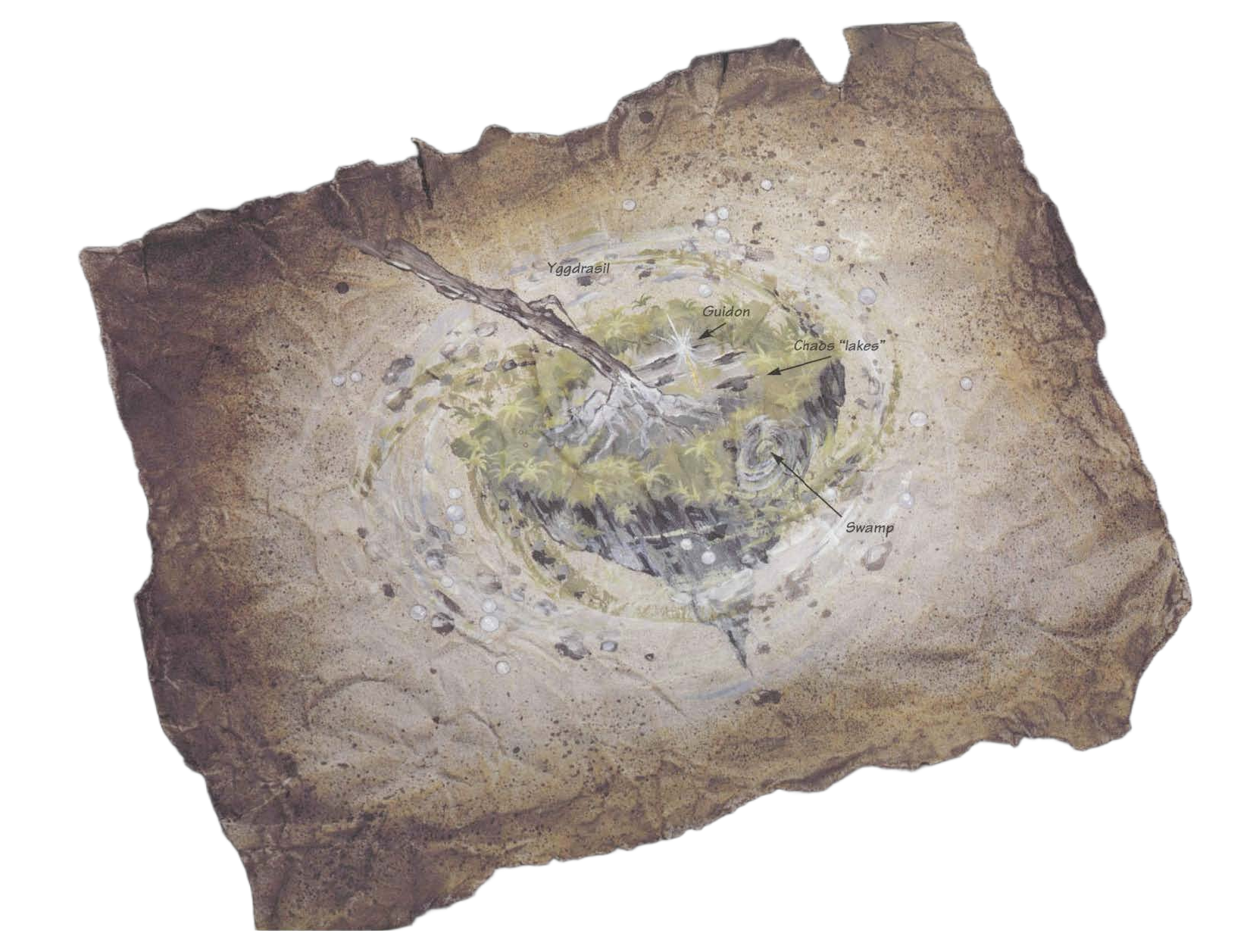
The site called "Pinwheel" is a uniquely stable spot within Limbo's rolling chaos. Its independent and stable existance, free of anarchs or powers, makes Pinwheel an excellent neutral meeting ground.